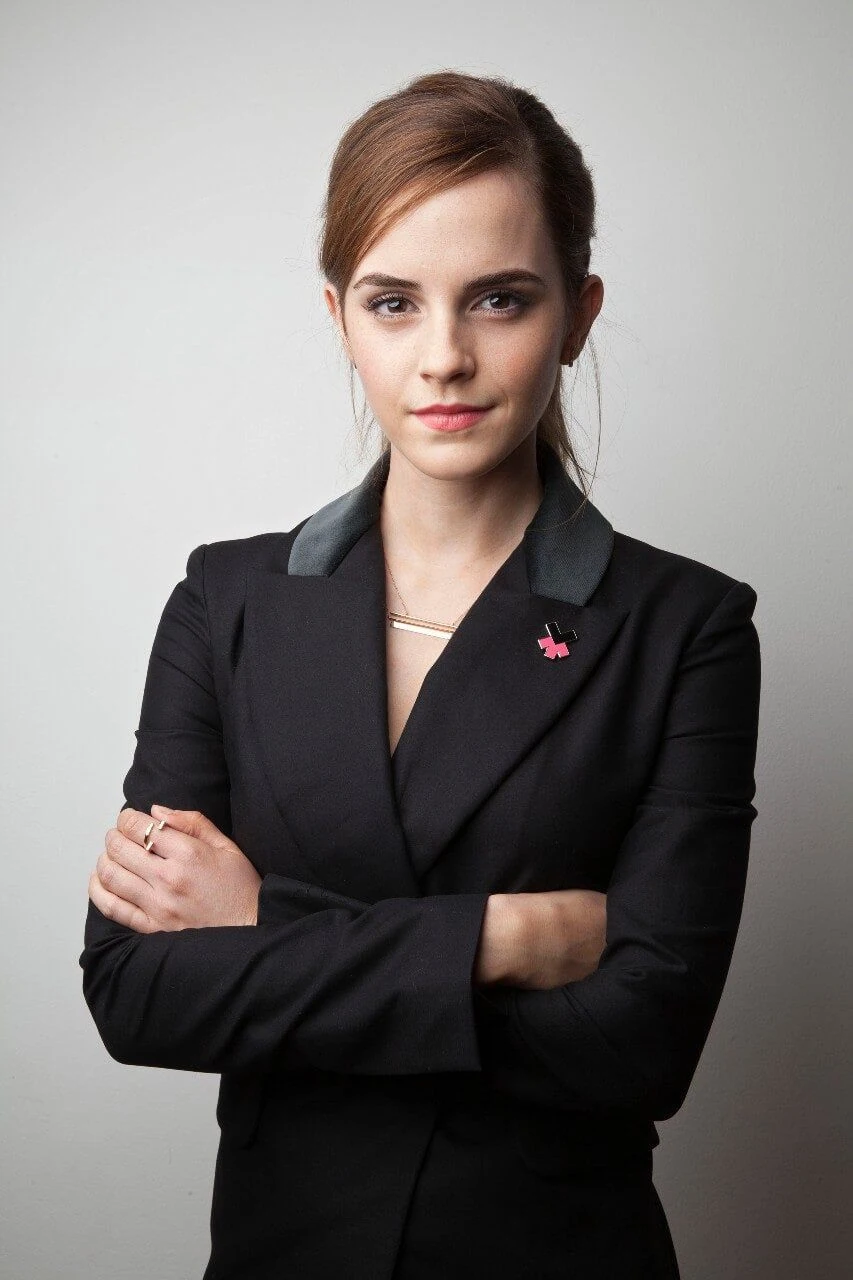
Emma Watson’s career began with one of the most recognisable parts in modern British cinema: Hermione Granger in the Harry Potter films. She first appeared on screen in 2001, aged 11, and grew up in public as the series became a global success. Alongside acting, she completed a degree in English literature and took on advocacy work, including helping launch the UN Women campaign HeForShe. Her story connects a British upbringing and a defining role in a British film series with a career and public voice that have travelled well beyond the screen.
From Paris to the Harry Potter films
Emma Charlotte Duerre Watson was born in Paris on 15 April 1990 to English lawyers Chris Watson and Jacqueline Luesby. She lived in France until she was five, then moved to England with her mother and younger brother. The family settled in Oxford, where Watson attended the Dragon School and trained in acting, dancing and singing at the Oxford branch of Stagecoach Theatre Arts. Before entering film, she had performed in school and theatre-school productions.
Casting for Harry Potter and the Philosopher’s Stone began in 1999. Watson auditioned eight times before being cast as Hermione Granger; the film, released in 2001, was her screen debut. She returned for each film in the series, playing a character whose confidence and intelligence made her central to the story. The role brought awards and international attention while Watson was still a school pupil. During filming, she received up to five hours of tutoring a day on set.
Her first major screen work beyond the franchise included the BBC television film Ballet Shoes in 2007 and a voice role in The Tale of Despereaux the following year. After the final Harry Potter film, she moved into varied parts: a supporting role in My Week with Marilyn (2011), a lead role in The Perks of Being a Wallflower (2012), and appearances in The Bling Ring and Noah (both 2013 and 2014 respectively). She later played Belle in the 2017 film Beauty and the Beast and Meg March in Greta Gerwig’s Little Women (2019).
Study alongside a public career
Watson continued her education while working. After completing secondary school, she took a gap year to film the last two Harry Potter films, then enrolled at Brown University in Rhode Island. She graduated in May 2014 with a bachelor’s degree in English literature. Her studies also took her back to Britain for the 2011–12 academic year, when she attended Worcester College, Oxford, as a visiting student.
Watson’s education was not separate from her public work, though it should not be treated as proof of any particular political position. In 2014 she was appointed a UN Women Goodwill Ambassador. That September, at UN headquarters in New York, she spoke at the launch of HeForShe, a campaign calling on men and boys to advocate for gender equality. Her address challenged the idea that feminism was hostile to men and argued for equality as a concern shared across genders. It attracted international attention and helped give the campaign a prominent public platform.
Her subsequent advocacy included visits to Bangladesh and Zambia to promote girls’ education. Watson also began the feminist book club Our Shared Shelf in 2016, inviting discussion of books and ideas through a public online forum. In 2018, she was a founding member of Time’s Up UK, which launched around the British Academy Film Awards. She also helped establish industry guidance on bullying and harassment with the British Film Institute and BAFTA. These activities place her work in both international campaigning and efforts to address conduct within the British screen industries.
Fashion, sustainability and changing roles
Watson’s connection with fashion has included both modelling and work on ethical clothing. In 2009 she began collaborating with People Tree, a fair-trade fashion brand, as a creative adviser. She helped develop clothing collections released in 2010, an approach that linked her public profile to a specific fashion project rather than simply to endorsements. Later, she used the Instagram account “The Press Tour” to document ethical brands worn during film promotion and guest-edited a 2018 issue of Vogue Australia focused on fashion sustainability.
From 2020 to 2023, Watson served on the board of Kering, a luxury-goods group, and chaired its sustainability committee. The appointment gave her a role inside a major fashion business as well as a public platform outside it. Her work in this area has ranged from a fair-trade clothing collaboration to public discussion of the choices made in fashion production and promotion.
Her screen career has been less constant in recent years. After Little Women, Watson said she was interested in work that amplified other voices and allowed her to keep learning. In 2023, she described feeling unhappy and constrained by aspects of the acting profession, while also saying she would consider returning for the right project. That account leaves room for a career in transition rather than a declared retirement.
Why Emma Watson deserves a place in British Legacy
Watson’s place in British Legacy rests first on the unusual scale and duration of her connection to a defining British cultural work. She was cast as Hermione Granger as a child and remained part of the Harry Potter film series through its final instalment. The films made a British literary character familiar to audiences around the world, while Watson’s performance became a central part of their screen adaptation. Her later choices show a career extending beyond that early success: from independent films and television to leading roles in major productions, she continued to take on work across different genres.
Her public contribution is specific as well. As a UN Women Goodwill Ambassador, she helped launch HeForShe, using a prominent international platform to call for men and boys to support gender equality. Her work with Time’s Up UK and industry partners connected that wider advocacy to bullying and harassment guidance within British film institutions. She also brought visibility to girls’ education and to sustainability in fashion, including through People Tree and her Kering board role. These efforts do not make her a representative of every British tradition, nor do they settle the effects of the causes she has supported. They do show how a British actor has used international recognition to draw attention to concrete questions in education, equality and working life. That combination of cultural reach and sustained advocacy gives her story a clear place in a British legacy shaped as much by public action as by performance.
Sources
Emma Watson — Wikipedia revision 1375381297
Adapted in part from Emma Watson by Wikipedia contributors, under CC BY-SA 4.0. Text has been edited and combined with the existing article; this adapted text is shared under the same licence. Contributor history.