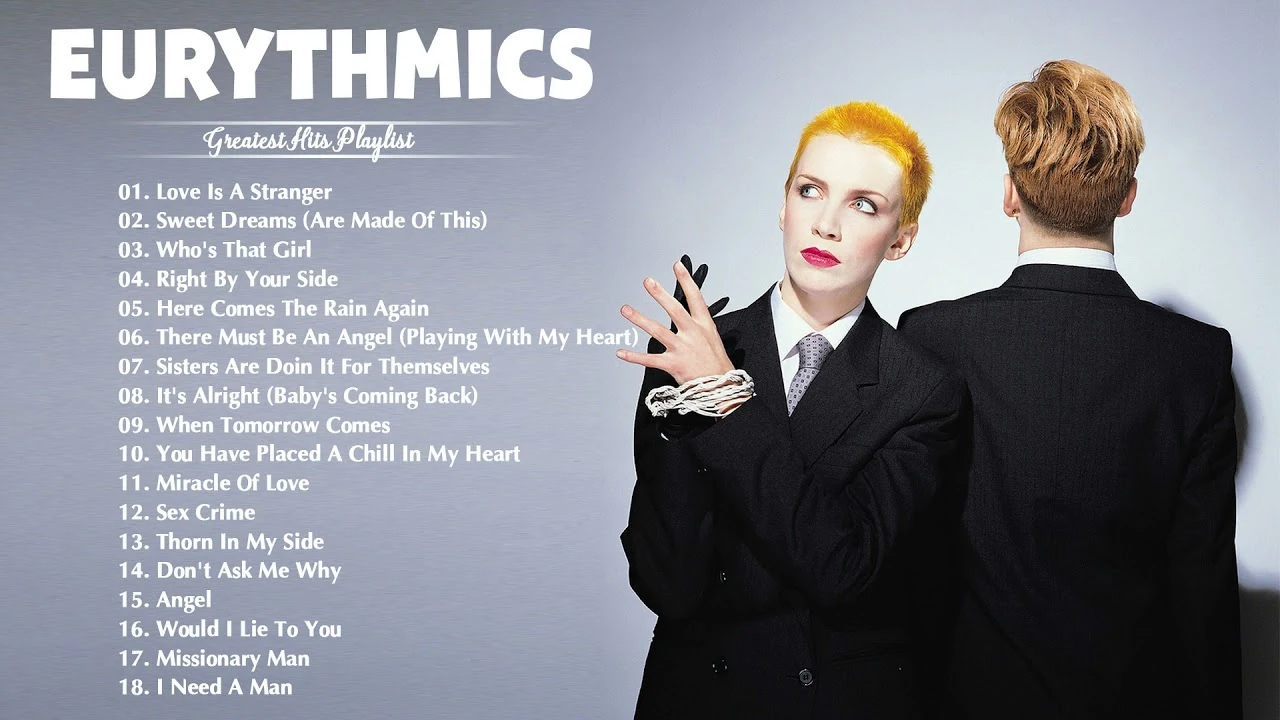
Eurythmics began with a decision to make pop music on their own terms. Annie Lennox and Dave Stewart had already played together in the Catch and the Tourists; in 1980, they formed a duo that could experiment with electronics and keep its creative options open. Their early records did not immediately find an audience. Then the sequenced bass line and striking video for “Sweet Dreams (Are Made of This)” helped turn them into international stars. Across the next decade, they shifted between synthesiser-led pop, orchestral textures and a fuller band sound rather than settling into one formula.
From the Tourists to a flexible new partnership
Lennox, a Scottish vocalist, and Stewart, an English musician and producer, met in London in 1975, where Lennox was working in a restaurant. They first played together in the punk band the Catch in 1976. After one single, the group evolved into the Tourists, which achieved some commercial success. The experience also brought tensions within the band and difficulties involving its management, publishers and record labels.
When the Tourists broke up in 1980, Lennox and Stewart wanted a different kind of working arrangement. They were interested in pop, but also in electronics and avant-garde ideas; a fixed band line-up seemed too restrictive. They chose the name Eurythmics after a system of pedagogical exercises Lennox had encountered as a child. They would remain the duo’s permanent members and songwriters, bringing in other musicians when the work called for them. Their personal relationship ended around this time, while their musical partnership continued.
Their first album, In the Garden, was recorded in Cologne with producer Conny Plank and released in 1981. Its mixture of psychedelic, krautrock and electropop influences included contributions from musicians such as Holger Czukay and Jaki Liebezeit of Can, Clem Burke of Blondie, and Robert Görl of D.A.F. The record made little commercial impression. The duo toured it with backing tracks and electronic equipment, which they transported themselves.
In 1982, Lennox and Stewart set up a small eight-track studio above a picture-framing factory in Chalk Farm, London, using a bank loan. The studio gave them greater freedom to record, but did not bring instant success: three singles released that year initially performed poorly in the UK. Managing the practical demands of their work, including moving their stage equipment, took its toll. Their early story was therefore not a straight ascent, but a period of experimentation, financial pressure and self-reliance.
The breakthrough: Sweet Dreams and Touch
Their fortunes changed with the second album, Sweet Dreams (Are Made of This), released in January 1983. Its title track was driven by a dark, sequenced synthesiser bass line. The accompanying video introduced Lennox’s orange crew cut to a wide audience and helped establish her as a pop icon. The single reached number two in the UK, topped the charts in Canada and the United States, and became a major international hit. “Love Is a Stranger”, first released before the breakthrough, was reissued and also found a larger audience.
The pair moved quickly into Touch, released in November 1983. It became their first UK number-one album and brought three major hit singles. “Who’s That Girl?” used its video to show Lennox in contrasting guises; “Right by Your Side” took a brighter, calypso-influenced direction; and “Here Comes the Rain Again” joined orchestral arrangements to synthesiser pop. These songs made clear that Eurythmics’ identity did not depend on repeating the sound of their breakthrough.
In 1984, the duo issued Touch Dance, a remix EP aimed at club audiences, and the soundtrack album 1984 (For the Love of Big Brother), made for the film adaptation of George Orwell’s novel. The soundtrack became the subject of a dispute: director Michael Radford said the music had been imposed on his film, while Eurythmics said they had been misled by the producers. The album was withdrawn for a time while the matter was litigated. Its lead single, “Sexcrime (Nineteen Eighty-Four)”, nevertheless became a major hit in the UK, Australia and Europe, as well as a dance success in the United States.
Changing the sound without losing the audience
Be Yourself Tonight, released in 1985, marked a move towards a fuller band sound, with real drums, brass and more guitar. The album drew on R&B as well as pop and brought in a large group of musicians. Stevie Wonder played harmonica on “There Must Be an Angel (Playing with My Heart)”, which became Eurythmics’ only UK number-one single. Lennox also duetted with Aretha Franklin on “Sisters Are Doin’ It for Themselves”. “Would I Lie to You?” offered another change of emphasis, with a more rock-oriented arrangement. The album was a substantial international success.
Their next records continued to test different approaches. Revenge (1986) leaned towards pop-rock and was followed by a large world tour. Savage (1987) was a sharper turn: it relied largely on programmed samples and drum loops, with darker lyrics. Director Sophie Muller made a video for every song, creating a connected visual work around characters played by Lennox. The album was less successful in the United States but reached the UK top ten and was certified platinum there.
In 1989, We Too Are One returned to a rock-pop sound. It entered the UK album chart at number one and produced four UK top-30 singles. After the accompanying tour ended in January 1990, the duo’s run of eight studio albums in eight years gave way to a split, although no formal announcement was made. Stewart worked on film music and released solo material; Lennox began her solo recording career with the album Diva in 1992. Their separate work marked a pause in Eurythmics, not the end of their association.
Reunion, recognition and later performances
After almost a decade apart, Lennox and Stewart reunited to record Peace, released in 1999. Its songs included “I Saved the World Today” and “17 Again”. The accompanying Peace Tour concluded in London in December, and proceeds went to Greenpeace and Amnesty International. That year, Eurythmics received the Brit Award for Outstanding Contribution to Music.
They reunited again in 2005 for the new single “I’ve Got a Life” and the compilation Ultimate Collection. The single reached number 14 in the UK and topped the US Dance Club Songs chart for three weeks; the album became a UK top-five hit and was certified platinum. Eurythmics were inducted into the UK Music Hall of Fame in 2005. The duo also performed together at later events, including a Beatles tribute in 2014, a benefit concert in 2019 and the Rock and Roll Hall of Fame induction ceremony in 2022, where they performed several of their best-known songs.
The group’s honours also include a Grammy Award for Best Rock Performance by a Duo or Group with Vocal for “Missionary Man” in 1987 and the MTV Video Music Award for Best New Artist in 1984. Their work was recognised beyond the UK as well: they were inducted into the Songwriters Hall of Fame in 2020 and the Rock and Roll Hall of Fame in 2022. The scale of their record sales, estimated at 75 million worldwide, reflects the reach of a catalogue that travelled across musical styles and national charts.
Why Eurythmics deserve a place in British Legacy
Eurythmics deserve a place in British Legacy because their history shows a British pop partnership building success through both invention and adaptation. Lennox and Stewart came out of the same band, the Tourists, but did not simply reproduce its format. They established themselves as the permanent creative centre of a duo, made room for collaborators and used their own London studio to work outside the usual expectations of expensive recording sessions. Their early commercial struggles make the later breakthrough more meaningful: the international success of “Sweet Dreams (Are Made of This)” followed several years of experimentation, not a ready-made path to fame.
Their contribution also reached beyond records. Lennox’s changing visual presentation and the duo’s distinctive videos made image an active part of their pop language, while their musical choices ranged from synthesiser-led tracks to orchestral arrangements and a more expansive band sound. That willingness to change helped Eurythmics reach audiences without being confined to a single style. Their later reunions, the Brit Award for Outstanding Contribution to Music and induction into the UK Music Hall of Fame provide concrete recognition of their standing in British music. The Peace Tour’s support for Greenpeace and Amnesty International adds a specific public dimension to that story. Taken together, their songwriting, production, performance and visual work form a substantial British cultural legacy with influence that travelled well beyond the UK.
Sources
Eurythmics — revision 1373255143
Adapted in part from Eurythmics by Wikipedia contributors, under CC BY-SA 4.0. Text has been edited and combined with the existing article; this adapted text is shared under the same licence. Contributor history.