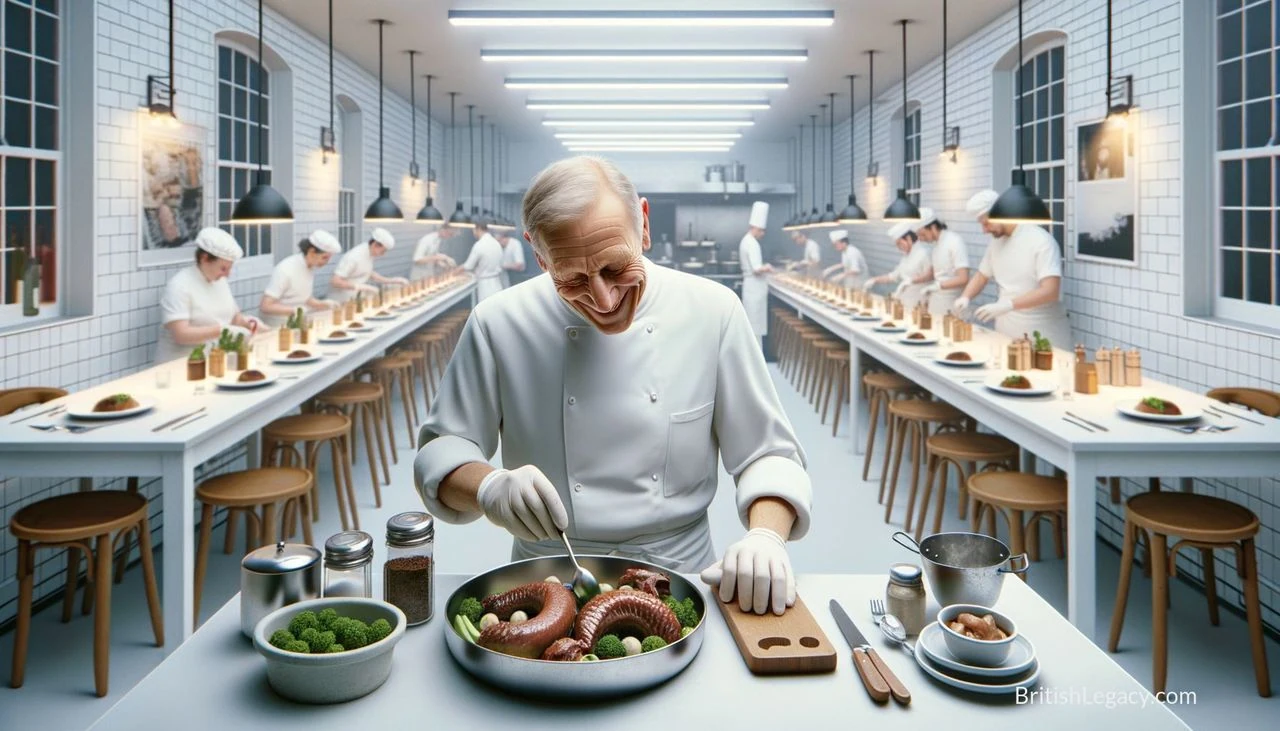
Fergus Henderson’s cooking starts with a practical proposition: if an animal has been killed for food, its parts should not be treated as waste merely because they are unfamiliar. At St. John, the London restaurant he founded in 1994 with business partner Trevor Gulliver, that approach became known as “nose-to-tail” eating. Dishes made with offal and other neglected cuts gave the idea a recognisable form, while Henderson’s books set out how to cook them at home.
Henderson trained as an architect, not a chef, and had no formal culinary training. His achievement was not to claim that British cooks had never used these ingredients before, but to bring them back into view: treating them as worthy of careful cooking and making them a defining part of a modern restaurant’s identity. St. John’s menu, his writing and the businesses that grew around the restaurant helped make this approach part of the conversation about British food.
From architecture to the kitchen
Born in London in 1963, Henderson followed his parents, Brian and Elizabeth, into architecture. He studied at the Architectural Association in London. His route into cooking was not through a conventional apprenticeship: he had no formal training in the profession and, according to the account of his career, had never worked under another chef.
In 1992, Henderson and his wife, fellow chef Margot Henderson, opened the French House Dining Room at the French House pub in Soho. He later left to establish St. John with Gulliver. The restaurant opened in 1994 on St John Street in London, in the Smithfield area. The original article describes its premises as a former bacon smokehouse; the restaurant’s location and name became closely associated with Henderson’s whole-animal approach.
St. John received a Michelin star in 2009. Henderson and Gulliver expanded the business in 2003 with St. John Bread and Wine in Spitalfields. A second St John restaurant, within a hotel in Chinatown, also received a Michelin star in 2009; that venue is no longer open. The group’s history was not a story of uninterrupted expansion: the Chinatown hotel, which opened in 2011, went into administration in 2012 and was subsequently sold and closed.
What “nose-to-tail” means
The phrase describes a way of cooking that makes use of the whole animal, including parts that are less commonly found on restaurant menus. Henderson’s books give examples including trotters, tripe, kidneys and chitterlings. The point is culinary as well as practical: these ingredients have their own textures and flavours, and cooking them well calls for knowledge rather than dismissal.
Among the dishes associated with Henderson’s cooking are roast bone marrow and parsley salad, braised hare, pig’s head and potato pie, and devilled kidneys. They draw on ingredients and preparations with a place in British cookery, but their prominence at St. John made them an emblem of the restaurant’s approach. The bone marrow and parsley salad, in particular, set rich marrow against the freshness of parsley; it showed how a dish built around an unfashionable cut could be direct and carefully balanced rather than an exercise in novelty.
Henderson has described the rationale in terms of courtesy to the animal: using all of it seems “common sense and even polite”. That wording is less a claim to have invented every dish or ingredient than an explanation of the ethic behind the cooking. Making use of less familiar parts can reduce waste, but the practice also asks diners to reconsider what counts as desirable food. The emphasis is on buying and cooking with attention, not simply on presenting unusual ingredients as a spectacle.
Books that took the cooking beyond St. John
In 1999, Henderson published Nose to Tail Eating: A Kind of British Cooking. Its recipes include animal parts such as trotters, tripe, kidneys and chitterlings, and its title makes the relationship between the cooking and its British context explicit. The book explains the thinking behind the dishes as well as giving readers ways to prepare them. That combination helped turn the phrase “nose-to-tail” into a shorthand for both a restaurant style and a broader set of choices about ingredients.
He followed it with Beyond Nose to Tail in 2007 and The Complete Nose to Tail: A Kind of British Cooking in 2012. In 2019, he published The Book of St John, a collection of more than 100 new recipes from the restaurant. The sequence records the development of the work: a first statement of the cooking, a second volume, a combined edition and, later, a book that presented the restaurant’s wider repertoire.
The books also matter because they take the recipes out of the dining room. A restaurant can introduce diners to an unfamiliar dish; a cookbook gives them a route to understanding the ingredients and trying the cooking themselves. Henderson’s writing made that knowledge more portable, connecting the restaurant’s menu to domestic kitchens and to a wider readership interested in British food.
A restaurant with a wider reach
Henderson’s influence is reflected in the attention paid to St. John by fellow chefs and critics. Anthony Bourdain and Mario Batali praised his cooking. Bourdain called Henderson “a genius and a hero”. The critic A. A. Gill, who had initially written against St. John, later retracted his hostility in the Sunday Times. Such responses indicate how the restaurant’s reputation changed; more importantly, they locate Henderson’s work within a conversation about what British food could be.
St. John’s recognition did not rest on one dish alone. Its Michelin star in 2009 marked a significant distinction for the restaurant, while the opening of Bread and Wine extended the group’s presence in London. The additional Chinatown restaurant received its own Michelin star, though its later closure and the hotel’s collapse are also part of the business history. Those outcomes provide a more complete account than a simple tale of success: a distinctive cooking philosophy could travel, while individual ventures still faced commercial difficulties.
Henderson was diagnosed with Parkinson’s disease in 1998. In 2005, he underwent deep brain stimulation, which improved his mobility. He was appointed an MBE in 2005 and later an OBE in the 2021 New Year Honours for services to the culinary arts. These honours mark recognition over time; the later OBE is distinct from, rather than a replacement for, the earlier MBE.
Why Fergus Henderson deserves a place in British Legacy
Fergus Henderson deserves a place in British Legacy because his work made a clear and lasting case for treating British ingredients and cooking traditions with seriousness. At St. John, offal and other neglected cuts were not incidental additions: they were central to a restaurant identity built around using the whole animal. The approach connected practical resourcefulness with culinary skill, inviting diners to value ingredients that fashion had pushed aside. It also gave British food a recognisable contemporary expression without suggesting that its older traditions had to be discarded.
His influence extends beyond the restaurant table. The Nose to Tail books explained the method and recipes to readers, while later publications carried the St. John repertoire further. The restaurant’s Michelin recognition and the praise of other chefs and critics show that this cooking gained attention well beyond its original London setting. The business history, including the closure of the Chinatown hotel, keeps that legacy grounded: an influential idea does not make every venture succeed. What endures is the combination of a distinctive restaurant, useful writing and a persuasive principle—that good cooking can begin by looking again at what others overlook. For British Legacy, that is a specific contribution to the country’s food culture, not a generic claim to national greatness.
Sources
Fergus Henderson — revision 1353742541
Adapted in part from Fergus Henderson by Wikipedia contributors, under CC BY-SA 4.0. Text has been edited and combined with the existing article; this adapted text is shared under the same licence. Contributor history.