
Florence Nightingale became famous as the “Lady with the Lamp”, but her lasting work was not confined to the wards of the Crimean War. She trained nurses, advised on hospital design and used statistics to argue for changes in public health. Her career joined practical nursing to the collection and presentation of evidence, helping give nursing a new professional standing in Britain.
An education and a vocation
Nightingale was born on 12 May 1820 in Florence, then part of the Grand Duchy of Tuscany, to the English couple William Edward Nightingale and Frances “Fanny” Nightingale Smith. The family returned to England in 1821. She grew up between family homes in Derbyshire and Hampshire, and received an unusually broad education for a woman of her class. Her father taught her subjects including mathematics, history, languages and literature.
In 1837, aged 16, she recorded what she understood as a call from God to service. It took years for that sense of vocation to become nursing. The expected course for a wealthy young woman was marriage, and her family opposed her plans. Nightingale nevertheless sought knowledge of nursing and hospital care. In 1850 she visited the Protestant community at Kaiserswerth in Germany, where she observed work with the sick and deprived and received four months of medical training. The experience strengthened her resolve; she later published an account of the institution.
In 1853 she became superintendent of the Institute for the Care of Sick Gentlewomen in Upper Harley Street, London. It was a practical post before her most visible work began. Nightingale’s later influence depended not only on her service at the bedside but on her ability to organise, write and press decision-makers to act.
Scutari and the limits of the lamp legend
During the Crimean War, reports of the conditions facing wounded British soldiers at Scutari, across the Bosporus from Constantinople, prompted Nightingale to organise a nursing party. She and 38 women volunteer nurses set out in October 1854 under the authorisation of Sidney Herbert, then Secretary at War. Nightingale arrived at Selimiye Barracks in November. The hospital was overcrowded; medicines and equipment were scarce, hygiene was neglected and infections were common. Soldiers were dying in far greater numbers from disease than from their wounds.
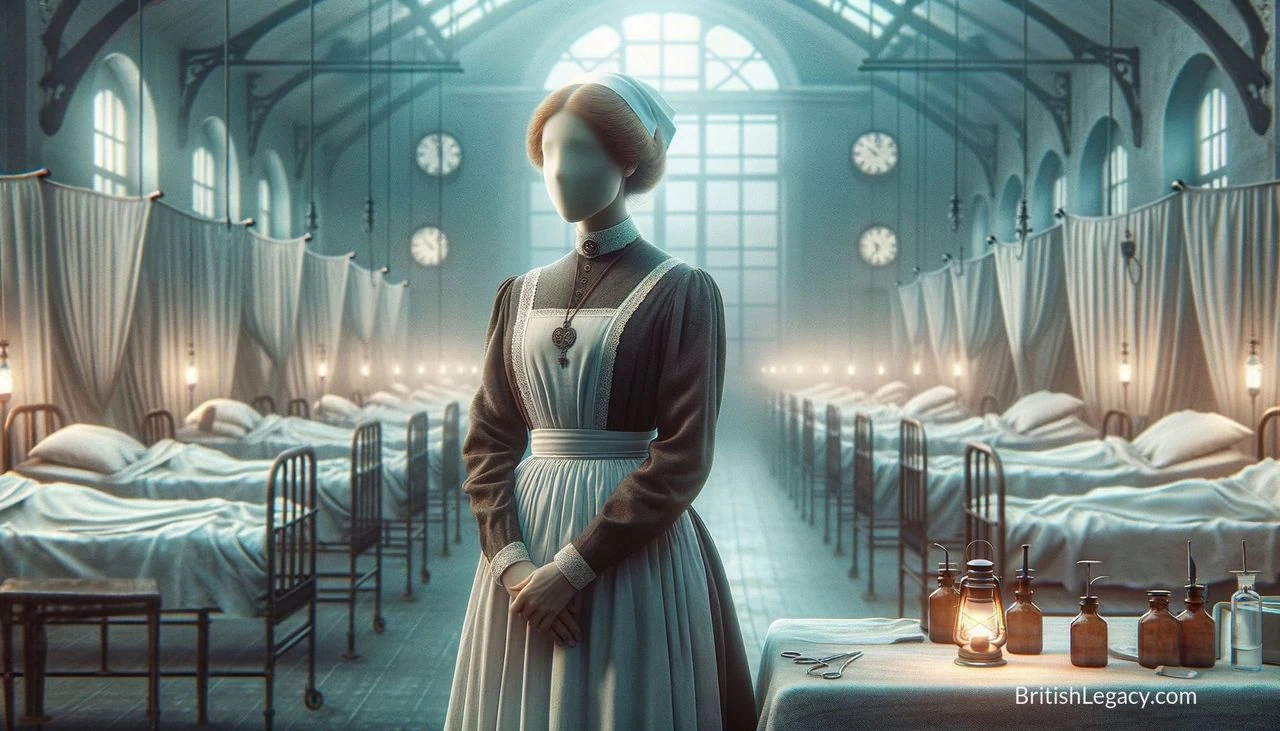
Nightingale and her nurses worked in difficult conditions. The image of her making night rounds with a lamp became a defining public representation, helped by newspaper reporting. It captured a visible aspect of her service, but the popular story can obscure the wider institutional problems and the work of others. The British government eventually sent a Sanitary Commission to Scutari. It cleared sewers and improved ventilation, after which death rates fell sharply.
Nightingale later concluded that poor living conditions were a major cause of the deaths. She collected and analysed evidence, using it to argue for sanitary reform in the army and in hospitals. The often-repeated claim that her actions alone reduced Scutari’s mortality from 42 per cent to two per cent is too simple: the supplied account describes the commission’s work and does not support assigning that whole change to Nightingale personally. Her importance lies in part in the way she turned the experience into a sustained campaign for better conditions.
Making evidence visible
Nightingale was a pioneer in the visual presentation of statistics. She used diagrams to make complex evidence more accessible to officials and politicians who might not read or grasp a conventional statistical report. Her “coxcombs”, or polar area diagrams, showed seasonal patterns in mortality among soldiers. The technique was striking, but it should not be mistaken for a diagram she invented: similar forms had appeared before. Her achievement was to make visual statistics an effective instrument of public argument.
After returning to Britain, she gathered evidence for the Royal Commission on the Health of the Army. Her attention extended to the health of soldiers and civilians in India. She investigated how poor drainage, unsafe water, overcrowding and inadequate ventilation affected mortality, and campaigned for improved sanitation. In 1858 and 1859 she successfully lobbied for a Royal Commission into conditions in India, then supplied it with a report. Her reform work linked military health to the broader conditions in which people lived.
Her approach was practical as well as analytical. Nightingale used diagrams to present reports on medical care to members of Parliament and civil servants, making patterns in the evidence easier to see. In 1859 she became the first woman elected to the Royal Statistical Society. Her work in statistics was not separate from nursing: it helped her make a case for changes to the conditions in which patients and soldiers were cared for.
She also wrote for readers beyond government. Notes on Nursing, published in 1859, set out practical principles of care and was read by the general public as well as used in nursing education. It addressed nursing at home, too: Nightingale argued that knowledge of how to support health and recovery should not be limited to medical professionals. Her writing helped make nursing practice a subject for instruction and public discussion.
Training a profession
In 1860, the Nightingale Training School for Nurses opened at St Thomas’ Hospital in London, funded by the Nightingale Fund raised in recognition of her Crimean War service. It established a formal route into nursing education. Graduates took their training to hospitals in Britain and elsewhere, helping spread the model. Nightingale also supported the introduction of trained nurses into workhouses, where sick people had often been cared for by other paupers rather than by trained staff.
Professionalisation did not mean that nursing’s place in hospitals was settled. Nightingale advocated strong, autonomous nursing leadership, with matrons responsible for their staff. That authority could bring nurses into conflict with medical colleagues, as disputes in hospitals demonstrated. The new profession required not only education but a reorganisation of responsibilities and status.
Nightingale continued to press for changes in hospital planning and sanitary conditions, and her work influenced reforms beyond the nursing school. Her writing, training initiatives and campaigning addressed different parts of the same problem: the quality of care depended on the knowledge of nurses, the organisation of hospitals and the conditions in which people lived.
Her recognition reflected the reach of her work. Nightingale became the first woman to receive the Order of Merit, in 1907. She died in London on 13 August 1910, aged 90, and was buried at St Margaret’s Church in East Wellow, Hampshire. The nursing school she established is now part of King’s College London.
Why Florence Nightingale deserves a place in British Legacy
Nightingale’s British legacy rests on connected achievements rather than a single celebrated episode. Her work at Scutari brought public attention to the conditions in military hospitals, but she did not stop at the story of a nurse carrying a lamp. She used what she had seen to press for sanitary reform, analysed mortality and presented evidence in forms intended to influence government. Her diagrams helped make statistics persuasive beyond specialist circles, while her campaigning on conditions in India widened her work from the army to public health.
In Britain, the training school at St Thomas’ Hospital gave nursing a formal educational foundation and helped establish it as a profession. Her writing brought practical nursing knowledge to a wider readership, and her advocacy for trained staff extended into workhouses. These changes mattered because they connected individual care with systems: how nurses were trained, how hospitals were managed and how poor sanitation could be challenged. Nightingale’s example is also a reminder to distinguish the lasting substance of her reforms from a simplified heroic legend. Her British significance lies in the combination of nursing education, public service and evidence-led reform, and in the institutions and professional practices that carried those ideas beyond her lifetime.
Sources
Florence Nightingale — Wikipedia revision 1375983362
Adapted in part from Florence Nightingale by Wikipedia contributors, under CC BY-SA 4.0. Text has been edited and combined with the existing article; this adapted text is shared under the same licence. Contributor history.
.jpg)