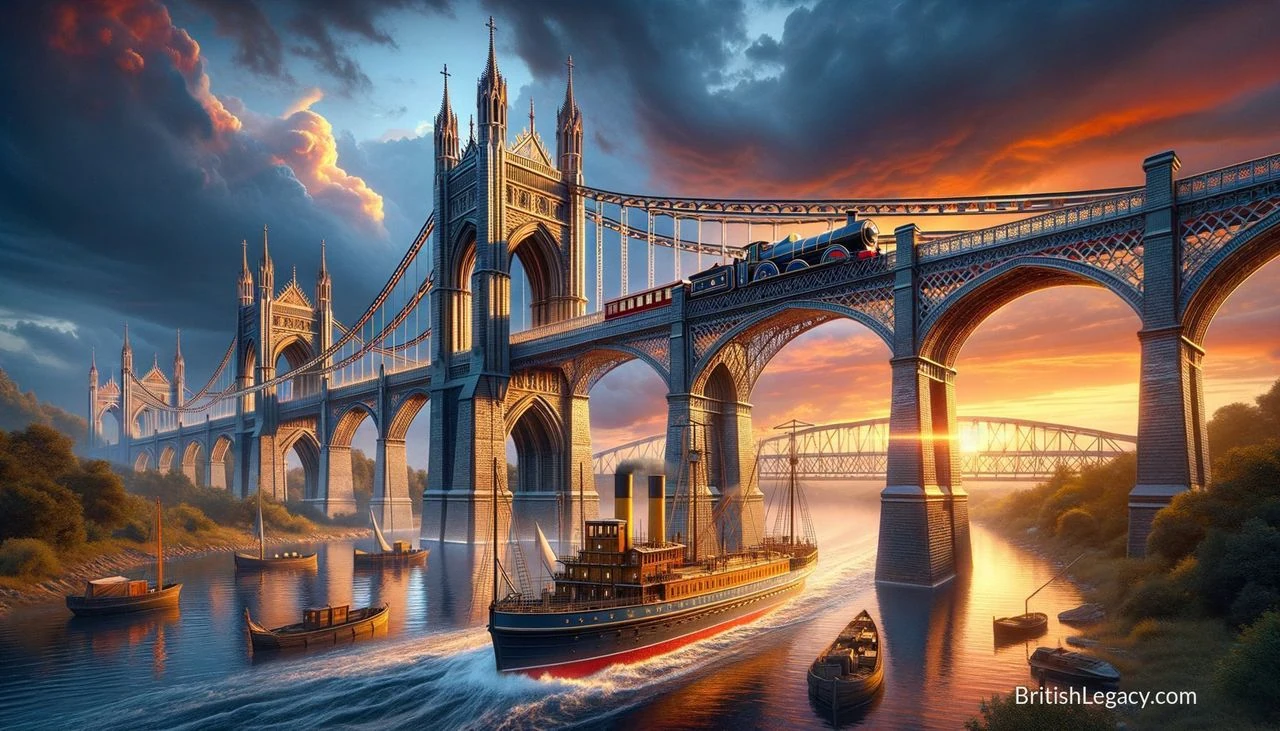
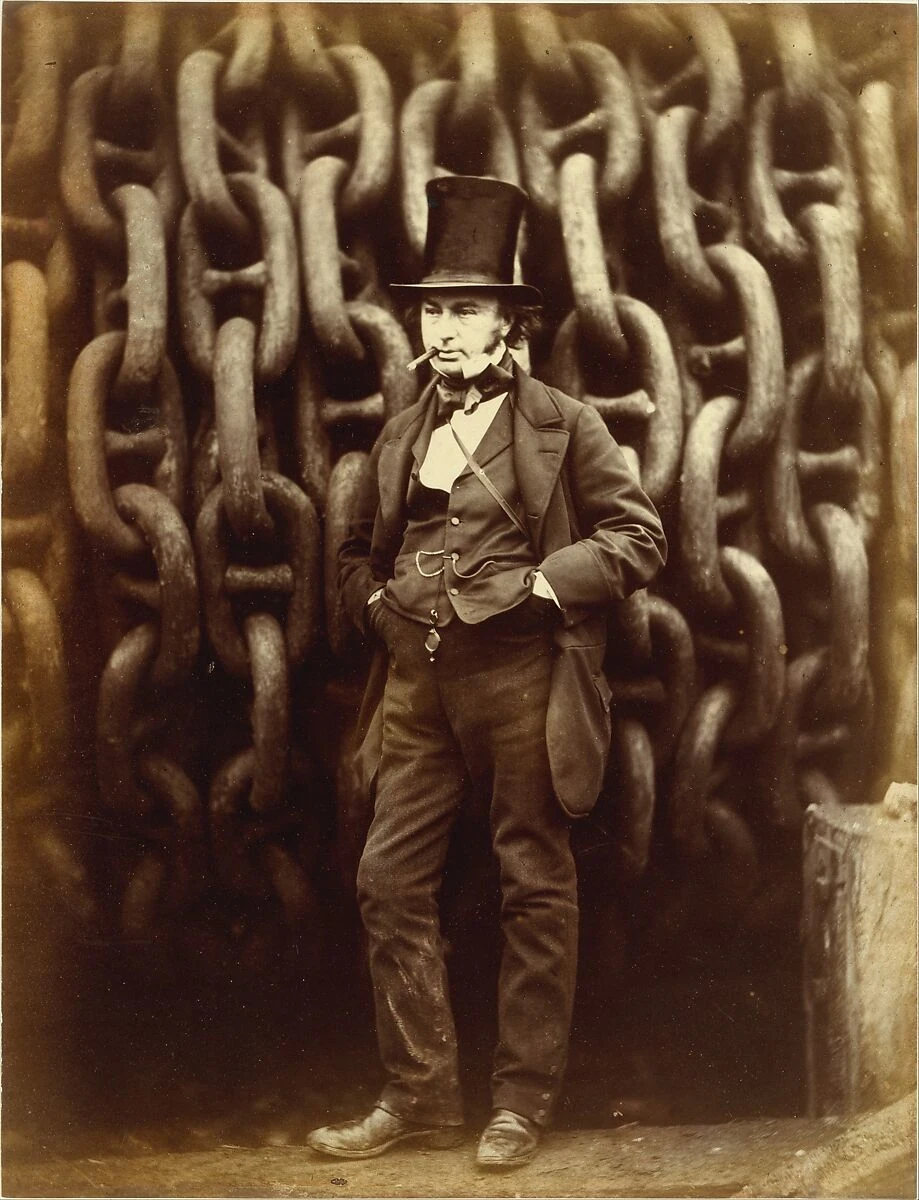
Isambard Kingdom Brunel’s career joined railways, bridges and steamships in a single ambition: to make movement faster, more direct and less constrained by the limits of existing engineering. As the Great Western Railway’s first engineer, he planned its London–Bristol main line; he designed the Clifton Suspension Bridge and the iron-hulled, propeller-driven SS Great Britain. Not every bold scheme succeeded. The atmospheric railway failed, his broad-gauge network eventually gave way to the narrower national standard, and the enormous SS Great Eastern never became the profitable passenger ship he had envisaged. Those setbacks belong in the story as much as the surviving structures do.
A Portsmouth childhood and an engineering education
Brunel was born in Britain Street, Portsea, Portsmouth, on 9 April 1806. His parents were the French-born engineer Marc Isambard Brunel and Sophia Kingdom, whose family gave him his middle name. He was their only son and the youngest of three children. Soon after his birth, the family moved to Chelsea in London. His father became his first teacher, introducing him to drawing, observation, mathematics and the principles of engineering while he was still a child.
His education crossed the Channel. After attending schools in England, he studied at the Lycée Henri-IV in Paris, where mathematics held a prominent place in the curriculum. He hoped to enter the École Polytechnique, but, as a foreigner, was ineligible. Instead he trained under the Parisian clockmaker Abraham-Louis Breguet, whose work gave him a grounding in precision mechanics. Brunel returned to England in 1822 and joined his father as an assistant the following year.
That apprenticeship brought practical experience, but the work that first made his name was the Thames Tunnel. His father was appointed engineer to the project in 1824, and Brunel became its resident engineer after John Armstrong resigned in 1826. He was closely involved in the dangerous excavation beneath the Thames, where flooding and unstable ground repeatedly threatened the work. In January 1828, a collapse injured Brunel and killed six workers. He spent months recovering; the tunnel, which was later completed to a different design and without his further involvement, did not open until 1843.
The bridge that began as an unfinished project
During his recovery in Bristol, Brunel turned his attention to a proposed bridge across the Avon Gorge. He entered a competition to design it, competing against established engineer Thomas Telford. The scheme encountered disputes over the design, difficulty raising money and, in 1831, the wider upheaval of Bristol’s Reform Bill riots. Work on the bridge was halted before it could be completed during Brunel’s lifetime.
After his death, colleagues and admirers at the Institution of Civil Engineers helped raise the funds to finish it as a memorial. Construction resumed in 1862, and the Clifton Suspension Bridge opened in 1864. Its 214-metre main span made it the longest bridge span in the world at the time. The completed structure drew on Brunel’s work, although accounts differ over how closely it followed his designs. It remains a working crossing over the gorge, linking the bridge’s Victorian engineering history with present-day Bristol.
Brunel’s bridge work extended well beyond Clifton. On the Great Western Railway, the Maidenhead Railway Bridge used unusually flat arches to preserve the line’s gentle gradient. On the South Devon and Cornwall railways, he built across difficult terrain with viaducts, many of them made partly or wholly of timber. At Saltash he designed the Royal Albert Bridge, using large spans to cross the Tamar while allowing ships to pass below. Prince Albert opened it in 1859, shortly before Brunel’s death.
The Great Western Railway and the cost of a bold gauge
Brunel became engineer to the Great Western Railway in 1833. The company’s central project was a railway linking London and Bristol, but his plans extended beyond laying track between the two cities. He sought a route with gentle curves and gradients and designed the railway as a sequence of connected works, including bridges, tunnels, stations and, eventually, steamship services. The London–Bristol line opened in stages and was complete in 1841.
His choice of gauge set the GWR apart. Brunel selected a broad gauge of 7 feet ¼ inch, believing it would allow faster and more comfortable travel than the narrower gauge used by most other British railways. It also offered room for larger goods wagons. The Box Tunnel, a 2.95-kilometre passage through the hills near Bath, was a particularly ambitious part of the route and, when completed in 1841, was the longest railway tunnel in the world.
There were real costs to Brunel’s choice. As separate railway networks expanded and connected, the incompatibility between the GWR’s broad gauge and the narrower lines created delays and the need to transfer goods between trains. A royal commission considered the competing gauges in 1845–46 and favoured the narrower one as the national standard. The GWR continued to use broad gauge for decades, but the network was gradually converted after Brunel’s death; the last broad-gauge stock was withdrawn in 1892. The debate shows the tension between designing for the performance of one system and ensuring it could work with the wider network.
Brunel also experimented with an atmospheric railway on the South Devon line. Instead of an engine on each train, stationary pumping engines moved air through a pipe to propel it. The approach promised a quieter railway and allowed steeper gradients, but its operating problems proved decisive: seals leaked, pipes froze and the system was difficult to maintain. The line closed for conversion back to conventional steam operation in 1848, after less than a year. It was a costly failure, but it belongs to the same pattern of testing whether new technology could overcome practical limits.
Three ships, three different outcomes
Brunel saw steamships as an extension of the railway rather than a separate enterprise. A passenger could, in principle, travel from London to the Atlantic coast by train and continue by ship. The first of his major vessels, the wooden-hulled SS Great Western, began regular transatlantic service in 1838. Its successful crossings showed that a steamship could carry enough fuel and cargo to make the ocean journey commercially workable.
For his next vessel, Brunel combined an iron hull with a screw propeller. The SS Great Britain was launched in 1843 and became the first iron-hulled, propeller-driven ship to cross the Atlantic. At 98 metres long, she was the largest ship afloat at the time. The new form of construction helped establish principles that would shape later shipbuilding, but the vessel’s early service was disrupted when she ran aground in Dundrum Bay in 1846. The accident contributed to the failure of the company that owned her. After serving in other roles, she was abandoned in the Falkland Islands and later recovered and restored. Today she is preserved as a museum ship in Bristol Harbour.
The third ship, the SS Great Eastern, was conceived on a far greater scale. Brunel intended her for long-distance routes to India and Australia, and her design included a length of about 210 metres and capacity for more than 4,000 people. Construction was beset by financial difficulties, delays and conflict with contractor John Scott Russell. The ship was eventually launched in 1858, but never found the passenger-trade success Brunel had hoped for. In 1865 she was put to work as a cable-layer, including on the first lasting transatlantic telegraph cable. Brunel had died before that later purpose emerged.
Work beyond railways and ships
Brunel’s work was not confined to transport. During the Crimean War, after being asked in 1855 to design a field hospital, he developed a prefabricated complex for Renkioi in the Dardanelles. Its design provided for ventilation, sanitation and temperature control. The hospital was assembled from components made in England and ready to receive patients by July 1855. Of about 1,300 patients treated there, 50 died, a rate reported in the supplied account as substantially below that at the Scutari hospital.
He also worked on infrastructure for ports and cities. In Bristol, he rebuilt harbour locks and designed a swivel bridge. At Paddington, he planned a new Great Western Railway terminus with a long trainshed; the station opened to its first train in 1854, although work continued afterwards. These projects show how his engineering practice connected the movement of people and goods with the stations, docks and facilities needed to support it.
Ambition, pressure and public memory
Brunel became a Fellow of the Royal Society in 1830 and held senior roles in the Institution of Civil Engineers, including vice-president from 1850. His career nevertheless brought repeated disputes with company directors, financial strain and the consequences of designs that proved difficult to deliver. Broad gauge created lasting incompatibility; the atmospheric railway was abandoned; the Great Eastern was commercially unsuccessful. He could be persistent in defending his choices, but persistence did not guarantee that a project would meet its practical or financial aims.
He married Mary Elizabeth Horsley in 1836. They had three children, including Henry Marc Brunel, who also became an engineer. Brunel died in Westminster on 15 September 1859, aged 53, and was buried at Kensal Green Cemetery beside his father. His death came shortly after he suffered a stroke. He did not live to see the later conversion of the GWR’s broad-gauge lines or the Great Eastern’s work as a cable-layer.
Brunel’s reputation has endured through working structures, preserved artefacts and public commemoration. In the BBC’s 2002 poll of the 100 Greatest Britons, he placed second. The bicentenary of his birth in 2006 brought commemorative coins and stamps. His name is also attached to places and institutions, while the Royal Albert Bridge carries an inscription commemorating him. These reminders do not make every proposal a success; they reflect the extent to which his projects became part of Britain’s built and industrial history.
Why Isambard Kingdom Brunel deserves a place in British Legacy
Brunel deserves a place in British Legacy because his work changed how people and goods could move across Britain and beyond. The Great Western Railway joined London and Bristol with a line whose engineering included the Box Tunnel and Maidenhead Railway Bridge. His ships extended that ambition across the Atlantic: the Great Western demonstrated the commercial possibility of regular steamship crossings, while the Great Britain helped establish iron-hull and screw-propeller technology in transatlantic travel. The Clifton Suspension Bridge and Royal Albert Bridge remain lasting examples of how civil engineering could connect places separated by difficult terrain.
His legacy is more instructive when it includes limits as well as achievements. Brunel’s broad gauge offered a different vision of railway performance but created costly incompatibility; the atmospheric railway did not prove maintainable; and the Great Eastern was too large for the commercial role intended for it. These outcomes make clear that engineering is not judged by boldness alone: a design must also work with the systems, finances and conditions around it. That combination of ambition, practical consequence and surviving public infrastructure is why Brunel’s story matters in a British context. His projects contributed to transport networks and engineering practice, while their varied fortunes offer a grounded account of innovation in Victorian Britain.
Sources
Isambard Kingdom Brunel · Isambard Kingdom Brunel
Adapted in part from Isambard Kingdom Brunel by Wikipedia contributors, under CC BY-SA 4.0. Text has been edited and combined with the existing article; this adapted text is shared under the same licence. Contributor history.