Stephen Hawking turned some of the most difficult questions in theoretical physics into subjects of public conversation. His work on black holes and the origins of the universe reshaped debates within cosmology; A Brief History of Time carried those questions far beyond the university. For much of his career, he worked at Cambridge, where he held the Lucasian Professorship of Mathematics from 1979 to 2009.
From Oxford to Cambridge
Hawking was born in Oxford on 8 January 1942. He began studying physics at University College, Oxford, in 1959, aged 17, and received a first-class degree. In 1962 he started postgraduate work at Trinity Hall, Cambridge, specialising in general relativity and cosmology. He completed his doctorate in applied mathematics and theoretical physics in 1966.
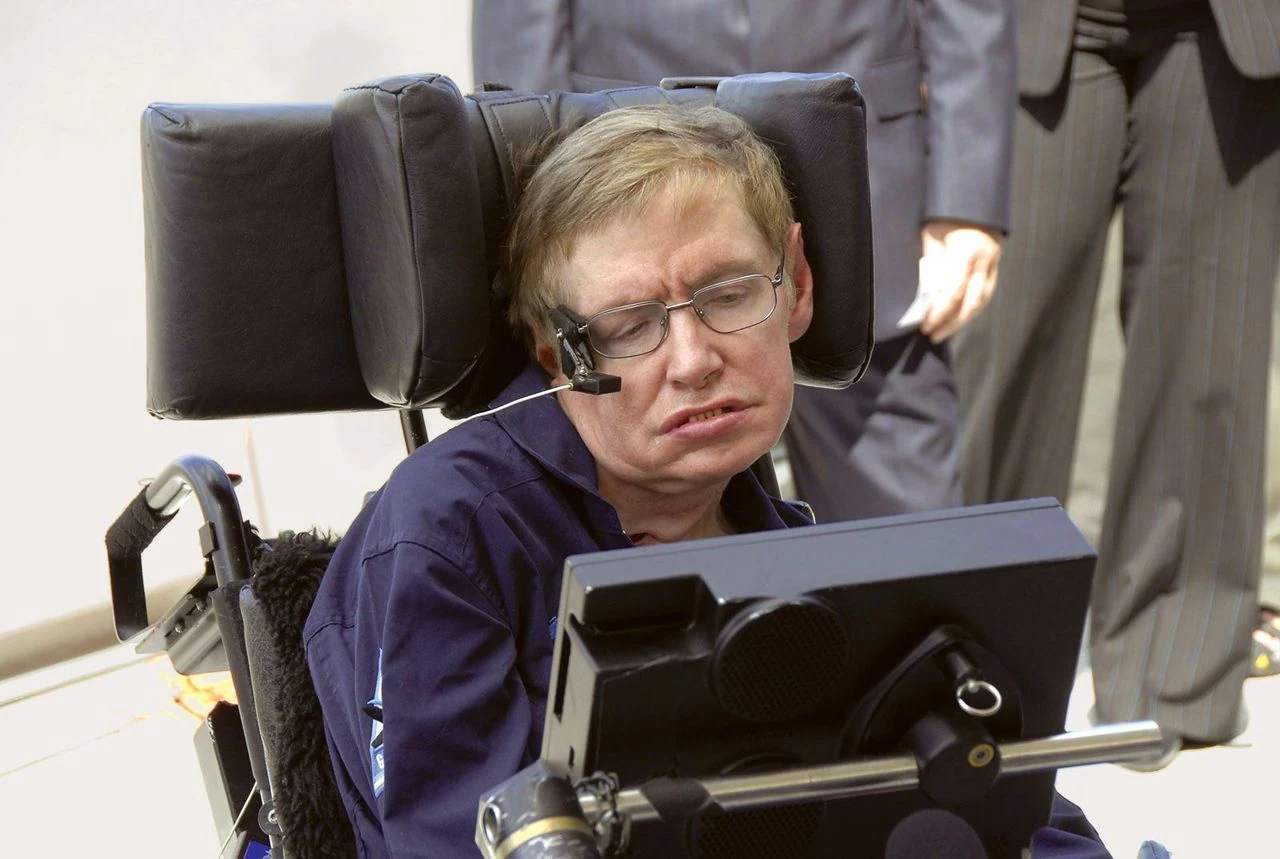
At 21, in 1963, Hawking was diagnosed with an early-onset, slow-progressing form of motor neurone disease. The illness gradually paralysed him over decades. His doctors initially expected his life to be much shorter, but he returned to his research and continued working for more than 50 years after the diagnosis. As his speech and movement diminished, he used a speech-generating device to communicate, eventually selecting words with a movement of his cheek.
Hawking’s early research developed during a period of debate about how the universe began. Working with Roger Penrose, he extended ideas about singularities in general relativity from black holes to cosmology. Their work helped establish that, under the theory and cosmological models they considered, the universe must have begun in a singularity. In 1966, Hawking’s essay on singularities and the geometry of space-time shared the Adams Prize.
Black holes and a changing universe
Hawking’s best-known scientific prediction came from applying quantum theory to black holes. In 1974 he proposed that they emit radiation, now known as Hawking radiation. The idea was initially controversial; by the late 1970s, further research had helped establish it as a major theoretical breakthrough. The prediction connected black holes with thermodynamics and raised difficult questions about what happens to the information carried by matter that falls into one.
That information problem remained a point of debate throughout Hawking’s career. He argued in 1981 that information could be irretrievably lost when a black hole evaporated, a proposal that seemed to conflict with a basic principle of quantum mechanics. In 2004 he conceded a wager with physicist John Preskill and presented a revised, still debated account of the problem. In 2014, Hawking called the alleged loss of information his “biggest blunder”. His scientific story was not a procession of settled answers: it also involved revising claims as arguments and evidence developed.
Hawking held academic posts at Cambridge as his research broadened. He became Lucasian Professor of Mathematics in 1979, one of the university’s most prominent chairs, and retired from the post in 2009. He later served as director of research in Cambridge’s Department of Applied Mathematics and Theoretical Physics. He was elected a Fellow of the Royal Society in 1974 and received the Copley Medal in 2006.
A difficult subject reaches a wide readership
Hawking began writing A Brief History of Time with the aim of explaining the universe to general readers. Published in 1988, it became a remarkable bestseller. The book’s success made him a public figure, but its subject remained the science: cosmology, the Big Bang, black holes and the possibility of a unified theory. An estimate reported in 2009 put sales at nine million copies. Later books included The Universe in a Nutshell (2001), A Briefer History of Time (2005), written with Leonard Mlodinow, and The Grand Design (2010), also co-written with Mlodinow.
He used other formats to communicate scientific ideas. With his daughter Lucy, he wrote the children’s book George’s Secret Key to the Universe (2007), followed by further books in the series. His work also entered television and popular culture: he appeared as himself in programmes including The Simpsons, Futurama and The Big Bang Theory, and as a holographic version of himself in Star Trek: The Next Generation. These appearances gave audiences a familiar voice and face to connect with the scientific questions he explored in print.
Hawking’s communication depended on technology that changed as his physical abilities changed. After losing his natural speech, he used a computer-based system that allowed him to select words and phrases for a synthesiser. When he could no longer operate its switch by hand, he controlled it with his cheek. The computer-assisted voice became part of his public identity, but it was also a practical means of continuing to write, lecture and take part in conversations.
Recognition and remembrance
Hawking’s honours reflected both his scientific standing and his place in British public life. He was appointed a Commander of the Order of the British Empire in 1982 and a Member of the Order of the Companions of Honour in 1989. In 2002, a BBC poll of the 100 Greatest Britons placed him at number 25. His international recognition included the United States Presidential Medal of Freedom in 2009 and the Breakthrough Prize in Fundamental Physics in 2012.
He died at his home in Cambridge on 14 March 2018, aged 76. After his cremation, his ashes were interred in Westminster Abbey, between the memorials of Isaac Newton and Charles Darwin. His memorial stone bears an equation describing the temperature of radiation from a black hole. The placement and inscription brought together the setting of his working life, the history of British science and the subject with which his name is most closely associated.
Why Stephen Hawking deserves a place in British Legacy
Hawking’s place in British Legacy rests first on work carried out within British academic life that altered the terms of important questions in physics. His Cambridge research with Roger Penrose on singularities connected the mathematics of black holes with the history of the universe. His prediction that black holes emit radiation brought quantum theory and gravity into a challenging relationship, while his later debate over information loss showed that scientific achievement includes argument, uncertainty and the willingness to revise a position. His election to the Royal Society and appointment to the Lucasian chair mark the standing he attained within British science.
His influence also reached people who would never read a specialist paper. A Brief History of Time and his later books made cosmology a subject for ordinary bookshelves; his children’s writing and television appearances widened that audience further. The communication system he used enabled him to continue that work as his speech and movement changed. Hawking’s story is therefore not simply one of individual endurance, nor does it depend on unsupported claims about medical campaigning. It is a legacy of research, teaching and public explanation, rooted in his long association with Cambridge and carried to readers and viewers far beyond it. British Legacy can remember him both for what he contributed to theoretical physics and for making its most distant questions part of shared culture.
Sources
Stephen Hawking · Stephen Hawking
Adapted in part from Stephen Hawking by Wikipedia contributors, under CC BY-SA 4.0. Text has been edited and combined with the existing article; this adapted text is shared under the same licence. Contributor history.