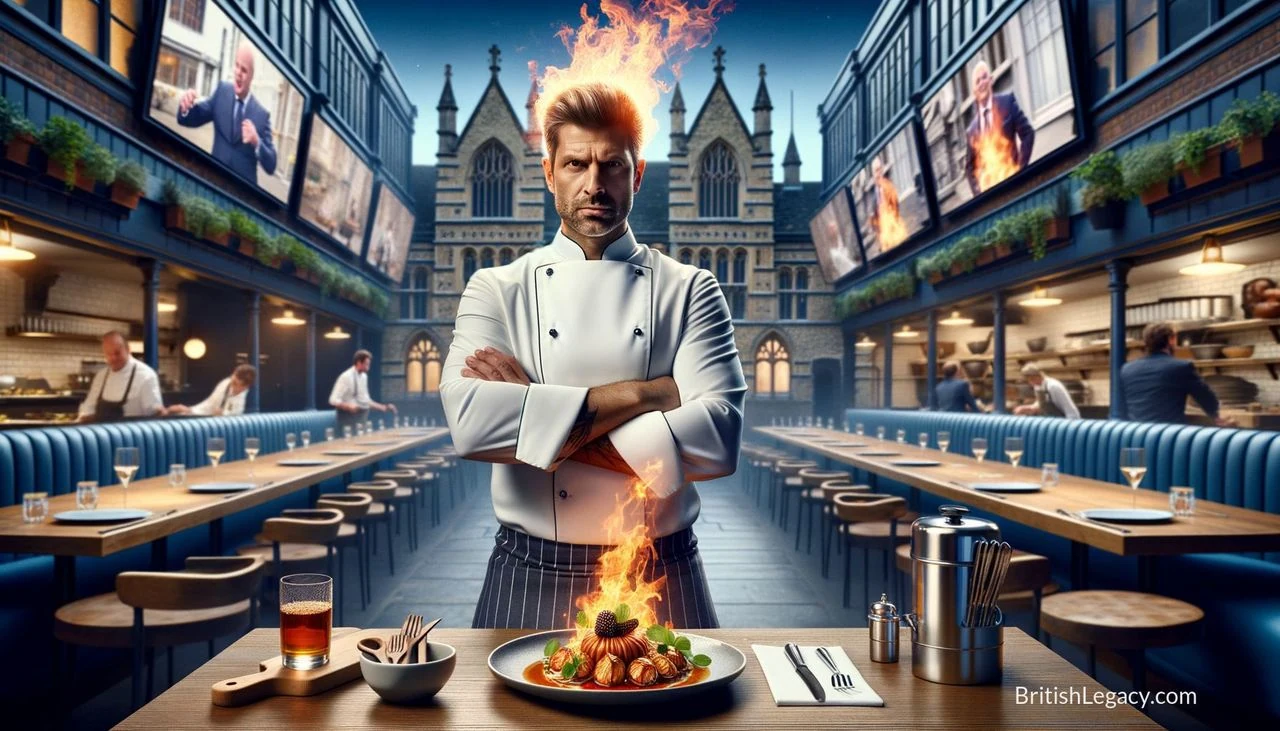
Gordon Ramsay’s career began with a change of direction. A knee injury ended his hopes of becoming a professional footballer; training in hotel management led instead to kitchens in London and France, and eventually to Restaurant Gordon Ramsay in Chelsea. The restaurant won its third Michelin star in 2001. Television then carried his demanding kitchen persona well beyond the restaurant world, making a chef whose career was rooted in British hospitality an international figure.
From football to the kitchen
Ramsay was born in Johnstone, Scotland, on 8 November 1966. His family moved to England, living for a time in Daventry before settling in the Bishopton area of Stratford-upon-Avon when he was nine. He was selected for under-14 football at 12 and later had a trial with Rangers, the club he supported. Injuries, including a serious knee injury, brought that ambition to an end.
At 19, Ramsay enrolled at North Oxfordshire Technical College to study hotel management. His first kitchen work included washing pots at a local Indian restaurant and, in the mid-1980s, working as a commis chef at the Wroxton House Hotel. He later ran the kitchen and dining room at the Wickham Arms before moving to London and joining Marco Pierre White at Harveys. After two years and ten months there, he decided to continue his training in French cooking.
White advised against Ramsay taking a job in Paris and encouraged him to work for Albert Roux at Le Gavroche in Mayfair. Ramsay followed that advice, then trained in France with Guy Savoy and Joël Robuchon. After three years, the physical and mental demands of kitchen work led him to spend a year as a personal chef on a private yacht, travelling to Sicily and Sardinia as well as working in Bermuda. The experience broadened his culinary education before he returned to London.
Building a restaurant career
In 1993, Ramsay became head chef at La Tante Claire in Chelsea. He then joined the restaurant Aubergine, where he became a partner and the kitchen earned its first Michelin star in 1995 and a second in 1997. A dispute over the owners’ plans for the restaurant, alongside Ramsay’s ambition to run his own establishment, led him to leave the partnership in 1998.
That year he opened Restaurant Gordon Ramsay on Royal Hospital Road in Chelsea, with help from his father-in-law, Chris Hutcheson, and former colleagues. The restaurant earned a third Michelin star in 2001. Ramsay was the first Scot to achieve that distinction. The restaurant became the most durable and prominent marker of his cooking career: the Wikipedia account records that it has held three stars since 2001, while noting that it is now run by chef Matt Abé.
From that first restaurant, Ramsay’s group developed venues in Britain and abroad, with ventures that included Pétrus, Gordon Ramsay at Claridge’s, and restaurants in Dubai, Tokyo and New York. Not every opening endured. The New York restaurant Gordon Ramsay at The London lost its two Michelin stars in 2013, with the guide’s director citing inconsistent meals; the restaurant at Claridge’s closed that year. Such changes are part of the record of an expanding restaurant business, rather than a story of uninterrupted success.
Ramsay’s name has also been attached to different kinds of dining. The imported account names the York & Albany and Bread Street Kitchen, and highlights dishes including Beef Wellington, lobster ravioli and eggs Benedict. His published and televised recipes have also included scrambled eggs and sticky toffee pudding. These examples span familiar British food and a broader restaurant repertoire, although the available evidence does not establish them as a definitive list of signature dishes.
Television brings the kitchens to a wider audience
Ramsay’s early television breakthrough came with the documentary Boiling Point in 1999, which followed his pursuit of a third Michelin star. Beyond Boiling Point followed in 2000. These programmes established a screen presence shaped by high standards, a quick temper and forceful language—traits that became central to his public image as well as his culinary reputation.
In 2004, Ramsay’s Kitchen Nightmares brought him to struggling restaurants, while the British version of Hell’s Kitchen placed celebrities in a restaurant kitchen. The American version of Hell’s Kitchen began in 2005, extending his reach across the Atlantic. Ramsay also presented Channel 4’s food programme The F Word and later became a familiar presence on American programmes including MasterChef and MasterChef Junior. His television work ranged from cookery and restaurant makeovers to competition formats, helping make kitchen practice and restaurant pressures familiar to audiences beyond the trade.
The screen persona was not simply a promotional extension of the restaurants. It made Ramsay’s exacting standards and confrontational manner part of the entertainment, sometimes attracting criticism for his language. The programmes also gave him a platform to demonstrate cooking, visit food cultures and explore subjects such as restaurant management. His career therefore connects two forms of public work: running kitchens and turning the work of kitchens into television.
Recognition, business and service
Ramsay was appointed an Officer of the Order of the British Empire in the 2006 New Year Honours for services to the hospitality industry. His other industry recognition included Catey Awards for Newcomer of the Year in 1995, Chef of the Year in 2000 and Independent Restaurateur of the Year in 2006. These honours reflect a career that crossed from the kitchen into restaurant management and the wider hospitality business.
His business interests have included restaurants, media and consultancy. The restaurant group expanded into pubs and international ventures, and the television career developed alongside it. That growth brought setbacks as well as new openings: businesses closed, restaurant partnerships changed, and a planned American expansion was slowed during the COVID-19 pandemic. In March 2020, after restaurants closed temporarily during lockdowns, Ramsay laid off more than 500 UK staff. The decision drew criticism, particularly in light of his wealth. It is an important part of the business history and prevents a simple account of expansion from obscuring the people affected by it.
Ramsay has also supported charitable causes. He became honorary patron of the Scottish Spina Bifida Association in 2004 and raised money for its work, including through marathon running and fundraising events. He took part in Soccer Aid, the charity football match supporting UNICEF, and worked with VSO on a fundraising initiative. Alongside these efforts, he has promoted training for aspiring chefs through a Scholars Programme and opened the Gordon Ramsay Academy, a cookery school in Woking, in 2021.
Why Gordon Ramsay deserves a place in British Legacy
Gordon Ramsay’s place in British Legacy rests on an identifiable achievement in British hospitality: building a restaurant career from professional training in Britain, further work in France and the opening of his own Chelsea restaurant. Restaurant Gordon Ramsay’s third Michelin star in 2001 marked a major moment in that career, and its continued three-star record gives the story a concrete point of reference. His wider group took British restaurant names and dining formats into international markets, while his own public profile kept the work of professional kitchens in view.
Television expanded that contribution. Through programmes such as Boiling Point, Ramsay’s Kitchen Nightmares and The F Word, viewers saw restaurant kitchens as places of skill, pressure and organisation, rather than simply the unseen source of a finished meal. His forceful presentation became part of that story, but so did the practical attention to cooking and running restaurants. His charitable fundraising, support for the Scottish Spina Bifida Association and cookery training initiatives add a further dimension: his public role has included raising funds and creating opportunities for aspiring chefs. Together, these achievements show a British career with influence across restaurants, television and hospitality, while its business setbacks and controversies remain part of the record.
Sources
Gordon Ramsay — Wikipedia, revision 1379264126
Adapted in part from Gordon Ramsay by Wikipedia contributors, under CC BY-SA 4.0. Text has been edited and combined with the existing article; this adapted text is shared under the same licence. Contributor history.