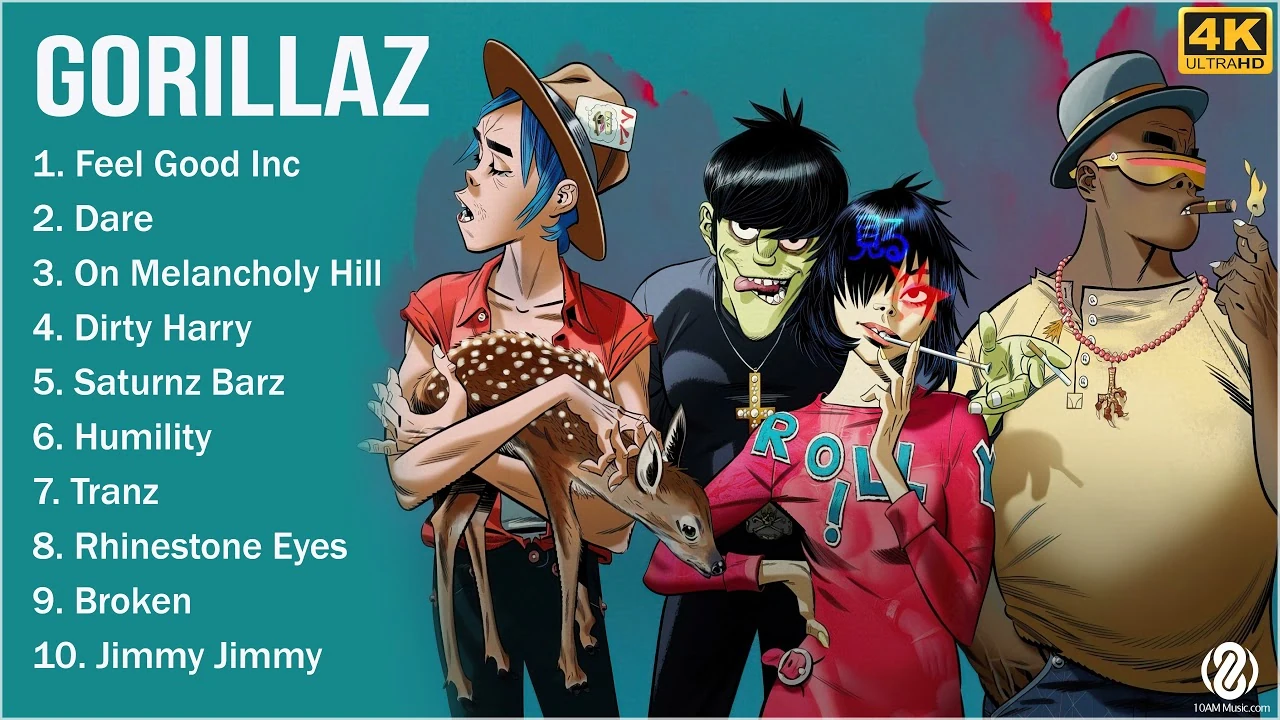
Gorillaz began with a challenge to the usual idea of a band: what if its members were fictional characters, while the music drew on a changing cast of real performers? Formed in 1998 by musician Damon Albarn and artist Jamie Hewlett, the project answered with songs that moved between rock, hip-hop, dub and electronic music, and an animated world that unfolded through videos, illustrations and other media. Its British origins are clear, but its sound and collaborators have never been confined to Britain.
Two creators, four animated members
Albarn and Hewlett had known each other since 1990, when Hewlett interviewed Blur for Deadline, the magazine that published his comic strip Tank Girl. They began sharing a flat in London in 1997. The idea for Gorillaz took shape while they were watching music television. Hewlett later described the project as a response to watching MTV for too long; Albarn wanted to make a deliberately constructed band that would still be interesting. They first recorded under the name Gorilla, and the animated band’s visual style developed from Hewlett’s comic art.
The characters gave the project a continuing cast and fictional setting. Its familiar quartet comprises 2-D, the singer and keyboard player; bassist Murdoc Niccals; guitarist and keyboard player Noodle; and drummer Russel Hobbs. But Gorillaz is not simply a cartoon band: Albarn has been its only permanent musical contributor, while Hewlett’s artwork and the characters’ fictional lives provide a visual and narrative identity. Their story has appeared in music videos, interviews, comic strips and short cartoons.
The first release was the Tomorrow Comes Today EP, issued in November 2000. Its title track’s video introduced the virtual members. Albarn had already begun exploring sounds that did not fit easily with Blur, including hip-hop, dub and Latin music. The new project made room for those ideas and for collaborators from beyond the British music scene.
A debut that made the concept work
The self-titled album Gorillaz arrived in March 2001. Its lead single, “Clint Eastwood”, featured rapper Del the Funky Homosapien; “19-2000” and “Rock the House” helped establish the record’s mixture of styles. The album drew on trip-hop, punk, dub and Latin influences, and brought in performers including Ibrahim Ferrer, Miho Hatori and Tina Weymouth. The range of guests became a defining feature rather than an occasional novelty.
The record reached number three on the UK Albums Chart and number 14 on the US Billboard 200, and went on to sell more than seven million copies worldwide, according to the supplied account. Hewlett directed the singles’ animated videos and designed an interactive band website, presented as a tour of the fictional Kong Studios. Music, character and digital presentation were linked from the outset.
Gorillaz initially carried the idea of virtual performance on to the stage in a deliberately constrained form. During the first tour, Albarn and the touring musicians played behind a large screen while Hewlett’s visuals were projected for the audience. The fictional members’ voice actors appeared at some shows. At the 2002 Brit Awards, the animated quartet appeared in 3D on large screens, in a production reported to have cost £300,000. The group received four nominations that year, including British Group and British Album, but won none.
Demon Days and a darker turn
After the first album’s success, Albarn and Hewlett returned to Gorillaz to show that it was more than a one-off gimmick. Their second album, Demon Days, was released in May 2005. Produced with Brian Burton, known as Danger Mouse, it took a darker conceptual approach: Albarn described it as a story of staying awake through the night and an allegory for the state of the world. “Feel Good Inc.”, featuring De La Soul, became the record’s lead single, while “Dare”, “Dirty Harry” and “El Mañana” extended its run of successful releases.
The album topped the UK chart and later went six times platinum there. Rather than mount a conventional tour, the group performed the album in full during a five-night residency at Manchester Opera House in November 2005. The musicians were visible as silhouettes, with Hewlett’s imagery on a screen above them. At the 2006 Grammy Awards, “Feel Good Inc.” won Best Pop Collaboration with Vocals. The animated band also appeared to perform at the Grammys using projection technology, though a proposed full holographic tour was abandoned over its expense and logistical difficulties.
Gorillaz’s changing stage presentation reflects a practical tension at the heart of the concept: the animated characters can lead the visual story, but live music depends on real performers. By the 2010 Escape to Plastic Beach tour, the touring band played fully in view. The project did not settle on one solution; its performances adapted as the band and its technology changed.
From Plastic Beach to new forms of release
Plastic Beach, released in 2010, brought environmental themes into the project’s increasingly expansive sound. Albarn described its imagined island as built from human waste and debris, drawing inspiration from marine pollution. The record featured a broad roster that included Snoop Dogg, Mos Def, Bobby Womack, Lou Reed and Gruff Rhys, alongside orchestral contributions from Sinfonia Viva and the Syrian National Orchestra for Arabic Music. It reached number two in both the UK and US album charts.
During the North American leg of the tour, Albarn recorded material on an iPad. Released as The Fall on Christmas Day 2010, the album was presented as a diary of the journey, with tracks recorded as he travelled. In 2012, “DoYaThing”, made with James Murphy and André 3000, continued the group’s collaborative approach. A public disagreement between Albarn and Hewlett followed, and Gorillaz entered a multi-year hiatus. They later agreed to work together again.
Humanz, released in 2017, was the first Gorillaz studio album in seven years. Its large cast included Grace Jones, Mavis Staples, Popcaan and Vince Staples. The album reached number two in the UK and US. The following year brought The Now Now, a more focused record on which Albarn sang much of the material himself. In its fictional story, the character Ace from The Powerpuff Girls temporarily replaced Murdoc as bassist.
In 2020 Gorillaz launched Song Machine, a web series built around releasing songs as episodes rather than following a conventional album-first plan. Guests included Slowthai, Fatoumata Diawara, Peter Hook, Robert Smith and Elton John. The first season culminated in the album Song Machine, Season One: Strange Timez. The format made the project’s long-standing openness to collaboration part of its release structure.
Continuing the project
The 2021 Meanwhile EP followed a free Gorillaz concert at London’s O2 Arena for NHS employees and their families. The band then performed its new songs at a public show. In 2022, the group toured South America, Europe, Australia and North America while introducing new material. The resulting album, Cracker Island, was released in 2023 and featured artists including Thundercat, Tame Impala, Stevie Nicks and Bad Bunny. It received generally positive reviews and was nominated for a Grammy for Best Alternative Music Album.
Gorillaz marked its 25th anniversary in 2025 with an exhibition at London’s Copper Box, including performances of the first three studio albums. The group announced its ninth album, The Mountain, for release in February 2026; the supplied Wikipedia account describes it as drawing musical and thematic inspiration from India. A tour was scheduled across Europe, America and Asia, including the band’s first performances in India. These later projects continued the pattern established at the start: using each new release to alter the relationship between songs, images, collaborators and performance.
Why Gorillaz deserves a place in British Legacy
Gorillaz deserves a place in British Legacy because it is a sustained British creative partnership that made its format part of its musical achievement. Albarn brought ideas and experience from British pop into a project that could move beyond Blur’s Britpop sound; Hewlett gave it a distinctive visual world, with characters and stories that could develop across records, videos and live appearances. The band’s London beginnings and its creators’ British careers are specific foundations for that legacy, not a claim that its music belongs only to Britain.
The project also shows how collaboration can be built into a band’s identity. Across records from Gorillaz to Cracker Island, Albarn worked with performers from a wide range of musical backgrounds, while the animated members gave audiences a recognisable thread through those changing sounds. The project’s different approaches to live performance and release—from screened concerts to a visible touring band, and from conventional albums to Song Machine episodes—show a willingness to adapt the form as well as the music. That combination of British musicianship, visual art and international collaboration created a distinctive route for presenting music to listeners. Its longevity, continuing releases and evolving performances demonstrate the creative possibilities of the partnership without reducing its achievement to a single hit or gimmick.
Sources
Gorillaz — Wikipedia, revision 1379152626
Adapted in part from Gorillaz by Wikipedia contributors, under CC BY-SA 4.0. Text has been edited and combined with the existing article; this adapted text is shared under the same licence. Contributor history.