
Before “Kiss from a Rose” became an international hit, Seal had already made his mark on the UK charts. His vocals on Adamski’s “Killer” helped take the track to number one; his own “Crazy” reached number two. Both songs announced a singer who could move between electronic dance music and soul, R&B and pop without being confined to one sound.
Born in Paddington, London, on 19 February 1963, Seal went on to release a run of successful albums, win three Brit Awards at one ceremony and earn four Grammy Awards. His career is not simply the story of a single ballad’s success: it is a London-born artist’s progression from club performances and dance records to a catalogue that found audiences on both sides of the Atlantic and beyond.
London beginnings and the first chart landmarks
Seal was born Seal Henry Olusegun Olumide Adeola Samuel, the son of a Nigerian mother, Adebisi Ogundeji, and a Brazilian father, Francis Samuel. He was raised by a foster family in Westminster and later received a two-year diploma in architecture. Before music became his profession, he held various jobs in the London area.
In the 1980s, he sang in local clubs and bars. In 1987, he joined the British funk band Push and toured with them in Japan. He later spent time with a blues band in Thailand, then travelled in India before returning to England. These early moves took him well beyond the local club circuit, but the breakthrough came through a collaboration close to home: producer Adamski recruited Seal to provide lyrics and vocals for “Killer”.
The single reached number one on the UK singles chart. Seal signed to Trevor Horn’s ZTT Records and released his self-titled debut album in 1991, produced by Horn. “Crazy” became an international hit, reaching number two in the UK and number seven on the US Billboard Hot 100. The album also included Seal’s own version of “Killer” and “Future Love Paradise”. The songs established a distinctive meeting point between his voice and the electronic production of the period.
At the 1992 Brit Awards, Seal won three awards: Best British Male, Best British Video for “Killer” and Best British Album for Seal. It was the first hat-trick of wins in the event’s history. The same year, he contributed an exclusive track to Red Hot + Dance, a compilation that raised money and awareness in support of the AIDS epidemic, with proceeds donated to AIDS charities.
From “Seal II” to a Grammy-winning song
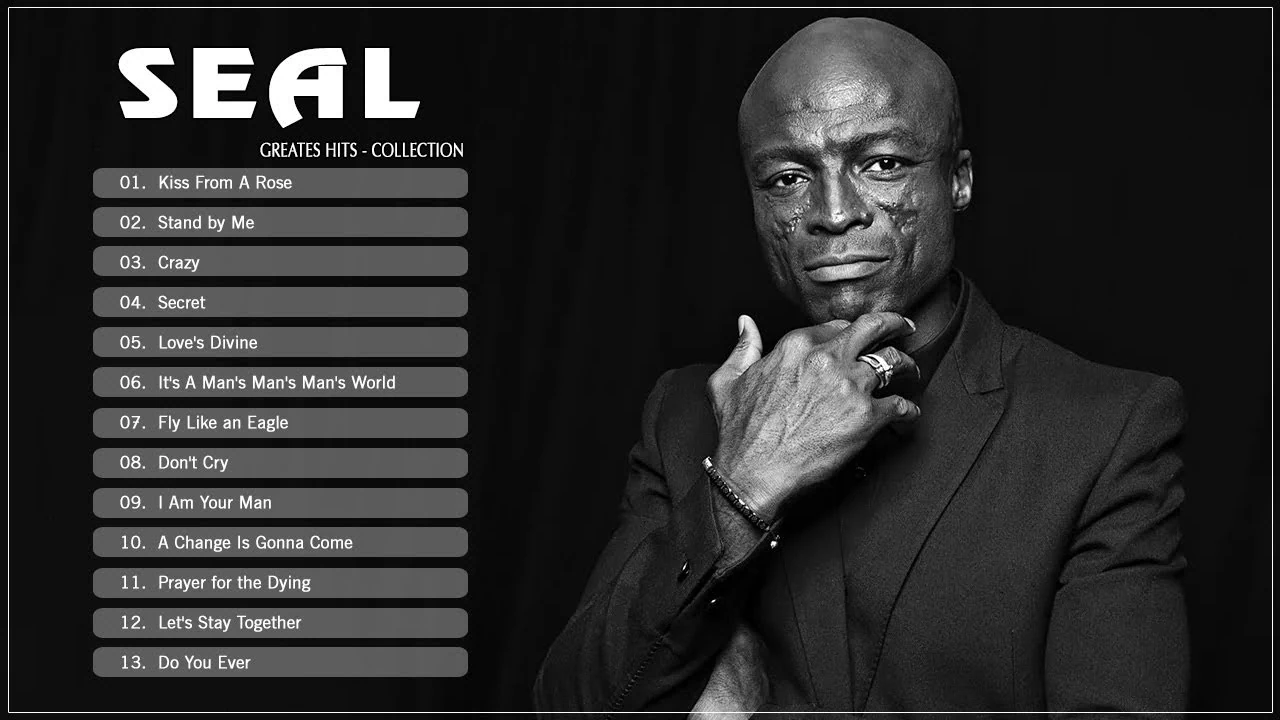
Seal and Horn reunited for a second self-titled album, released in 1994 and often called Seal II. It reached the top of the UK Albums Chart, as had its predecessor. Among its songs were “Prayer for the Dying” and “Newborn Friend”; the former later became a minor US pop hit. The album also contained “Kiss from a Rose”, which had a more modest reception when first released as a single.
Its fortunes changed after the song was remixed and featured on the soundtrack to Batman Forever in 1995. “Kiss from a Rose” reached number one on the US Billboard Hot 100 and number four in the UK. At the 1996 Grammy Awards it won Record of the Year, Song of the Year and Best Male Pop Vocal Performance. The track’s journey—from a song on Seal’s second album to a prominent film soundtrack recording—became the defining commercial landmark of his career.
Seal’s work through the decade was not limited to those two albums. He performed with Jeff Beck on a cover of Jimi Hendrix’s “Manic Depression” for the 1993 tribute album Stone Free. In 1998, he released Human Being, his first album after leaving ZTT for Warner Bros. The album followed a turbulent period in his relationship with Horn and was poorly received by critics, though it achieved gold certification from the Recording Industry Association of America two months after release.
New records, collaborations and changing sounds
A planned album, Togetherland, was ultimately cancelled. Seal’s stated reason was that he did not think it met his standards; other reports attributed the decision to the label’s commercial concerns. One song from the project, “This Could Be Heaven”, was released in the United States and appeared on the soundtrack to The Family Man. The episode marks a less straightforward part of a recording career often recounted through its hits: not every planned record reached listeners.
Seal continued to record and collaborate. He co-wrote and sang on Jakatta’s 2002 single “My Vision”, recorded the duet “Les Mots” with Mylène Farmer, and appeared on Santana’s album Shaman. His 2003 album Seal IV included “Waiting for You”, “Get It Together” and “Love’s Divine”, the last of which became a hit in several European countries. A greatest-hits collection followed in 2004, alongside a concert recording made at Paris’s Olympia Theatre.
In 2007, System took a more dance-oriented direction. Its single “Amazing” received a Grammy nomination, and the album included “Wedding Day”, a duet with his then-wife Heidi Klum. Seal performed “Amazing” at the 2007 Royal Variety Performance. The following year, he released Soul, a set of soul standards produced by David Foster, including a cover of Sam Cooke’s “A Change Is Gonna Come”.
His later albums continued to move between approaches. Seal 6: Commitment appeared in 2010, followed by the cover collection Soul 2 in 2011. After releasing 7 in 2015, he turned to standards on the 2017 album Standards, which received a Grammy nomination for Best Traditional Pop Vocal Album. In 2021, he collaborated with Claptone on “Just a Ghost”. The following year he launched a limited-edition Leica camera; in 2023 he announced a North American tour with Trevor Horn as musical director. In 2024, an alternate version of “Kiss from a Rose” appeared with a deluxe edition of Seal marking the album’s 30th anniversary. Seal released the new Horn-produced song “All I Know Is Now” in February 2025.
Recognition, performance and public work
Seal’s award record extends beyond the 1992 Brit Awards and the Grammys for “Kiss from a Rose”. He has won four Grammy Awards in total, including one for his contribution to Herbie Hancock’s 2010 album The Imagine Project, and two Ivor Novello Awards for “Killer” and “Crazy”. His recording career has sold more than 20 million albums or singles, according to the supplied biographical source.
He has also appeared in settings beyond the recording studio. In 1992, he performed with Queen at the Freddie Mercury Tribute Concert at Wembley Stadium, singing “Who Wants to Live Forever” and joining the all-star finale for “We Are the Champions”. In 2012, he became a coach on the first season of Australia’s The Voice, whose winner was Karise Eden. He returned the next year and coached winner Harrison Craig, then rejoined the programme in 2017.
Some public appearances have drawn criticism. In 2011, Seal performed at an event in Grozny that became a birthday celebration for Chechen president Ramzan Kadyrov. Human-rights organisations criticised the performers’ participation, arguing that it helped legitimise Kadyrov and his government. Seal declined to apologise and said, through Twitter, that people should “leave me out of your politics”. The incident is part of the documented public record of his career, distinct from the musical achievements for which he is best known.
Why Seal deserves a place in British Legacy
Seal’s British story begins with more than a birthplace. His early career developed through London clubs and a collaboration with Adamski that took “Killer” to the top of the UK singles chart. His 1991 album and “Crazy” then established him as a solo artist, while his three wins at the 1992 Brit Awards placed that early success firmly within the British music scene. These are specific milestones in a career that started in London and gained momentum through records made with British producer Trevor Horn.
That foundation supported a body of work that travelled well beyond the UK. “Kiss from a Rose” moved from Seal’s second album to a major film soundtrack, topped the US chart and won three Grammys. Later records such as System, Soul and Standards show a career willing to revisit dance, soul and traditional pop rather than repeat one successful formula. His collaborations and performances—from the Freddie Mercury Tribute Concert to work with Adamski, Jeff Beck and Herbie Hancock—also place him within a wider musical conversation. Seal belongs in British Legacy because his achievements are both locally grounded and internationally recognised: a London singer whose UK chart beginnings led to a long recording career, significant awards and songs that reached audiences across different genres and generations.
Sources
Seal (musician), revision 1379249838
Adapted in part from Seal (musician) by Wikipedia contributors, under CC BY-SA 4.0. Text has been edited and combined with the existing article; this adapted text is shared under the same licence. Contributor history.
.jpg)