When the Rolling Stones played the Marquee Club in London on 12 July 1962, they were a young band learning its trade in the capital’s rhythm-and-blues scene. Their repertoire drew heavily on American blues and early rock and roll: Muddy Waters, Chuck Berry and Bo Diddley were among the musicians whose records shaped their sound. What the Stones made from those influences was neither a simple imitation nor a polished pop product. Their rhythmic drive, ragged guitars and Mick Jagger’s distinctive delivery gave British audiences a tougher, more unsettled form of rock. Over the decades that followed, the group moved from clubs to stadiums, built a catalogue of original songs and helped establish British rock as an international force. [1]
Finding their sound in London
The band’s beginnings lay in friendships and encounters between young musicians. Mick Jagger and Keith Richards, who had known each other as children in Dartford, renewed their acquaintance at Dartford railway station in 1961. Jagger was carrying records by Chuck Berry and Muddy Waters; the discovery of their shared musical interests helped set a songwriting and performing partnership in motion. Richards and Jagger began playing with Dick Taylor, while Brian Jones, a committed blues enthusiast and slide guitarist, became an early leader. Pianist Ian Stewart and drummer Charlie Watts also entered the circle through London’s blues scene. [1]
Jones placed an advert seeking bandmates in the music paper Jazz News. The musicians rehearsed and played at venues including the Ealing Jazz Club and the Crawdaddy Club in Richmond. Their first show billed as the Rollin’ Stones took place at the Marquee in July 1962. The early group’s line-up was not yet settled: Bill Wyman joined as bassist later that year, and Watts became the permanent drummer in early 1963. Stewart, though removed from the official line-up by manager Andrew Loog Oldham, continued as road manager and a keyboard player in the studio and on tour. These early changes matter to the story: the Stones’ identity formed through a working musical circle, not a fixed set of names on a poster.
Oldham helped the group secure a recording deal with Decca and shaped a public image that contrasted with the neatness associated with other British pop acts. He encouraged the press to present the Stones as unruly and threatening. The band’s sound, however, was more than its publicity. Their early records depended on the interplay of guitar, bass and drums, and on a strong grasp of the blues and rock and roll they admired. The first single, a cover of Chuck Berry’s “Come On”, appeared in 1963. In their initial years, covers remained central to their repertoire, but Oldham also pushed Jagger and Richards towards writing songs of their own.
Their progress was not immediate everywhere. The first US tour in 1964 was a disappointment, but recording sessions at Chicago’s Chess Studios brought them closer to some of the musicians and sounds that had inspired them. In Britain, their audience grew through club work, touring and singles. “It’s All Over Now”, a cover of a song by Bobby and Shirley Womack, became their first UK number one. By 1964 they were among the leading acts of the British Invasion, the wave of British groups that found major audiences in the United States.
Original songs and ambitious records
The shift from interpreters to writers was a turning point. “The Last Time”, released in 1965, was the first Jagger–Richards song to reach number one in the UK. Later that year, “(I Can’t Get No) Satisfaction” became an international hit. Richards’s repeating guitar riff gave the song its distinctive engine, while Jagger’s vocal turned frustration into a sharp, memorable hook. “Get Off of My Cloud” followed, and in 1966 “Paint It Black” brought an unusual, insistent sound to the top of the charts. These records made the group’s harder edge part of mainstream pop rather than a feature confined to clubs.
Aftermath, released in 1966, was the first Rolling Stones album made entirely from Jagger–Richards compositions. It also displayed Brian Jones’s appetite for expanding the band’s musical palette: he played sitar on “Paint It Black”, dulcimer on “Lady Jane” and marimbas on “Under My Thumb”. The album’s range, including the extended “Goin’ Home”, made it more than a collection assembled around singles. The Stones were developing a way to use albums as coherent statements while retaining the directness of their earlier work.
The late-1960s run from Beggars Banquet to Let It Bleed brought together blues-based playing, vivid characters and a darker sense of the world around them. “Street Fighting Man” registered the political turbulence of 1968; “Sympathy for the Devil” made performance and moral unease part of the same theatrical song. On Let It Bleed, “Gimme Shelter” built tension through its arrangement, while “You Can’t Always Get What You Want” found a more reflective scale. The records did not smooth away their roots in American music. Instead, they used those roots to make something recognisably the Stones’ own: forceful, flexible and increasingly ambitious.
Their sound continued to change. Sticky Fingers and Exile on Main St. extended the band’s command of groove and texture. Richards developed open-tuned guitar parts, and the two-guitar interplay between him and first Mick Taylor, then Ronnie Wood, became a defining feature. The rhythm section provided a firm foundation without making the songs feel rigid: Watts brought a jazz-informed swing, while Wyman’s bass anchored the music. Goats Head Soup produced “Angie”; later, Some Girls answered the late-1970s musical climate with faster, leaner songs, including “Miss You”. Tattoo You gave them “Start Me Up”, a compact, instantly recognisable single assembled from earlier sessions.
Changing line-ups, keeping a centre
Continuity in the Rolling Stones has never meant an unchanged membership. Jones left in 1969, weeks before his death. Taylor joined for the next phase and left at the end of 1974; Wood became a member in 1975. Wyman departed in the early 1990s. Watts, whose drumming had helped give the band its characteristic poise, died in 2021. In the years since, Steve Jordan has taken the drummer’s role on stage, while Darryl Jones has performed with the group as its regular bassist following Wyman’s departure. The band’s changing personnel is part of its history, not an interruption to it.
Jagger and Richards have remained the central songwriting partnership, though their relationship has also included serious friction. In the 1980s, their disagreements coincided with solo projects and uncertainty about the band’s future. They came back together for Steel Wheels in 1989, followed by large-scale touring. The group’s work in later decades has included Voodoo Lounge, which won the Grammy for Best Rock Album, and Blue & Lonesome, a return to blues covers. Hackney Diamonds, released in 2023, was their first album of new original material in 18 years. The band also released Foreign Tongues in July 2026. The long chronology is not evidence that every period sounded the same; it shows a group repeatedly testing how its musical character could survive changing circumstances. [1]
From club stages to a new kind of spectacle
The Stones changed not only what a British rock band might record, but what audiences could expect from a live show. Their early performances took place in small clubs, where the stage offered little space and the sound system had limited reach. As their audiences grew, the band and their crew had to solve practical problems of sound, lighting and visibility. Their 1969 American tour is often treated as an important step towards arena rock: amplification and lighting were developed to make performers visible and audible in much larger venues. Later tours expanded the staging, with larger structures, lighting effects and screens designed for stadium crowds.
This growth involved more than simply making everything bigger. Large shows required technical planning behind the apparent spontaneity of a band playing live: staging, timing and sound had to work across spaces far removed from the clubs where the group had started. From the Hyde Park concert held after Jones’s death to subsequent arena and stadium tours, the Stones helped define the production standards expected of touring rock acts. Their 1994 Voodoo Lounge tour, among other major tours, demonstrated how a veteran group could remain a substantial live draw without relying on nostalgia alone.
They also took an early step into a changing media landscape. In November 1994, a 20-minute video of a Stones performance was broadcast over the internet. It was an early streaming-video demonstration rather than a modern full-length webcast, but it showed the band’s willingness to use new ways of reaching an audience. Their continuing tours and later releases have kept the group in public life across successive generations of recording and distribution.
A British band with a wider cultural footprint
The Stones’ British story is inseparable from the American music they learned from. They began by playing blues and rock and roll songs created by Black American musicians, and the band’s own accounts and musical development show how deeply those records shaped them. Their achievement was not to make that influence disappear, but to build original work from it. The group’s success helped bring renewed attention to blues musicians in the United States as well as establishing British performers as interpreters and creators in their own right.
Their public image was influential, but the music explains its staying power. The group moved from covers to the increasingly distinctive writing of Jagger and Richards; Jones added instrumental colour; and the rhythm section gave the songs a particular swing. Their arrangements could be rough-edged without being careless, and their records could shift from a lean riff to a more expansive, dramatic production. That combination fed into the development of hard rock and helped shape the expectations listeners brought to a rock band: not only memorable songs, but a recognisable sound and a commanding live presence.
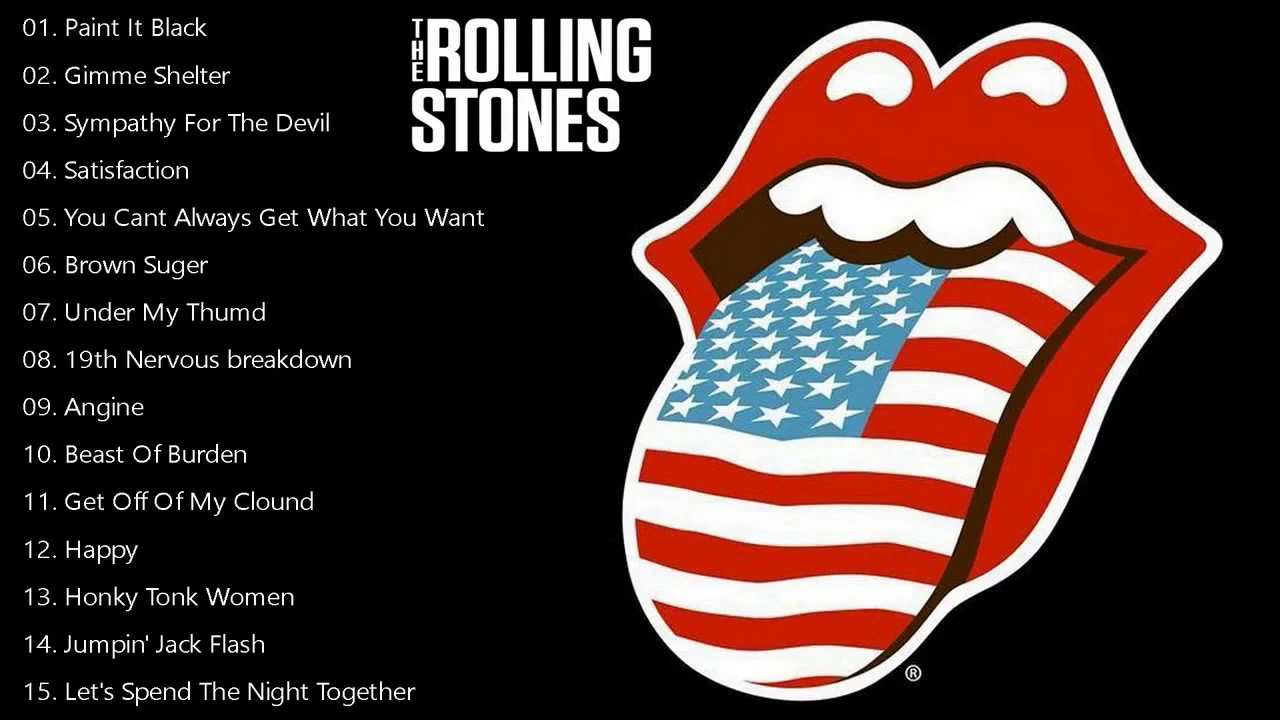
The group’s visual identity also travelled far beyond record sleeves. In 1970, designer John Pasche created the tongue-and-lips logo. Its bold, economical design became closely associated with the band and has appeared across merchandise and stage settings. The Victoria and Albert Museum holds the original artwork, recognising the logo as part of a wider design history as well as a piece of music branding. The band has also received public recognition in Britain: it was featured on Royal Mail stamps in 2022, and the Royal Mint issued a commemorative coin marking its 60th anniversary that year. [1]
The Stones were inducted into the Rock and Roll Hall of Fame in 1989 and the UK Music Hall of Fame in 2004. They have won four Grammy Awards and received the Recording Academy’s Lifetime Achievement Award. Such honours describe the scale of their recognition, but the more revealing measure is how many parts of British cultural life their work now touches: popular music, live production, graphic design and the history of cultural exchange.
Why The Rolling Stones deserve a place in British Legacy
The Rolling Stones deserve a place in British Legacy because their story shows how a band rooted in a particular British scene could absorb musical traditions from elsewhere and answer them with original work. They came together in London’s rhythm-and-blues world, learned from American blues and rock and roll, and developed a voice that British audiences recognised as their own. Jagger and Richards’s writing moved the group beyond a repertoire of covers; Jones’s use of sitar, dulcimer and marimbas widened its sound; and the playing of Watts and Wyman gave many of its best-known records their distinctive balance of swing and drive. From “Satisfaction” to “Gimme Shelter”, the band helped expand the range and confidence of British rock.
Their contribution also reaches beyond the recording studio. The Stones and their crews helped raise expectations for the scale and technical organisation of live performance, while the tongue-and-lips logo carries their identity into Britain’s design collections. Their work has been recognised by institutions including the UK Music Hall of Fame, the Victoria and Albert Museum, Royal Mail and the Royal Mint. Those connections make their legacy concrete rather than a general claim about national pride. The band’s career further illustrates that cultural exchange can be acknowledged rather than concealed: American blues was a vital source, and British musicianship and songwriting made a lasting response to it. Their records, tours and visual identity form an unusually broad contribution to British popular culture—one still extending through new music and performance more than six decades after their first London show.
Sources
Adapted in part from The Rolling Stones by Wikipedia contributors, under CC BY-SA 4.0. Text has been edited and combined with the existing article; this adapted text is shared under the same licence. Contributor history.