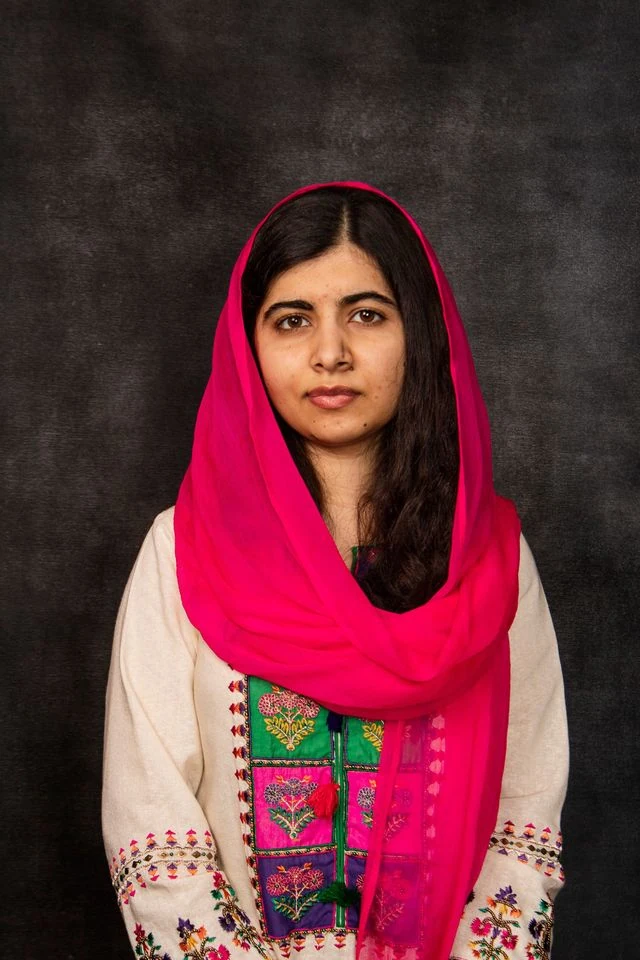
Malala Yousafzai’s campaign for girls’ education began in Pakistan, where she wrote anonymously about life under Taliban rule. After a gunman shot her on a school bus in 2012, she was brought to Birmingham for treatment. She recovered, continued her education in the city and built an international platform for her cause. Her British story is not simply one of refuge: Birmingham became part of the setting from which she resumed her studies and developed her work as an activist.
A schoolgirl’s account of Swat
Yousafzai was born in Mingora, in Pakistan’s Swat District, on 12 July 1997. Her father, Ziauddin Yousafzai, ran schools and was an educational activist. In 2009, when she was 11, Malala began writing for the BBC Urdu website under the pseudonym Gul Makai. Her diary described daily life during the Pakistani Taliban’s occupation of Swat, including the restrictions imposed on girls’ education and the closure of her school.
The blog gave readers a child’s perspective on a conflict that was disrupting ordinary life. Yousafzai wrote about fears for her safety and her education, while her family faced displacement as the Pakistani military moved into the region. After the diary ended, she continued to speak publicly about girls’ right to attend school. Her public profile grew through interviews and television appearances, and in 2011 she received Pakistan’s National Youth Peace Prize.
Her advocacy also brought danger. On 9 October 2012, a Taliban gunman shot her and two other girls as they travelled by bus after an exam in Swat. Yousafzai was 15. She was first treated in Pakistan, then transferred to the Queen Elizabeth Hospital in Birmingham for further medical care. After leaving hospital, she continued rehabilitation in the West Midlands with her family. The attack drew international attention, but it did not end her public work.
Recovery, education and a new base
While recovering, Yousafzai became a more prominent advocate for the right to education. In July 2013, on her 16th birthday, she addressed the United Nations, calling for education for every child. The event was named Malala Day. Her appeal was not for personal revenge against those who had attacked her; she called instead for education and dialogue, including for the children of her attackers.
She returned to school at Edgbaston High School in Birmingham, where she studied from 2013 to 2017. Her education continued at the University of Oxford’s Lady Margaret Hall, where she studied Philosophy, Politics and Economics. She completed the degree in 2020. The progression from a school in Birmingham to Oxford forms a concrete part of her British connection: education was not only the subject of her campaigning but also the path she pursued after recovering from an attack that had sought to silence her.
In 2013, Yousafzai co-authored I Am Malala, an account of her life and campaign, with British journalist Christina Lamb. The book brought her story to a wide readership. That year she also received the European Parliament’s Sakharov Prize for Freedom of Thought. In 2014, she shared the Nobel Peace Prize with Indian children’s rights activist Kailash Satyarthi. At 17, she became the youngest person to receive a Nobel Prize.
From an individual campaign to the Malala Fund
Yousafzai co-founded the Malala Fund with Shiza Shahid. Based in Birmingham, the organisation supports education advocates and programmes internationally. Its work gives institutional form to the campaign that began with a schoolgirl’s account of being denied the chance to learn: it supports people working to make education accessible to girls, rather than relying on one public voice alone.
Yousafzai’s advocacy has reached audiences well beyond Britain. She has addressed international institutions and met political leaders, and she has continued to speak about barriers to girls’ education. In 2015, she opened a school in Lebanon’s Bekaa Valley for Syrian refugee girls, with funding from the Malala Fund. Her work has therefore joined public campaigning to practical support for education programmes in different countries.
She has also continued her education and creative work alongside campaigning. In 2021, she began a multi-year partnership with Apple to develop programming for its streaming service. Her public role is consequently wider than that of a campaigner speaking at international events: it includes supporting an organisation, writing and work in film and television.
Why Malala Yousafzai deserves a place in British Legacy
Yousafzai’s place in British Legacy rests on a specific chapter of her life and work. After the 2012 attack, Birmingham provided the setting for specialist treatment, rehabilitation and a return to school. She then studied at Oxford, completing a degree while continuing to campaign internationally for girls’ education. These are more than incidental links to Britain: they show how medical care and education in the country became part of the practical conditions that allowed her to recover and carry on her work.
Her British connection is also institutional. The Malala Fund, which she co-founded with Shiza Shahid, is based in Birmingham and supports education advocates and programmes around the world. That work connects her experience to efforts that reach beyond her own story, helping others address barriers to girls’ learning. Her Nobel recognition at 17 brought exceptional public attention, but her lasting contribution is not captured by an award alone. It lies in turning a personal campaign for the right to attend school into sustained advocacy and support for education. Remembering Yousafzai in a British context should therefore recognise both the role Birmingham played in her recovery and the international work she has built from a life that continued there.
Sources
Malala Yousafzai (revision 1379474877)
Adapted in part from Malala Yousafzai by Wikipedia contributors, under CC BY-SA 4.0. Text has been edited and combined with the existing article; this adapted text is shared under the same licence. Contributor history.