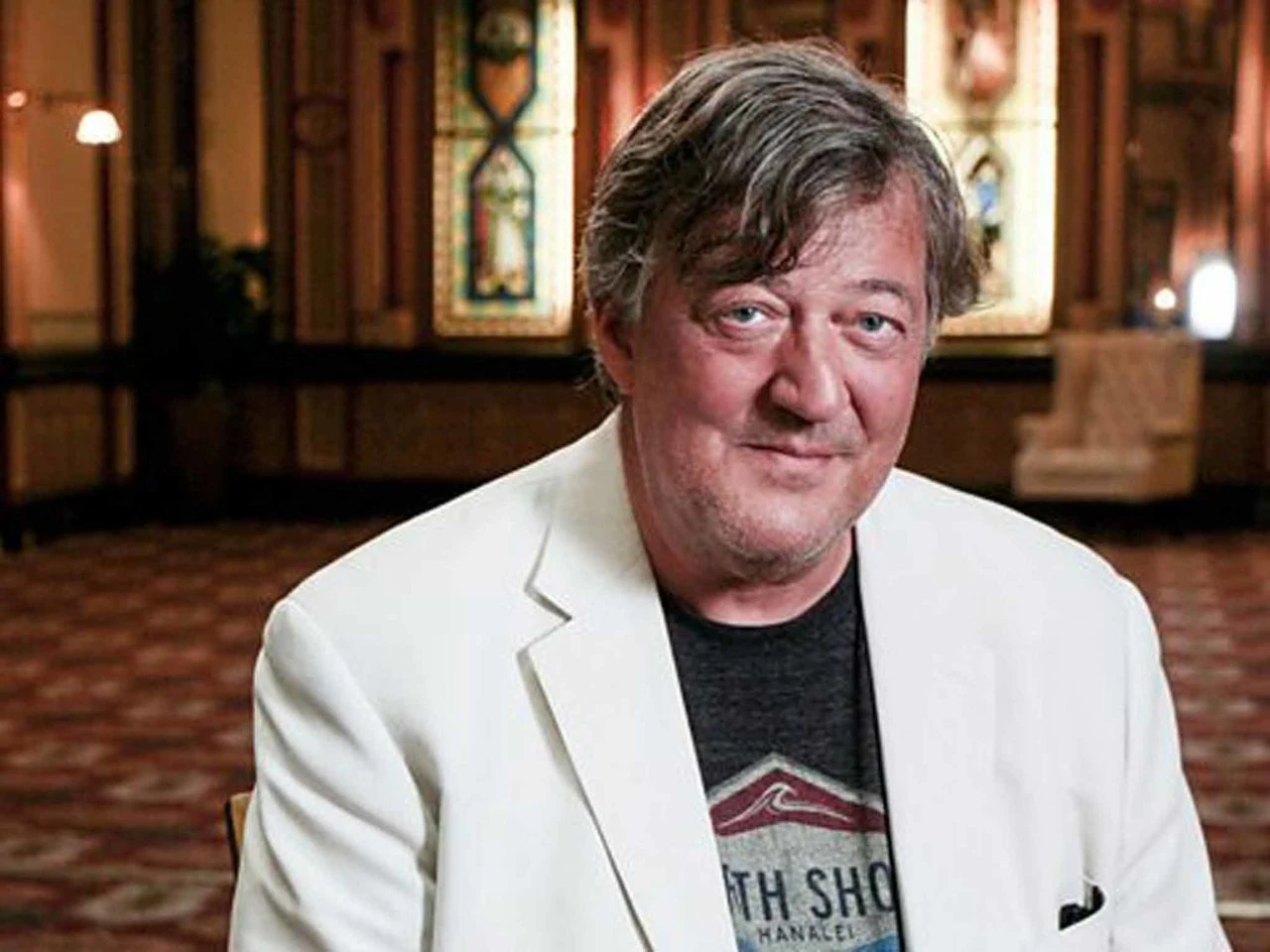
Stephen Fry’s career has crossed sketch comedy, classic drama, novels, documentary-making and broadcasting. His partnership with Hugh Laurie brought a distinctive comic double act to television; his later years as host of QI made general knowledge the basis for a popular comedy panel show. Alongside this work, Fry has spoken publicly about his experience of cyclothymia and used documentary television to examine attitudes towards gay people.
Cambridge and a comedy partnership
Stephen John Fry was born in Hampstead, London, on 24 August 1957. His school years took him through several schools, and he did not initially pass the examinations required for university. After studying at Norfolk College of Arts and Technology, he returned to his education at City College Norwich. He passed A-levels in English and French and gained a place at Queens’ College, Cambridge, where he read English literature and graduated in 1981.
At Cambridge, Fry joined the Footlights, the university’s theatrical club, and met Hugh Laurie through their mutual friend Emma Thompson. Fry and Laurie became collaborators in television comedy, but Fry’s early work also established him as a writer. His play Latin! or Tobacco and Boys won a Fringe First prize at the 1980 Edinburgh Festival. The following year’s Footlights revue, The Cellar Tapes, won the Perrier Comedy Award.
Fry, Laurie and Thompson appeared in There’s Nothing to Worry About!, which developed into the television series Alfresco. Fry and Laurie then made A Bit of Fry & Laurie, which ran for four series from 1989 to 1995. They also starred together in Jeeves and Wooster from 1990 to 1993, with Fry playing Jeeves and Laurie playing Bertie Wooster. Fry’s other television work included Blackadder, in which he played Lord Melchett and other roles.
His work in theatre included adapting the musical Me and My Girl for the West End. The production ran for eight years before transferring to Broadway, where Fry received a Tony Award nomination for his adaptation. His screen roles also extended beyond comedy. He played Oscar Wilde in the 1997 film Wilde, earning a Golden Globe nomination, and appeared in Robert Altman’s Gosford Park in 2001.
Books, stages and the QI chair
Fry’s writing spans fiction, memoir, journalism and work for stage and screen. His first novel, The Liar, was published in 1991. Later novels include The Hippopotamus, Making History and The Stars’ Tennis Balls. He wrote The Ode Less Travelled, a guide to writing poetry, and published three autobiographical books. His writing for performance includes the English libretto and dialogue for Kenneth Branagh’s film adaptation of The Magic Flute.
Fry’s work as a reader and narrator has carried literature into audio. He recorded the British editions of all seven Harry Potter audiobooks and narrated works by authors including Douglas Adams and Michael Bond. He also wrote and presented programmes about language and literature, among them the BBC Radio 4 series Fry’s English Delight.
In 2003, Fry began hosting QI, the BBC comedy panel show built around questions of general knowledge. He stayed in the role until 2016, when Sandi Toksvig took over. The programme provided a long-running platform for his mixture of verbal fluency, curiosity and humour. His documentary and travel work ranged from Stephen Fry in America to Last Chance to See, in which he travelled with zoologist Mark Carwardine in search of endangered species.
Fry returned to the stage as Malvolio in Shakespeare’s Twelfth Night at Shakespeare’s Globe in 2012. The production transferred to the West End and then Broadway, where Fry received a Tony Award nomination for his performance. His screen work has included voicing the Cheshire Cat in Alice in Wonderland, playing the Master of Lake-town in The Hobbit films, and appearing in the television series Doctor Who.
Making mental health and LGBTQ+ lives visible
In the 2006 documentary Stephen Fry: The Secret Life of the Manic Depressive, Fry spoke about his own experience of cyclothymia, a form of bipolar disorder, and interviewed others about their mental-health experiences. The programme received an Emmy Award. Fry has continued to speak publicly about mental health and, since 2011, has served as president of the charity Mind. His documentary testimony connected a personal account with a wider public discussion of mental illness.
His 2013 two-part documentary Stephen Fry: Out There explored attitudes towards homosexuality and the lives of gay people in different parts of the world. Fry has also supported LGBTQ+ inclusion through public advocacy, including writing the foreword to a University of East Anglia Students’ Union report on LGBT+ students’ experiences. He married comedian Elliott Spencer in Dereham, Norfolk, in January 2015.
Fry’s public roles have also included support for the Norwich Playhouse and the audiobook charity Listening Books, of which he is a patron. He has worked with conservation organisations, including as president of the Great Fen Project and vice-president of Fauna and Flora International. In 2022, he became president of Marylebone Cricket Club, serving for one year. In the 2025 New Year Honours, he was knighted for services to mental-health awareness, the environment and charity.
Why Stephen Fry deserves a place in British Legacy
Fry’s place in British cultural life is grounded in the range and reach of his work. From the Cambridge Footlights and the television partnership with Hugh Laurie to Blackadder, Jeeves and Wooster and QI, he has contributed to several distinct eras and forms of British comedy. His adaptation of Me and My Girl joined his writing to musical theatre, while his performance as Malvolio carried a Shakespeare production from the Globe to the West End and Broadway. Novels, memoirs, journalism and audiobook recordings show how his literary work has reached audiences beyond the television screen.
His public contribution is equally tangible. In The Secret Life of the Manic Depressive, Fry brought his own experience of cyclothymia into a widely accessible documentary, and his continuing role with Mind connects that visibility to a mental-health charity. Out There examined the lives of gay people internationally, while his support for LGBT+ inclusion added a public and educational dimension to his advocacy. These achievements do not require a claim that one person changed society on his own: they show how entertainment, personal testimony and charitable involvement can help make mental health and LGBTQ+ lives part of mainstream discussion. That combination of creative work and sustained public engagement gives Fry a specific, well-evidenced place in British Legacy.
Sources
Stephen Fry — Wikipedia revision 1376823197
Adapted in part from Stephen Fry by Wikipedia contributors, under CC BY-SA 4.0. Text has been edited and combined with the existing article; this adapted text is shared under the same licence. Contributor history.