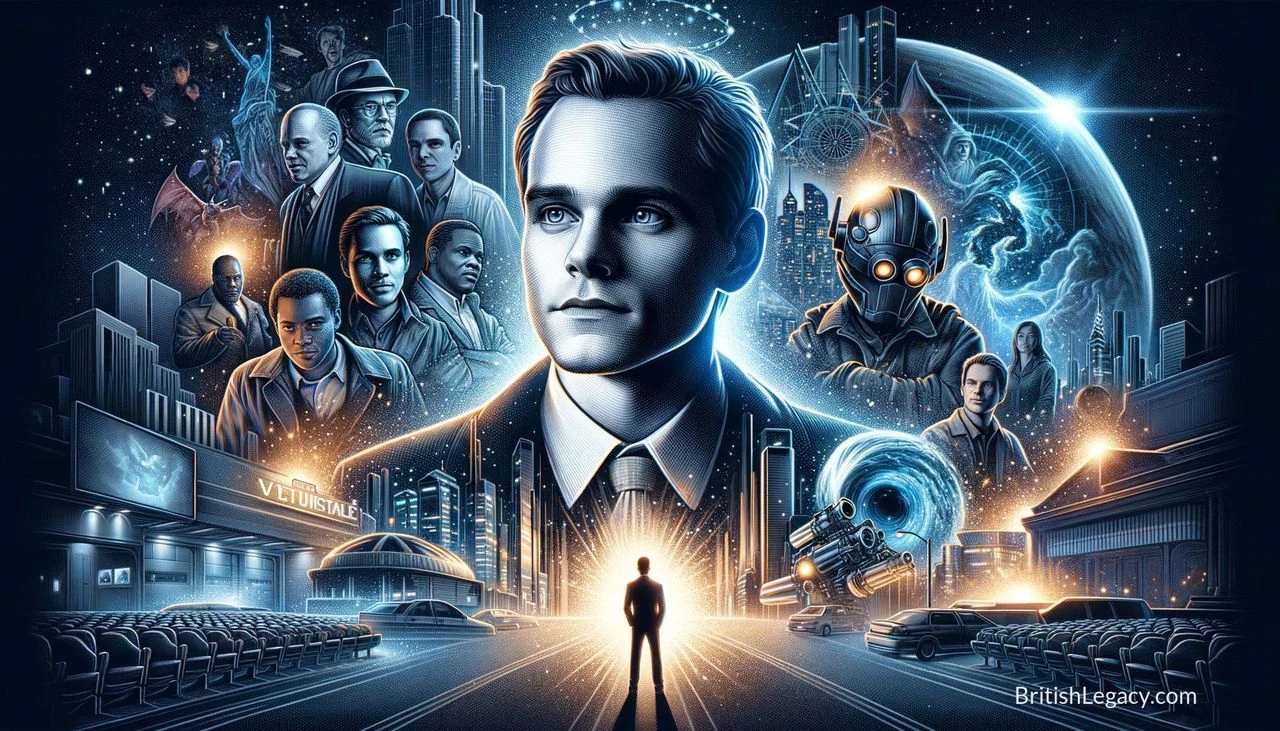
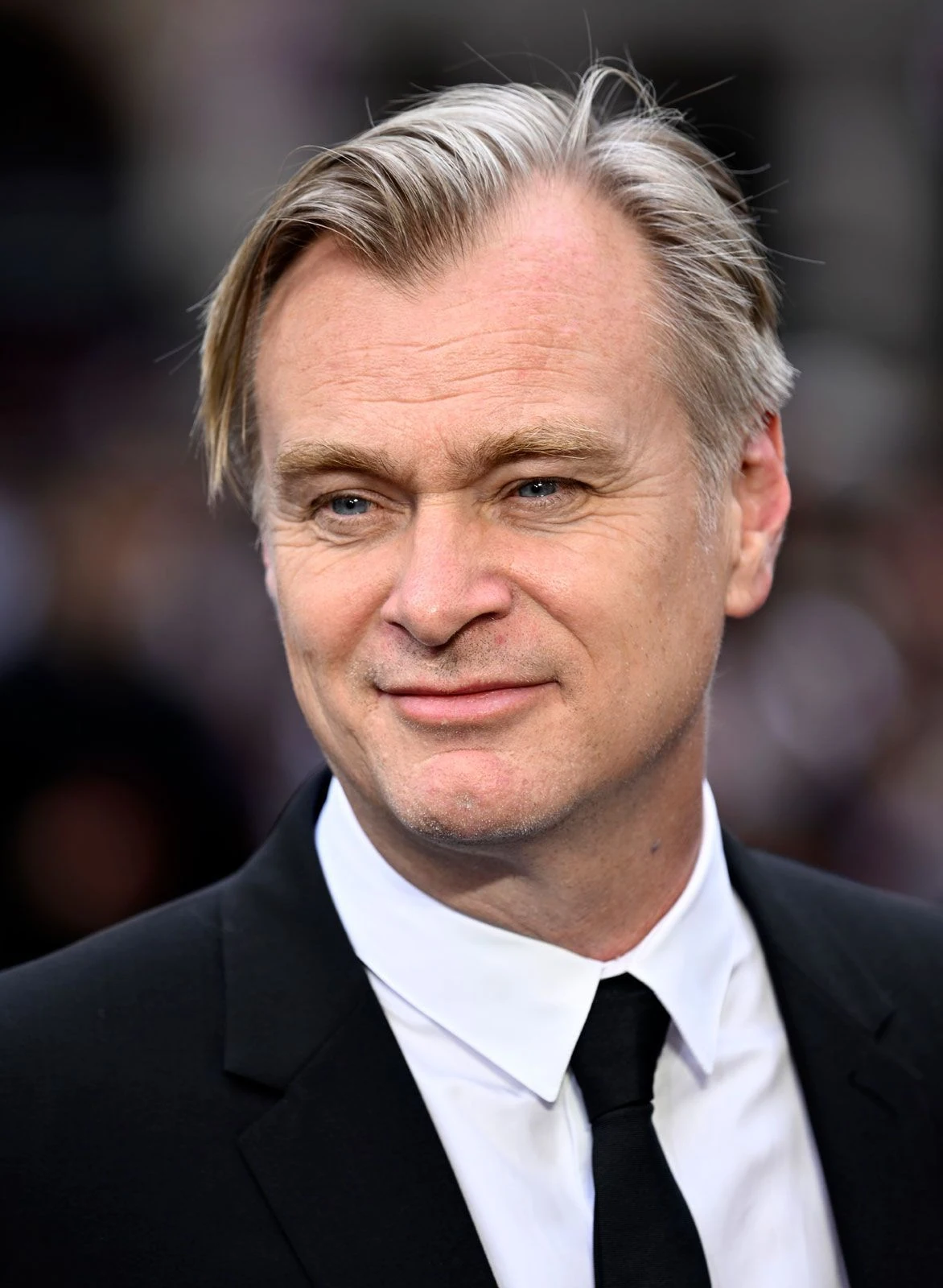
Christopher Nolan’s career spans two kinds of filmmaking that are often treated as opposites: resourceful independent production and the large-scale Hollywood event. He made his first feature, Following, with a small crew and a budget of around £3,000, shooting on weekends over the course of a year. More than two decades later, Oppenheimer won him Academy Awards for directing and best picture. Across that journey, he has built a distinctive body of work around fractured chronology, memory and time, while continuing to argue for film projection and theatrical exhibition.
Learning to make films at UCL
Born in Westminster, London, on 30 July 1970, Nolan grew up between London and Evanston, Illinois, where his American mother’s family lived. He began making films as a child, borrowing his father’s Super 8 camera and using toys and homemade sets. As a teenager, he made films with Adrien and Roko Belic; he and Roko co-directed the surreal short Tarantella in 1989.
Nolan studied English literature at University College London, graduating in 1993. UCL was also a practical choice: its Film Society had 16 mm cameras and a Steenbeck editing suite. Nolan became the society’s president. He and fellow member Emma Thomas screened 35 mm films during term time and used the money to make 16 mm films in the summers. Thomas would become his producing partner as well as his wife.
After university, Nolan worked as a script reader, camera operator and director of corporate and industrial films. He made short films with limited equipment, including Larceny (1996) and Doodlebug (1997). His feature debut, Following (1998), was written, directed, photographed and edited by Nolan. Its story follows a young writer who trails strangers through London. Made with friends, many of them working without pay, it depended on careful rehearsal and weekend filming to make the most of limited resources.
The film’s festival reception helped Nolan secure the opportunity to make Memento (2000), the breakthrough that brought him wider attention. Its central character has anterograde amnesia and uses notes and tattoos to pursue his wife’s murderer; its reverse-chronological structure makes the audience work alongside him to establish what can be trusted. Nolan developed the screenplay from an idea by his brother Jonathan. He followed it with Insomnia (2002), a studio thriller starring Al Pacino, Robin Williams and Hilary Swank.
Reworking the studio blockbuster
In 2005, Nolan directed Batman Begins, a new account of the character’s origins that grounded the comic-book world in a recognisable setting. The film revived the franchise and established the direction of his trilogy, completed by The Dark Knight (2008) and The Dark Knight Rises (2012). With Christian Bale as Bruce Wayne, the films explored fear, justice and the use of power through crime stories on an increasingly large canvas.
The Dark Knight was a landmark in Nolan’s use of large-format cameras: it became the first major motion picture to use high-resolution IMAX cameras. Its combination of urban crime drama and superhero spectacle, and Heath Ledger’s performance as the Joker, drew wide attention. Ledger received a posthumous Academy Award for best supporting actor. The film’s commercial success and influence helped make Nolan’s version of the superhero film a reference point for later productions, although the trilogy’s gritty realism was not always successfully imitated.
Between the Batman films, Nolan made The Prestige (2006), a story of rival magicians adapted from Christopher Priest’s novel. Inception (2010) turned an idea he had developed over several years into a studio-scale science-fiction thriller about entering and shaping other people’s dreams. Its layered structure brought a complex premise to a broad audience, while its success showed that a blockbuster could demand close attention without giving up spectacle.
Interstellar (2014), built around scientific theories associated with physicist Kip Thorne, sent its characters through a wormhole in search of a future for humanity. Nolan’s subsequent films took different routes through history and time. Dunkirk (2017) portrays the evacuation of Allied troops from France in 1940 through three interlocking strands, using relatively little dialogue. Tenet (2020), released during the Covid-19 pandemic, made time reversal the organising device of a globe-spanning action story. Its reception was divided, but its technical ambition and formal experimentation remained characteristic of Nolan’s work.
Film as a craft and a public experience
Nolan’s methods are part of the story as much as his subjects. He has favoured practical effects, miniatures and in-camera techniques, and has continued to shoot on celluloid and use IMAX cameras rather than treating digital production as the only route to large-scale filmmaking. These choices do not remove computer-generated imagery from his films; they reflect a preference for combining effects and physical production methods, and for designing work to be experienced on a cinema screen.
His interest in film history has also extended beyond his own productions. In 2015, he made Quay, a short documentary about the filmmakers Stephen and Timothy Quay, and organised theatrical screenings of their work. That year he and visual artist Tacita Dean convened a discussion on the future of film with people from archives, laboratories and cinemas. Nolan joined the board of The Film Foundation, which works on film preservation, and served on the US National Film Preservation Board. In 2018, he presented a new 70 mm print of Stanley Kubrick’s 2001: A Space Odyssey, made from the original camera negative.
His own films continued to expand in scale. Oppenheimer (2023), about physicist J. Robert Oppenheimer and the development of the atomic bomb, was his first feature distributed by Universal Pictures after he left Warner Bros. The film received widespread acclaim and won Nolan Academy Awards for best director and best picture. His next feature, The Odyssey (2026), adapted Homer’s epic and was filmed entirely with IMAX 70 mm cameras. It continued his interest in making major studio productions whose technical form is designed for theatrical presentation.
Recognition and British ties
Nolan’s achievements have been recognised on both sides of the Atlantic. He received an honorary fellowship from UCL in 2006 and an honorary doctorate in 2017. He was appointed a Commander of the Order of the British Empire in 2019 for services to film, and was made a knight bachelor in 2024 for his contributions to film. The British Film Institute awarded him its Fellowship in 2024, citing his contribution to cinema. His career also retains a practical connection to British film culture: UCL’s facilities and student Film Society helped him learn the craft and make the short films that preceded his professional career.
Nolan and Emma Thomas have worked together across his films since the early stages of his career. They founded the production company Syncopy in 2001. Their partnership links the small-scale production of his early work with the planning and oversight required for international studio films. Nolan was elected president of the Directors Guild of America in 2025, a role reflecting his position within the wider film industry, alongside his work as a director and producer.
Why Christopher Nolan deserves a place in British Legacy
Nolan’s place in British Legacy rests on more than his international success. His beginnings are rooted in a recognisably British route into filmmaking: studying English at UCL, using the university’s Film Society equipment, and making short films with limited resources before producing Following on weekends with friends. That early work did not simply precede his Hollywood career; it established a way of working in which narrative design, editing and practical production remained closely connected. The move from a low-budget London feature to films watched around the world demonstrates how skills developed in a British educational and student-film setting could travel into the centre of commercial cinema.
His wider contribution is also concrete. Films such as Memento, The Dark Knight, Inception and Dunkirk have brought structural experimentation into popular genres, giving audiences stories that combine scale with questions about memory, identity, time and ethics. His work on preservation, his advocacy for analogue film and IMAX, and his efforts to bring the Quay brothers’ films to theatrical audiences show a sustained interest in cinema as both an art form and a material craft. These achievements connect his individual career to British film education and to a wider culture of making, exhibiting and preserving films. They offer a specific legacy: ambitious filmmaking can reach a mass audience without abandoning formal invention or the conditions that make cinema distinctive.
Sources
Christopher Nolan — Wikipedia, revision 1379543683 · Christopher Nolan — Wikipedia
Adapted in part from Christopher Nolan by Wikipedia contributors, under CC BY-SA 4.0. Text has been edited and combined with the existing article; this adapted text is shared under the same licence. Contributor history.