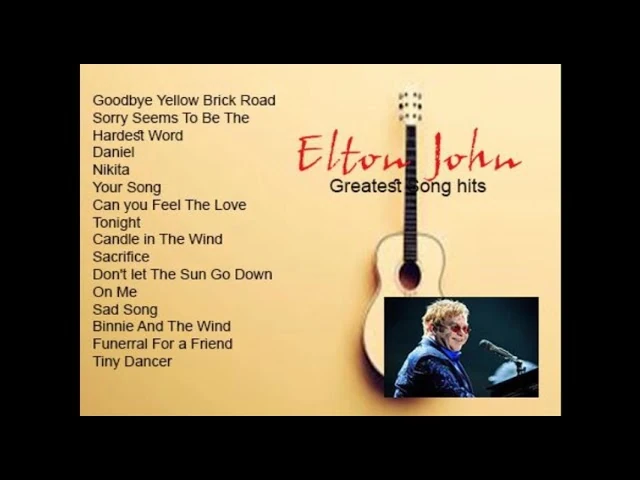
Elton John’s career began not with feathers or stadiums but with a piano in Pinner. Born Reginald Kenneth Dwight on 25 March 1947, he learnt quickly, studied at the Royal Academy of Music and then put that training to work in pubs, music publishing and a working band. The scale of his later fame was extraordinary; the craft beneath it was built through practice and performance. With lyricist Bernie Taupin, he made piano-led songs that could be intimate, theatrical, funny or elegiac, and carried them from the recording studio into film, theatre and public life.
His British story is evident in the places and institutions through which his work travelled: musical education in London, the songwriting trade, the West End, Watford Football Club and honours for music and charity. Across a career spanning several decades, John has repeatedly found ways to put familiar songs beside new collaborations and forms. The flamboyant image was part of the appeal, but it was melody, musicianship and a durable partnership that gave the spectacle its staying power.
A musical education put to work
Dwight grew up in Pinner, where he began playing his grandmother’s piano as a young boy. He showed a gift for picking out music by ear and started formal piano lessons at seven. At 11, he won a junior scholarship to the Royal Academy of Music, attending Saturday classes in central London. He studied works by composers including Bach and Chopin and sang in the choir, but left the academy before taking his final examinations. The scholarship gave him a grounding in musical technique; it was not the end of his education as a performer.
As a teenager he took a job playing piano at the Northwood Hills Hotel, performing popular songs as well as his own compositions. He also joined Bluesology, a band that backed touring American soul and rhythm-and-blues performers. By day, he ran errands for a music publisher; by night, he played gigs. This was a practical apprenticeship in the demands of popular music: learning repertoire, working with other musicians and playing to audiences in rooms far removed from the arena stages that would come later.
In 1967, Dwight answered an advertisement placed by Liberty Records’ A&R manager, Ray Williams. Williams gave him an envelope of lyrics written by another applicant, Bernie Taupin. Dwight set the words to music and sent the song back; the exchange began a partnership that would last for decades. He took his professional name from Bluesology members Elton Dean and Long John Baldry, and legally changed his name to Elton Hercules John in 1972.
Two writers, a piano and a distinctive sound
The division of work between John and Taupin helped shape their songs. Taupin generally wrote the lyrics separately and sent them to John, who composed the music. Their different approaches gave the partnership room to range: words with vivid characters and settings met melodies capable of tenderness, momentum or full-scale release. The songs were not the product of a conventional co-writing session in which both partners sat together at the same instrument. That separation became a lasting working method rather than an obstacle.
Your Song, released in 1970, brought the partnership to a wider audience. It established a quality that would recur throughout John’s work: a strong, accessible melody without sacrificing a sense of intimacy. On Tumbleweed Connection, Tiny Dancer and Rocket Man, the writing moved through different moods and musical landscapes. John’s piano was not simply accompaniment. It could set the rhythm, carry the drama and give a song its identity before the vocal had fully begun.
That emphasis mattered in a popular music landscape whose mythology often placed the guitar at its centre. John made the piano a lead instrument for rock and pop, one capable of driving a band as forcefully as it could support a ballad. His music drew on pop, rock, soul and gospel, while his formal training informed the harmonic choices without turning the songs into exercises. The result was a body of work in which technical skill and immediate appeal could coexist.
The extraordinary run of the 1970s
John’s rise accelerated in the early 1970s. Honky Château was his first US number-one album, and its songs included Rocket Man. Don’t Shoot Me I’m Only the Piano Player followed, then Goodbye Yellow Brick Road, the double album that brought together hit singles and longer, more expansive pieces. Caribou, Captain Fantastic and the Brown Dirt Cowboy and Rock of the Westies continued a remarkably productive sequence.
The records did not merely repeat a successful formula. Rocket Man used the image of space travel to explore distance and duty; Bennie and the Jets played with the sound and artifice of pop stardom. Goodbye Yellow Brick Road balanced grandeur with a sense of looking back. The songs held their shape amid the elaborate costumes and increasingly large performances because the melodies were strong enough to carry the show.
John’s image became part of that public performance. Glam-influenced clothes, platform boots and theatrical costumes enlarged the visual scale of the concerts, but the piano and songs remained their centre. His stage presence could be exuberant without making the music secondary. The contrast between extravagant presentation and carefully made songs was not a contradiction; it was one of the ways he made the performance distinctive.
One song acquired a second and very different public life. First released in 1973, Candle in the Wind was rewritten in 1997 by Taupin to honour Diana, Princess of Wales. John performed the new version at her funeral in Westminster Abbey. It became the best-selling single in UK chart history, and proceeds went to Diana’s charities through the Diana, Princess of Wales Memorial Fund. Its place in a moment of public mourning showed how a song from his earlier catalogue could be reshaped for a national occasion.
From the recording studio to stage and screen
John’s work beyond pop recordings demonstrated that his gift for melody could serve a story as well as a single. With lyricist Tim Rice, he wrote songs for Disney’s animated film The Lion King. Can You Feel the Love Tonight won the Academy Award for Best Original Song in 1995. John and Taupin later won the same award for (I’m Gonna) Love Me Again, written for the film Rocketman. The film, released in 2019, dramatised John’s life and career, with Taron Egerton playing him.
Musical theatre offered another setting for his writing. John and Rice’s Aida won the Tony Award for Best Original Score. For Billy Elliot the Musical, John composed music for a stage adaptation of the British film, working with playwright Lee Hall. The London production opened in 2005 and ran until 2016. Its success showed that John could write for character and dramatic development as well as for the self-contained structure of a pop song.
He continued to work with other musicians across generations and styles. In 2021, The Lockdown Sessions brought him together with a range of collaborators, including younger artists. The project recalled his early experience as a session musician, but it also extended his career-long willingness to place his piano and voice in new musical surroundings. In 2025, he released Who Believes in Angels?, a collaborative album with Brandi Carlile.
His farewell tour concluded in Stockholm in July 2023, after more than 300 concerts around the world. The end of touring did not mark the end of his public appearances or musical work. His career has repeatedly moved between periods of large-scale performance and new collaborations, rather than depending solely on the recreation of its most successful years.
Public work, Watford and recognition
John’s use of his public profile has extended well beyond music. He founded the Elton John AIDS Foundation in 1992, after the deaths of his friends Ryan White and Freddie Mercury. The foundation funds HIV-related programmes, including prevention and support for people living with or at risk of HIV, and works against prejudice and discrimination. The organisation gave his charitable involvement an enduring structure, rather than limiting it to occasional benefit performances. John has also raised funds through events, including the Academy Awards party he began hosting in 1993.
Football gave his public life a particularly local focus. A supporter of Watford Football Club since youth, John became its chairman and director in 1976 and appointed Graham Taylor as manager. During their time at the club, Watford rose through the divisions, finished runners-up in the First Division in 1983 and reached the 1984 FA Cup Final. John sold the club in 1987 but remained president, later returning as chairman from 1997 to 2002. He is an honorary life president. His involvement linked personal allegiance to sustained investment and a defining period in the club’s history.
Recognition for his work has come from musical and civic institutions. John was appointed a Commander of the Order of the British Empire in 1995 and knighted in 1998 for services to music and charity. In 2020 he became a Member of the Order of the Companions of Honour. He has also supported musical education through scholarship funding at the Royal Academy of Music, the institution where his own formal training began.
Why Elton John deserves a place in British Legacy
Elton John deserves a place in British Legacy because he widened the possibilities of British popular music through a recognisable combination of musicianship, songwriting and performance. His piano was not a decorative addition to a singer’s act: it was the driving instrument and dramatic centre of his music. The partnership with Bernie Taupin gave that musical force a distinctive body of songs, from the delicacy of Your Song to the scale of Goodbye Yellow Brick Road. Their method sustained creative work across decades, while John’s command of the stage made the songs legible to audiences on an ever larger scale.
His contribution also reaches beyond the record and concert hall. Work for The Lion King, Aida and Billy Elliot the Musical carried his writing into film and theatre; his involvement with Watford connected national celebrity to a football club and its supporters. The Elton John AIDS Foundation turned public attention and fundraising into continuing work on HIV-related programmes. His support for Royal Academy of Music scholarships connects his own early opportunity with opportunities for other students. These are specific, lasting parts of his British legacy: songs that entered public life, music made for several forms, commitment to a local club and organised charitable work that reaches far beyond the stage.
Sources
Elton John — Wikipedia, revision 1375699285
Adapted in part from Elton John by Wikipedia contributors, under CC BY-SA 4.0. Text has been edited and combined with the existing article; this adapted text is shared under the same licence. Contributor history.