
Eric Clapton’s place in British music rests on more than a celebrated guitar sound. Born in Ripley, Surrey, in 1945, he came up through the clubs and bands of the British rhythm-and-blues scene, bringing an intense study of American blues into music that reached a far wider audience. With the Yardbirds, John Mayall’s Bluesbreakers and Cream, he helped make the electric guitar a more forceful and expressive presence in British rock. Later, as a member of Derek and the Dominos and as a solo artist, he showed that a quieter, song-led approach could carry equal weight.
His career has included major reinventions, international honours and a long relationship with London’s Royal Albert Hall. It has also included addiction, personal tragedy and public conduct that deserves to be recorded plainly. Alongside his music, the Crossroads Centre in Antigua gives his experience of recovery a practical legacy.
Learning the blues in Surrey
Clapton was born Eric Patrick Clapton on 30 March 1945. His early family life was complicated: he grew up believing that his grandparents were his parents and that his mother was his older sister. He received an acoustic guitar for his thirteenth birthday, but its steel strings made it difficult to play and he soon lost interest. Two years later he returned to it, practising for long hours and learning blues chords by playing along with records. He recorded his practice on a reel-to-reel machine and listened back repeatedly.
That patient work formed part of an education outside the conventional music-school route. In 1961, after leaving Hollyfield School in Surbiton, he studied at Kingston College of Art. He was expelled at the end of the academic year because his attention had remained on music. He began busking around Kingston, Richmond and London’s West End, and in 1962 performed in pubs around Surrey with fellow blues enthusiast Dave Brock. In 1963 he joined the Roosters, an early British rhythm-and-blues group, and later that year played a short run of gigs with Casey Jones and the Engineers.
Clapton joined the Yardbirds in October 1963. The group played American blues material and became part of the live circuit around Richmond, where it took over the Rolling Stones’ residency at the Crawdaddy Club. Its repertory and his playing drew on Chicago blues and guitarists including Buddy Guy, Freddie King and B.B. King. He appeared with the Yardbirds at the Royal Albert Hall for the first time on 7 December 1964, a venue that would become a recurring setting throughout his career.
The Yardbirds’ first major hit, “For Your Love”, marked a move towards pop. Clapton, devoted to blues rather than the band’s new direction, left in March 1965. His departure was an early sign that commercial success alone would not determine his choices. His nickname, “Slowhand”, came from the slow handclapping audiences used while he changed a broken guitar string on stage; the band’s manager, Giorgio Gomelsky, turned the expression into a name.
The Bluesbreakers and Cream
Clapton joined John Mayall’s Bluesbreakers in 1965, left briefly, then returned that autumn. By the time he departed in July 1966, he had become one of the best-known blues guitarists on the British club circuit. The album Blues Breakers – John Mayall – With Eric Clapton was released after he had left. Fans called it the Beano album, after the comic Clapton is shown reading on its cover. Its concentrated, amplified guitar sound became an influential reference point for British blues rock.
Clapton had moved from a Fender Telecaster and Vox AC30 to a Gibson Les Paul and Marshall amplifier. The combination gave his playing a thick, sustained overdrive, and the response from fans was captured in the graffito “Clapton is God”. The slogan was extravagant, but it reflected the attention his sound was commanding. His musicianship was rooted in Black American blues, and the British scene’s engagement with that tradition shaped his early work.
In 1966, drummer Ginger Baker invited Clapton to join a new group with bassist and singer Jack Bruce. Cream became one of the early supergroups, combining blues-based songs with loud performances, extended improvisation and the contrasting strengths of its three members. Its records ranged from compact rock songs to lengthy live explorations. “Sunshine of Your Love” and “White Room” became enduring examples of the group’s studio work; its live version of Robert Johnson’s “Crossroads” showed how far the trio could stretch a blues composition.
Cream’s success was international, but the band lasted only 28 months. Tensions between Bruce and Baker, alongside the pressures of the group’s life on the road, contributed to its end in 1968. Clapton’s musical world was also changing. The arrival of Jimi Hendrix in London brought a striking new approach to the guitar, and Clapton, like other leading musicians in the capital, saw him perform. Rather than work in isolation, Clapton’s development took place amid exchange and competition between musicians.
His connection to George Harrison also produced important work beyond his own bands. He played the lead guitar solo on the Beatles’ “While My Guitar Gently Weeps” and co-wrote “Badge” with Harrison for Cream. Their friendship continued, and Clapton later served as musical director for the 2002 Concert for George at the Royal Albert Hall.
Finding another role: Derek and the Dominos
After Cream, Clapton formed Blind Faith with Baker, Steve Winwood and Ric Grech. The group made one album and undertook a tour before breaking up. Clapton then toured with Delaney and Bonnie and Friends, whose encouragement helped him develop as a singer and songwriter. His first solo album, Eric Clapton, followed in 1970, drawing on the group’s musicians and a wider circle of session players.
For Derek and the Dominos, Clapton wanted to work as part of an ensemble rather than make every performance a showcase for a guitar star. The group’s album, Layla and Other Assorted Love Songs, was recorded in 1970 and built around blues-influenced songs and interlocking guitars. Duane Allman’s slide playing became an important part of its sound. The title track moves from its urgent opening riff and pleading vocal into a contrasting piano coda, making the arrangement itself part of the song’s emotional force.
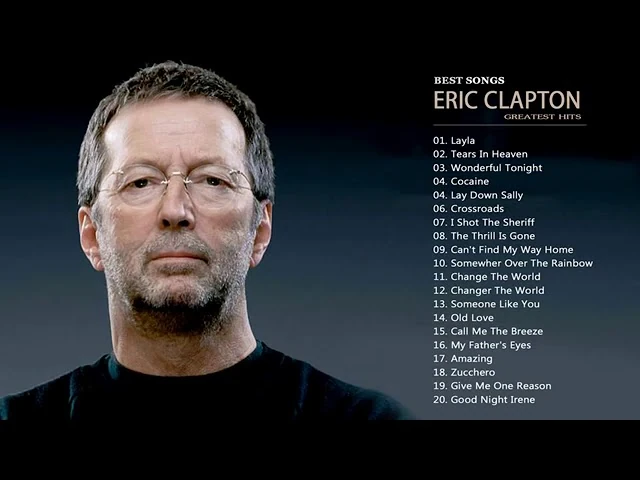
Clapton’s solo career continued through the 1970s with a shift towards songs, groove and space. 461 Ocean Boulevard (1974) took a less guitar-dominated approach than his earlier work. Its cover of Bob Marley’s “I Shot the Sheriff” became a major hit, helping bring reggae to a much larger pop and rock audience. Slowhand (1977), which included “Wonderful Tonight”, further demonstrated his ability to make restraint a feature rather than a retreat.
Another turning point came after the death of his son Conor in 1991. Clapton and Will Jennings wrote “Tears in Heaven” following the loss. His 1992 Unplugged performance presented a different side of his music: acoustic arrangements that altered familiar material without relying on the amplified sound associated with his early reputation. At the 35th Grammy Awards, he received six awards connected to “Tears in Heaven” and Unplugged, including Song of the Year and Album of the Year. The success marked both the reach of the music and the possibility of reinvention late in a long career.
A stage, a centre and a complicated record
The Royal Albert Hall provides a particularly clear thread through Clapton’s British career. His first appearance there was with the Yardbirds in 1964; over the decades that followed, he played there more than 200 times. In 2018 he became one of the first recipients of a star on the Hall’s Walk of Fame. The venue’s scale and history contrast with his beginnings on the club circuit, but the continuity matters: he carried a music formed in small rooms onto one of Britain’s best-known stages.
Clapton has also used his public profile to support recovery services. In 1998, drawing on his own experience of addiction and recovery, he founded the Crossroads Centre in Antigua as a treatment centre for people with substance-abuse problems. He has supported it through fundraising, including the Crossroads Guitar Festival and auctions of instruments from his collection. This work gives his personal history a practical dimension: the money and attention generated by his career have helped sustain a place intended to assist other people seeking treatment.
That account must sit alongside an episode that has had consequences beyond Clapton himself. In 1976, he made racist remarks from the stage at a concert in Birmingham and voiced support for the politician Enoch Powell. The outburst helped spur the creation of Rock Against Racism, which brought anti-racist politics into British music culture through concerts and campaigning. In 2018 Clapton said he was disgusted with his earlier remarks. The episode remains part of his public record, particularly because his musical career was built in close engagement with Black American music. It should neither erase his musical achievements nor be softened into a harmless footnote.
Recognition for Clapton’s work includes 18 Grammy Awards, the Brit Award for Outstanding Contribution to Music, four Ivor Novello Awards and a CBE for services to music in 2004. He is the only person inducted into the Rock and Roll Hall of Fame three times: as a solo artist and as a member of both the Yardbirds and Cream. His recording career has continued into the 2020s, with Meanwhile released in 2024.
Why Eric Clapton deserves a place in British Legacy
Eric Clapton deserves a place in British Legacy because his career helps explain how British musicians made blues a central language of modern rock. He did not invent the music he played: its roots and traditions came from Black American musicians whose work he studied closely. His significance lies in what happened as that music travelled through British clubs, recording studios and bands. The Beano album established a powerful model for blues-rock guitar; Cream expanded the possibilities of a rock trio through volume and improvisation; and Layla, Slowhand and Unplugged show how the same musician could put songs and arrangements ahead of sheer display. These distinct phases make his work a useful record of British popular music changing across several decades.
His legacy is also tangible beyond recordings. The Royal Albert Hall relationship links a guitarist who began in the rhythm-and-blues circuit to one of Britain’s great public stages. The Crossroads Centre, meanwhile, represents a sustained effort to turn his experience of recovery and the drawing power of his fame into support for people dealing with addiction. A responsible account must include the harm and contradiction in his public record, including the racist remarks that helped prompt Rock Against Racism. Remembering Clapton honestly means recognising both the musical influence and the limits of celebrity as a moral example. British Legacy can preserve that complexity while explaining why his work changed what British rock could sound like.
Sources
Eric Clapton — Wikipedia, revision 1375224230
Adapted in part from Eric Clapton by Wikipedia contributors, under CC BY-SA 4.0. Text has been edited and combined with the existing article; this adapted text is shared under the same licence. Contributor history.
_(cropped).jpg)