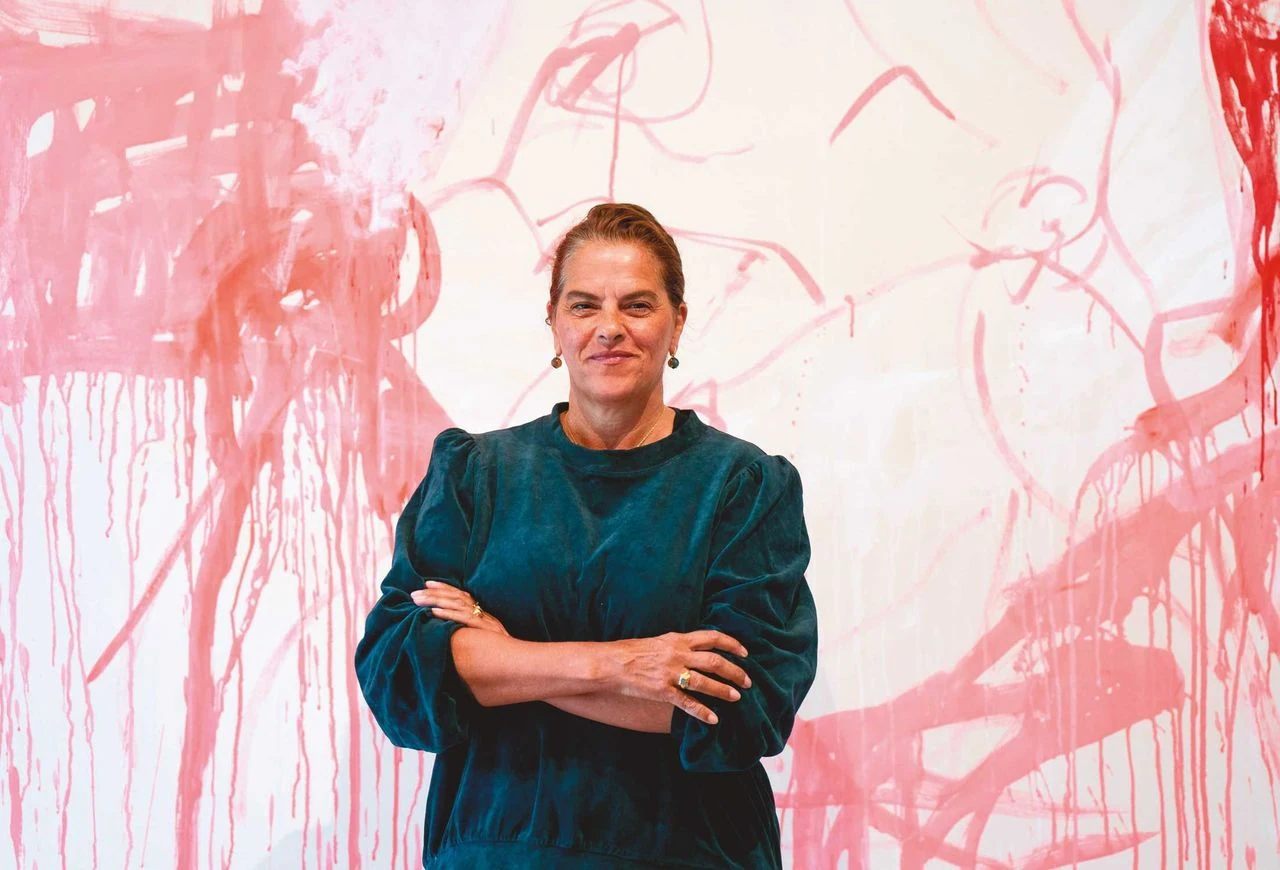
Tracey Emin’s art makes autobiography impossible to separate from its materials. A bed, a sewn name, a line of neon or a hurried drawing can carry the weight of memory, desire, grief and embarrassment. Her practice has ranged from film and photography to sculpture, painting and textiles, but its recurring subject is the attempt to give personal experience a public form. That approach brought her into the orbit of the Young British Artists and, in 1999, to the Turner Prize shortlist for My Bed.
Margate, Maidstone and an artist’s voice
Born in Croydon in 1963, Emin grew up in Margate, Kent, with her twin brother. She studied fashion at Medway College of Design before moving on to printmaking at Maidstone College of Art, where she graduated with a first-class degree. In 1987 she went to London to study painting at the Royal College of Art, completing her MA in 1989. She later studied philosophy at Birkbeck, University of London.
Her early work and the places she lived in became material for a practice that resisted a neat division between life and art. In 1993, she and fellow artist Sarah Lucas opened The Shop in Bethnal Green, selling their work and running a life-drawing room. That November, Emin held her first solo exhibition at White Cube. My Major Retrospective assembled photographs, images of paintings she had destroyed and personal objects; it established a method of treating her own history as something to select, arrange and show.
In 1995, Emin made Everyone I Have Ever Slept With 1963–1995, a tent bearing appliquéd names. Its title invited assumptions, while the names included sexual partners and people with whom she had shared a bed as a child, including family members. The work entered the 1997 Sensation exhibition at the Royal Academy in London and travelled to Berlin and New York. It was destroyed in the 2004 Momart warehouse fire, along with the beach-hut sculpture The Last Thing I Said to You Is Don't Leave Me Here.
My Bed and public recognition
Emin became widely known after appearing on the live Channel 4 discussion programme Is Painting Dead? in 1997. Two years later, she was shortlisted for the Turner Prize and showed My Bed at the Tate Gallery. The installation presented her unmade bed and the objects surrounding it after a period of severe emotional distress. Its domestic materials drew intense attention, but the work’s force lies in more than its capacity to provoke: it makes the bedroom a setting for an account of vulnerability, without separating the physical traces of a life from the artwork.
Autobiographical film offered another way to address the relationship between memory and public judgement. In Why I Never Became a Dancer (1995), Emin narrated her adolescence in Margate and ended with herself dancing. Top Spot (2004), a feature-length film combining digital video and Super 8 footage, returned to adolescence and the passage into adult life. Her work does not rely on one medium or one fixed account. Monoprints, paintings, photographs, sewn textiles, neon and installations each let her handle personal material differently.
In 2007, Emin represented Britain at the Venice Biennale with Borrowed Light, an exhibition of new and earlier works at the British Pavilion. It brought together needlework, photographs, film, drawing, painting, sculpture and neon. The presentation carried her practice beyond the British art scene while retaining its distinctive mix of handmade forms and direct, autobiographical language. In the same year, she became a Royal Academician; in 2011, the Royal Academy appointed her Professor of Drawing.
Teaching, institutions and Margate
Emin’s role as Professor of Drawing connected her public standing to a major British art institution. She has also lectured at the Royal Academy, Tate Britain and the Victoria and Albert Museum. In 2012, she produced a poster and limited-edition print for the London Olympic and Paralympic Games, one of 12 British artists selected, and carried the Olympic torch through Margate.
Her relationship with Margate has continued through work and practical support for artists. After living in Spitalfields, east London, she returned to the Kent town, where she funds TKE Studios, providing workspace for aspiring artists. In 2023, she opened studios offering affordable professional space and established the Tracey Emin Artist Residency programme. These initiatives make her connection to the place where she grew up more than a biographical detail: they create opportunities for other artists to work there.
Charitable activity has also included specific donations and fundraising. Emin gave the hand-sewn blanket Star Trek Voyager to an auction for the Elton John AIDS Foundation in 2007; it sold for £800,000. She has donated artworks to charity auctions, including the neon work I Promise To Love You, sold in 2008 to raise money for the Global Fund. In 2008, she went to Uganda to establish the Tracey Emin Library at Forest High School. These documented projects sit on firmer ground than broad claims about a general programme of advocacy: they show how she has used her work, profile and resources in particular settings.
Recognition and changing work
Emin’s career has included sustained recognition from British cultural institutions. She was appointed CBE in the 2013 New Year Honours for services to the arts and became a Dame Commander of the Order of the British Empire in the 2024 Birthday Honours for services to art. The University of Kent awarded her an honorary doctorate in 2007, and Margate made her an honorary freewoman in 2022.
Her exhibitions have continued to bring distinct bodies of work into conversation. In 2020, she selected works by Edvard Munch to show alongside her own at the Royal Academy in The Loneliness of the Soul; the exhibition was later presented at the Munch Museum in Oslo and returned to the Royal Academy in 2021. In 2024, By The Time You See Me There Will Be Nothing Left, comprising work made after her cancer diagnosis, was shown at Xavier Hufkens in Brussels. Across these projects, the materials and subjects change, while her longstanding interest in the emotional charge of personal history remains visible.
Why Tracey Emin deserves a place in British Legacy
Tracey Emin deserves a place in British Legacy because she has made a sustained contribution to contemporary British art through a practice that is both recognisable and varied. The tent, Everyone I Have Ever Slept With 1963–1995, and the installation My Bed brought autobiographical material into major public exhibitions, including the Royal Academy’s Sensation and the Turner Prize at Tate. Those works made intimate experience part of a wider debate about what could count as art, and how an artist might use the objects and language of everyday life. Her work has not been confined to a single, attention-grabbing form: film, drawing, painting, photography, textiles, sculpture and neon have all served as ways to make and share that personal record.
Her British legacy is also rooted in institutions and places. As a Royal Academician and Professor of Drawing, she has held roles within one of the country’s longstanding art institutions; as the artist chosen to represent Britain at the Venice Biennale, she presented her work in an international setting. In Margate, TKE Studios and its residency programme provide space and opportunities for other artists. Her fundraising donations and the library she established in Uganda show further, specific uses of her work and public profile. Together, these achievements connect artistic experiment with public exhibition, education and support for other makers. They give her story particular value in a British cultural history that should include not only celebrated objects, but also the ways artists shape institutions and make room for those who follow.
Sources
Adapted in part from Tracey Emin by Wikipedia contributors, under CC BY-SA 4.0. Text has been edited and combined with the existing article; this adapted text is shared under the same licence. Contributor history.