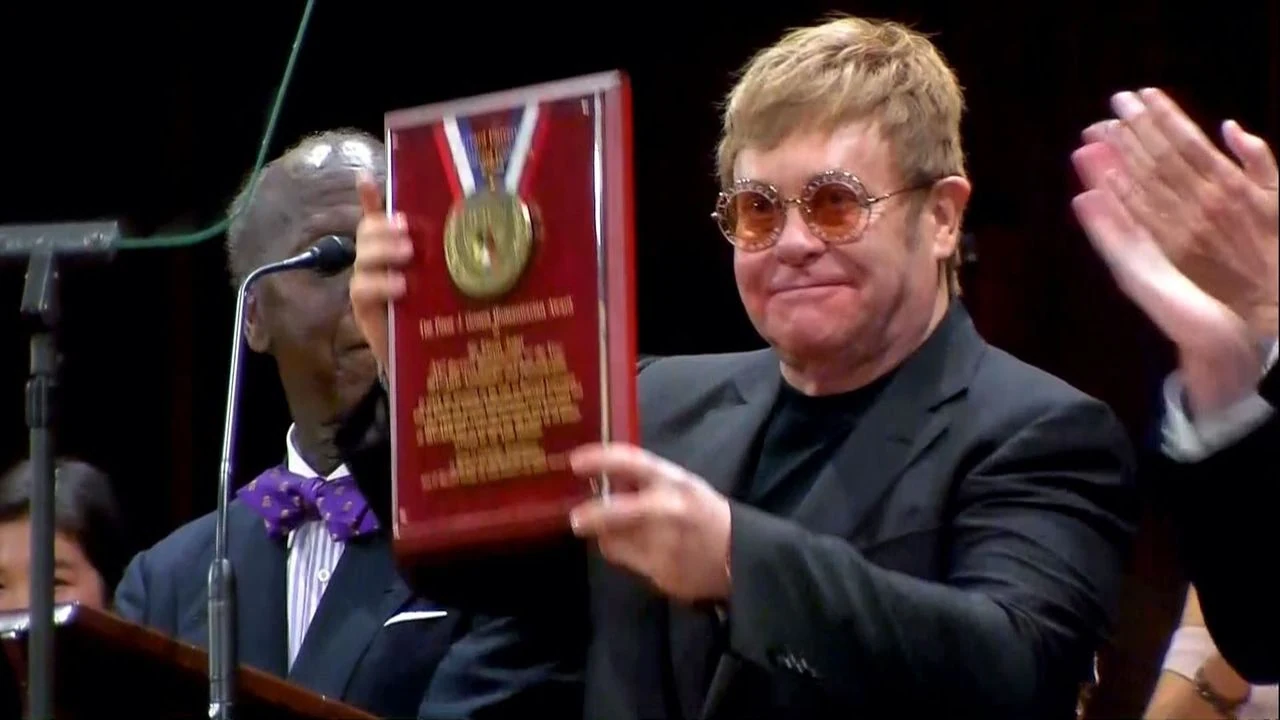
Elton John’s career has joined piano-led pop songwriting to a vivid public performance style—and, increasingly, to sustained work raising money for people affected by HIV/AIDS. Born Reginald Kenneth Dwight in Pinner, Middlesex, he learnt piano as a child, left school before his A-level examinations to pursue music and, in 1967, began the songwriting partnership with Bernie Taupin that would shape his work for decades. His songs travelled far beyond Britain; his story, and the institutions he built to support AIDS-related programmes, remain firmly connected to British music and public life.
A pianist from Pinner
Dwight grew up in Pinner, where he began playing his grandmother’s piano. He started formal lessons at seven and, aged 11, won a junior scholarship to the Royal Academy of Music. He attended Saturday classes at the academy for several years, studying classical music and singing in the choir, but left before his final examinations. At 15, with help from his mother and stepfather, he began working as a pianist at the Northwood Hills Hotel, playing popular standards and his own songs.
In 1962, he formed the band Bluesology with friends. The group later backed visiting American soul and R&B performers, and in 1966 became the supporting band for singer Long John Baldry. The stage name Elton John drew on two members of Bluesology: saxophonist Elton Dean and Baldry. He legally changed his name to Elton Hercules John in 1972.
A 1967 advertisement in the British music paper New Musical Express brought John and Taupin together. Both had answered an advertisement placed by Ray Williams of Liberty Records. Williams gave John an envelope of Taupin’s lyrics; John set them to music, beginning a collaboration that continued across more than 30 albums. Their method was distinctive: Taupin generally wrote lyrics separately and sent them to John, who composed the music. After working as staff songwriters for Dick James’s publishing company, they began writing songs for John to record.
From early singles to a catalogue of hits
John’s first album, Empty Sky, appeared in 1969. The following year, Elton John established the mixture of rock songs and ballads that would recur in his work. Its single “Your Song” became his first major hit as a singer, reaching the UK top ten and the US top ten. Early albums including Tumbleweed Connection and Madman Across the Water built on that success.
In 1972, Honky Château became his first US number-one album, with “Rocket Man” among its best-known songs. The run continued with Don’t Shoot Me I’m Only the Piano Player and Goodbye Yellow Brick Road, released in 1973. The latter brought together “Bennie and the Jets”, “Goodbye Yellow Brick Road” and “Candle in the Wind”. Its success helped establish John as a major British popular musician, while his striking costumes and elaborate performances made the concert stage part of the act.
He went on to record across changing musical eras, working with Taupin and with other songwriters and performers. Among the later milestones were the 1992 album The One, his music for Disney’s The Lion King, and his score for the stage musical Aida, created with lyricist Tim Rice. With Lee Hall, he composed the music for Billy Elliot the Musical, which opened in London’s West End in 2005. The show received four Laurence Olivier Awards, including Best New Musical.
John’s recordings have sold more than 300 million copies worldwide. His honours include five Grammy Awards, two Academy Awards, a Tony Award, two Golden Globes and a Primetime Emmy Award. The list reflects a career spanning recorded music, film and theatre, rather than a success confined to one period or medium.
Public profile and British connections
John’s relationship with British public life has included both music and football. A supporter of Watford Football Club since his youth, he became its chairman and director in 1976, appointed Graham Taylor as manager and invested in the club as it rose through the divisions. Watford finished runners-up in the First Division in 1983 and reached the FA Cup final the following year. John sold the club in 1987, later returned as chairman, and stepped down in 2002 while remaining its president. In 2014, the club named a stand at Vicarage Road in his honour.
His British honours include appointment as a Commander of the Order of the British Empire in 1995 and a knighthood in 1998 for services to music and charity. In 2013, he received the first Brits Icon award, recognising his impact on British culture. He was appointed to the Order of the Companions of Honour in 2020. He has also performed at major British occasions, including the 2012 Diamond Jubilee concert at Buckingham Palace and Glastonbury Festival in 2023.
His 1997 performance of “Candle in the Wind” at the funeral of Diana, Princess of Wales, brought a song already in his repertoire into a new public context. Taupin revised the lyrics in tribute to Diana, and proceeds from the single went to her charities through the Diana, Princess of Wales Memorial Fund. The single became one of the most widely sold in chart history. This was one of several occasions when John’s music and high public profile were channelled into fundraising.
Building the Elton John AIDS Foundation
John’s work against AIDS grew out of the deaths of people close to him, including Ryan White and Freddie Mercury. In 1985, he joined Dionne Warwick, Gladys Knight and Stevie Wonder to record “That’s What Friends Are For”; its proceeds supported the American Foundation for AIDS Research. He later visited White in hospital and performed at the teenager’s funeral. These events helped turn concern into a sustained commitment to fundraising and advocacy.
In 1992, John established the Elton John AIDS Foundation to fund HIV/AIDS prevention, challenge prejudice and discrimination, and provide services to people living with or at risk of HIV. The foundation has raised more than £300 million for HIV-related programmes in 55 countries. Its work has included supporting prevention and care, while John’s fundraising events and public appearances have helped keep the issue in view. From 1993, he hosted an annual Academy Awards party to raise money for the foundation; the event became one of Hollywood’s most prominent Oscar-season fundraisers.
John has also used concerts and other events to raise money for AIDS-related causes. His annual White Tie & Tiara Ball, held at his home in Old Windsor, combined performances and auctions for the foundation. In 2023, the foundation donated $125,000 to support the purchase of equipment intended to help people living with HIV in Ukraine access care and treatment. These examples show the range of the organisation’s work, from public fundraising to support for specific health services.
Why Sir Elton John deserves a place in British Legacy
John’s place in British Legacy rests first on the scale and reach of his musical work. From a child learning piano in Pinner to a songwriter with a catalogue spanning pop albums, film and theatre, he built an international career through a long-running creative partnership with Bernie Taupin. Songs such as “Your Song”, “Rocket Man” and “Candle in the Wind” became part of popular culture well beyond Britain. His work for The Lion King and Billy Elliot the Musical also shows how his songwriting moved between recording, cinema and the West End stage. British honours and public performances at home reflect a career that has remained closely connected to the country where it began.
His legacy also includes a practical contribution to HIV/AIDS fundraising. By establishing the Elton John AIDS Foundation, John helped create an organisation that has raised more than £300 million for programmes in 55 countries. Its support for prevention, care and efforts to challenge discrimination gives substance to the philanthropic reputation described in accounts of his career. Fundraising concerts and events have provided a route from public attention to financial support, while the foundation continues work beyond the spotlight. The combination of musical achievement, sustained giving and a British career rooted in local places and institutions makes John a distinctive subject for British Legacy: not simply a famous performer, but an artist whose influence has reached into both cultural life and organised charitable work.
Sources
Adapted in part from Elton John by Wikipedia contributors, under CC BY-SA 4.0. Text has been edited and combined with the existing article; this adapted text is shared under the same licence. Contributor history.