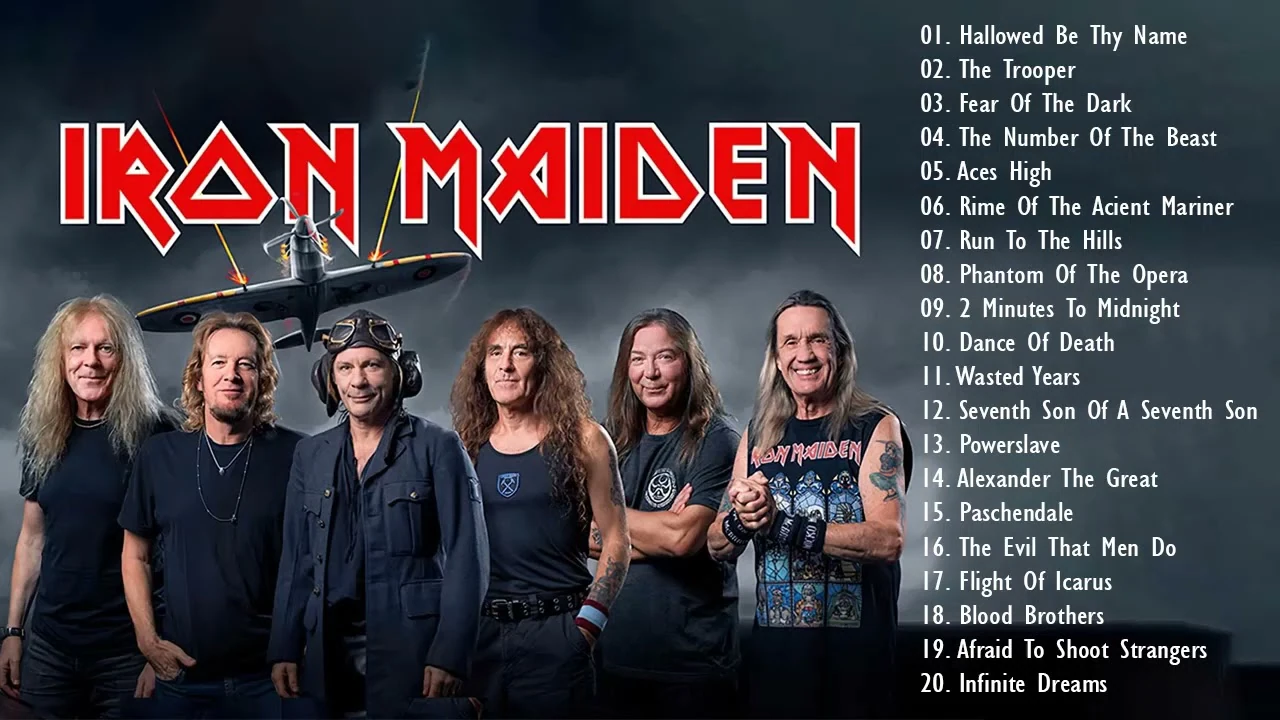
Iron Maiden began in Leyton, East London, in 1975, when bassist Steve Harris formed a band whose identity would be built through local gigs, persistent rehearsal and restless musical ambition. They became leading figures in the new wave of British heavy metal, but their achievement was not simply to make the music louder or faster. Their songs grew into intricate, often epic constructions; their lyrics turned history and literature into popular storytelling; and their performances joined music to an unmistakable visual world. The combination helped an East London band reach audiences across the globe without leaving behind the cultural materials that had shaped it.
From East London pubs to a record deal
In their early years, Iron Maiden’s line-up changed repeatedly. Harris and guitarist Dave Murray became the band’s longest-serving members, but the group’s first performances were made by musicians still finding their roles and sound. They made their live debut at St Nicks Hall in Poplar on 1 May 1976, then established a semi-residency at the Cart and Horses pub in Stratford. Those early venues mattered: the band developed in front of local audiences rather than arriving as a finished industry product.
A four-song demo recorded at the end of 1978 gave them a route into a wider heavy-metal following. Neal Kay, who ran the Bandwagon Heavy Metal Soundhouse club, played the recording there; “Prowler” rose to the top of the club’s chart, published in Sounds. The group issued three songs from the demo as The Soundhouse Tapes, selling all 5,000 copies within weeks. Rod Smallwood, who had acquired a copy, became their manager. In December 1979 the band signed with EMI, a turning point that moved them from the pub circuit towards national and international audiences.
Their self-titled debut appeared in 1980 and reached number four on the UK Albums Chart. It established the forceful early sound through songs including “Running Free”, “Phantom of the Opera” and “Iron Maiden”. The following year, Killers continued their development, with Martin Birch beginning a long association as producer. The early albums were not the finished form of the band, but they showed the strength of the songwriting and the momentum built through touring.
A defining run of albums
Bruce Dickinson joined as lead singer in 1981, replacing Paul Di’Anno, and made his recording debut with The Number of the Beast in 1982. The album became Iron Maiden’s first UK number one. Its achievement lay not only in the scale of its choruses but in the way its songs were constructed: shifts of pace and atmosphere gave the music a dramatic shape that could sustain more than a repeated riff. The band took the record on an extensive world tour, playing 188 shows in ten months.
The next albums extended that approach. Piece of Mind (1983) reached number three in the UK and included “The Trooper” and “Flight of Icarus”. Powerslave (1984) combined direct singles such as “Aces High” with the long-form adaptation “Rime of the Ancient Mariner”, drawn from Samuel Taylor Coleridge’s poem. The World Slavery Tour that followed comprised 193 shows in 28 countries over 13 months. Its schedule and production illustrated how seriously the group treated live performance: this was a touring operation as well as a series of concerts.
The band continued to experiment without abandoning the musical character they had established. On Somewhere in Time (1986), synthesised bass and guitars added layers of texture. Seventh Son of a Seventh Son (1988) took a more progressive direction, using keyboards and a concept-album structure. The changing arrangements were not a break with the band’s identity so much as an enlargement of it. Across the decade, Harris’s driving bass lines, harmonised guitars and Dickinson’s expansive singing gave the music both its momentum and its distinctive scale.
History, literature and the songs’ stories
Iron Maiden’s lyrics draw on history, war, mythology, religion, science fiction and literature. Their references are not confined to decoration: the subject often gives a song its dramatic framework. “The Trooper” takes its subject from the Charge of the Light Brigade, while “Aces High” looks to the Battle of Britain. “Rime of the Ancient Mariner” brings Coleridge’s poem into an extended metal composition. Later, “Paschendale” revisited the First World War. Such songs can be forceful without reducing their subjects to simple spectacle; they make room for atmosphere, tension and reflection as well as energy.
That range helped the band travel internationally while keeping a recognisable connection to British culture. Listeners did not need specialist knowledge to respond to the music, but a reference could lead towards a poem, historical episode or film. “The Wicker Man” drew on the British cult film of the same name, while “Brave New World” took its title from Aldous Huxley’s novel. The 1992 song “Fear of the Dark” became a regular live favourite, its subject of unease transformed into a collective chorus. Iron Maiden made their cultural material accessible through entertainment rather than turning it into a lecture.
Eddie and the live world
The band’s visual identity is inseparable from Eddie, the macabre mascot first created by artist Derek Riggs. Initially represented by a papier-mâché mask that could squirt fake blood during performances, Eddie appeared on the debut album cover and became a recurring presence across the band’s releases. The character was more than a logo: its grotesque, comic and threatening qualities gave the music a visible mythology. Album artwork, stage sets and merchandise extended that world beyond the records.
Live performance gave the band another way to build their reputation. In 1984 they took a full-scale production to Poland and other Eastern European countries, becoming the first Western artists to bring such production behind the Iron Curtain. Later, their touring plans also involved practical feats of transport. For the 2008–09 Somewhere Back in Time tour, an aircraft named Ed Force One carried the band, crew and stage equipment; Dickinson piloted it. The shows were not just a presentation of familiar songs but a demonstration of how a large, carefully organised rock production could reach audiences across continents.
Disruption and a second act
The band’s career was not an uninterrupted ascent. Guitarist Adrian Smith left in 1990, and Dickinson departed in 1993. Blaze Bayley became the singer in 1994, a change that divided listeners. The albums The X Factor and Virtual XI belong to this less settled period, but the group continued to tour and make new work. “Bring Your Daughter... to the Slaughter”, originally recorded for a film soundtrack by Dickinson’s solo project, became Iron Maiden’s only UK number-one single when released under the band’s name.
Dickinson and Smith returned in 1999, with Janick Gers remaining in the group to create a three-guitar line-up. The reunion produced more than a backward-looking celebration. Brave New World (2000) restored the expanded, progressive sound, and later albums continued to test the band’s capacity for long compositions and ambitious themes. Dance of Death (2003) included “Paschendale”; A Matter of Life and Death (2006) explored war and religion; and The Final Frontier (2010), The Book of Souls (2015) and Senjutsu (2021) carried the catalogue into a new century.
The band also remained a touring force. The 2016 Book of Souls tour visited six continents, while the Legacy of the Beast tour, begun in 2018, eventually played 140 shows to more than 3.5 million people. The Future Past World Tour ran in 2023–24. Nicko McBrain retired from touring after its conclusion, while remaining a member involved in studio projects; Simon Dawson was announced as his touring replacement. In 2025, Iron Maiden began the Run for Your Lives tour, marking the band’s fiftieth anniversary and focusing on their first nine studio albums.
Recognition at home and abroad
Iron Maiden’s public recognition grew well beyond the heavy-metal audience. They received the International Achievement Award at the Ivor Novello Awards in 2001, and “El Dorado” won the Grammy Award for Best Metal Performance in 2011 after earlier Grammy nominations. In 2009 the band won the Brit Award for Best British Live Act. These honours recorded different parts of their work: songwriting, recorded music and the scale of their performances.
Recognition also came through national cultural institutions. Royal Mail issued dedicated Iron Maiden stamps and cards in 2023. The Royal Mint released an official coin for the band’s fiftieth anniversary in 2025, featuring Eddie. In 2026, the group was inducted into the Rock and Roll Hall of Fame. The band’s history had begun in East London pubs; these honours reflected how far that local beginning had travelled, and how thoroughly heavy metal had entered the account of British popular culture.
Why Iron Maiden deserves a place in British Legacy
Iron Maiden deserve a place in British Legacy because they made a distinctive British musical tradition both ambitious and widely accessible. Formed in Leyton and developed through East London venues, the band built its reputation through music, persistence and touring rather than an image imposed from outside. Their songs carry British poetry, military history and cultural references into a form heard around the world. Coleridge, the Charge of the Light Brigade and the Battle of Britain become part of a shared musical experience, not distant subjects reserved for specialists. That achievement gives their work a particular connection to the country in which it began, while explaining why audiences elsewhere could make it their own.
Their influence is also visible in the form they helped establish: melodic and technically demanding heavy metal, written with narrative scope and staged as a complete visual world. Eddie made the band instantly recognisable; elaborate tours brought that world to audiences on an extraordinary scale. The band’s changing membership and difficult periods make the longevity more meaningful, while their post-1999 albums show that their continued success was not solely a matter of nostalgia. Their honours—from the Ivor Novello and Brit Awards to Royal Mail stamps, a Royal Mint coin and Rock Hall induction—mark a shift from subculture to national recognition. More importantly, their work continues to offer musicians a model of discipline and arrangement, and listeners a vivid meeting of history, literature, theatre and sound. Iron Maiden’s legacy is a British-made body of popular art that has travelled widely without losing its character.
Sources
Iron Maiden — Wikipedia revision 1374074697
Adapted in part from Iron Maiden by Wikipedia contributors, under CC BY-SA 4.0. Text has been edited and combined with the existing article; this adapted text is shared under the same licence. Contributor history.