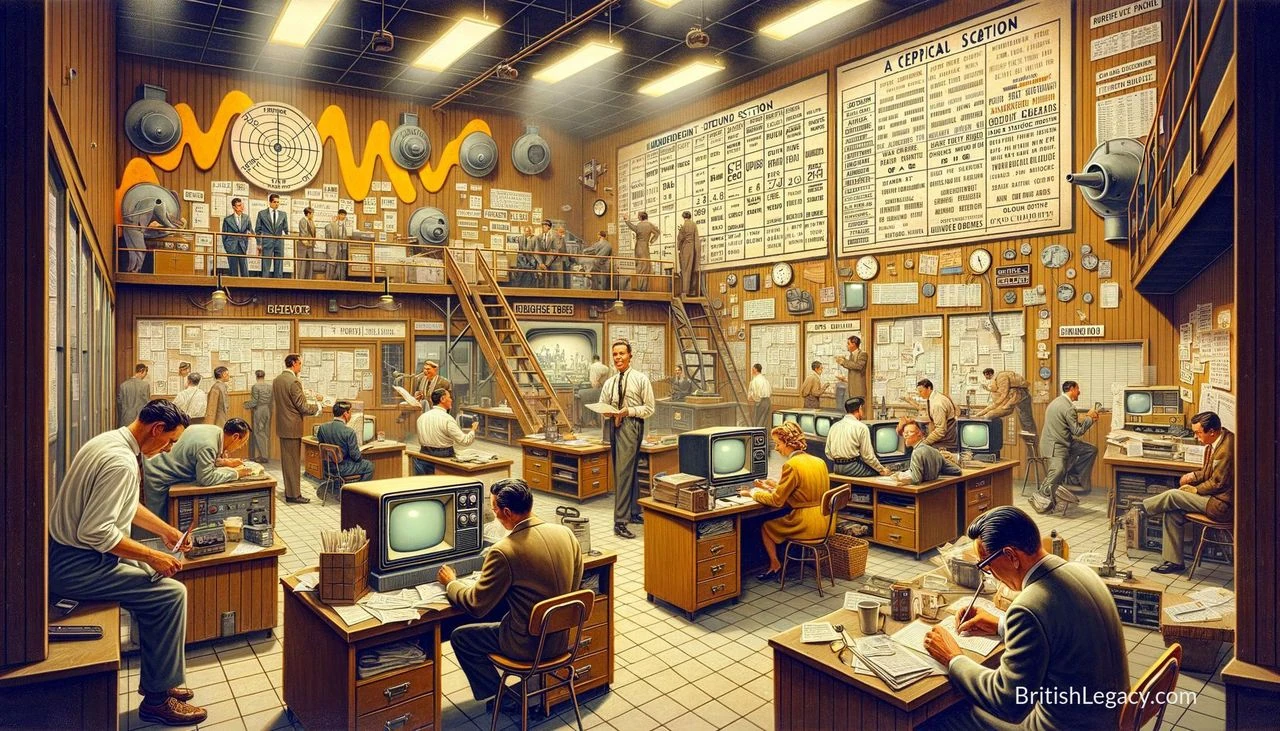
ITV did not begin as one national channel. On 22 September 1955, Associated-Rediffusion started the first Independent Television service in London, offering viewers a commercial alternative to the BBC. Other regional services followed, creating a network whose structure joined separate local broadcasters to programmes shared across the country. That combination of regional roots and national reach has shaped ITV’s story ever since.
A new model for British television
The Television Act 1954 set the framework for the change. It created the Independent Television Authority, which regulated the new industry and awarded franchises. The first six franchises were for London, the Midlands and the North of England, with separate weekday and weekend services. London’s Associated-Rediffusion went on air first; the Midlands service followed in February 1956 and the North’s in May. By 1962, services covered the country through fourteen regional stations.
Franchisees were initially independent companies. Some names associated with the early network, including Granada, ATV and Thames, became familiar to viewers, but the companies that held franchises changed through successive reviews and mergers. The network’s history is therefore not the history of one unchanging organisation. It is a story of regional operators working within a shared system, with national programmes alongside local services.
That distinction also matters when using the name ITV. The network is separate from ITV plc, the company formed in 2004 by the merger of Granada plc and Carlton Communications. ITV plc holds the Channel 3 licences across most of the UK; STV Group holds those for central and northern Scotland. Today, ITV plc commissions the network schedule centrally, while programmes are made by ITV Studios and independent production companies. STV broadcasts under its own name in its licence areas.
Franchises, regulation and consolidation
The franchise system changed over time. Reviews in 1963, 1967, 1974, 1980 and 1991 altered regions and replaced operators. Weekend franchises were largely removed in 1968, while new services included a national breakfast franchise from 1983. These changes affected not only who held a licence but how the network balanced regional identity with shared programming.
The Broadcasting Act 1990 brought another major shift. It replaced the Independent Broadcasting Authority with the Independent Television Commission and allowed companies to buy regional operators; licences were awarded by auction to the highest bidder. The system attracted criticism, including because operators could face very different payments. Consolidation followed. By 2004, Granada and Carlton together held the franchises across England, Wales, the Scottish borders and the Isle of Man, and their merger created ITV plc. Later acquisitions included Channel Television in 2011 and UTV in 2015.
The network’s organisation has continued to distinguish it from a single-channel company. Its fifteen licences cover fourteen regions, including separate weekday and weekend London licences, as well as a national breakfast licence. The majority are held by ITV plc, with STV Group responsible for the two Scottish licences. Ofcom regulates the network and awards broadcasting licences. This framework preserves a regional dimension even as scheduling and ownership have become more centralised.
Programmes shared across the country
ITV’s history is closely associated with drama and entertainment. Coronation Street began in 1960, and Emmerdale became another of the network’s long-running soaps. The supplied article also points to Brideshead Revisited as an example of ITV period drama. These contrasting titles suggest the breadth of its scripted output: continuing stories of everyday life alongside adaptations and productions set in other periods.
Entertainment has taken many forms, from game shows to reality formats. The current article names I'm a Celebrity…Get Me Out of Here! and Britain's Got Talent; the wider network history also includes formats such as Who Wants to Be a Millionaire? and The X Factor. ITV’s schedule has changed with audience tastes and competition, and it has also faced criticism over the prominence of reality television. Drama and entertainment are only part of the picture: the network has carried sports, daytime programmes and children’s output, too.
Regional programming has remained a defining feature, particularly in news. The franchise companies historically made local programmes as well as network shows. Today, regional news continues, though the amount of non-news regional output has fallen in many English regions. The names Granada Reports, Calendar and Lookaround illustrate how regional identities can persist within a more centrally organised service.
News, public service and changing platforms
Independent Television News has produced national news for the network since its launch. The original article highlights ITV News at Ten, alongside current-affairs programmes such as World in Action and Exposure. ITV’s record includes prominent investigative and documentary programmes, though the history has not been uniform: several long-running current-affairs and documentary series ended, and News at Ten was taken off air in 1999 before returning in 2001.
Commercial broadcasting does not mean that the network has no public-service responsibilities. As a public service broadcaster, ITV must provide programming of public importance, including news, current affairs, children’s and religious programmes, as well as party election broadcasts and coverage of political events such as the Budget. Its output must also include subtitles, signing and audio description. In return, the Channel 3 service is available free to air and occupies a prominent place on television platforms.
The network has adapted as viewing habits and technology have changed. ITV’s current streaming service is ITVX; STV serves viewers in central and northern Scotland through STV Player. This is a change from the ITV Hub named in the current article. Television remains central to the network’s history, but its distribution now includes streaming as well as scheduled broadcasts. The national ITV identity is also comparatively recent: before 1989, regional companies generally identified themselves by their own names, and a single ITV1 identity was not adopted across England and Wales until 2002.
Why ITV deserves a place in British Legacy
ITV deserves a place in British Legacy because its launch widened the country’s television system. The 1954 Act established a regulated franchise model, and the first service began in London in 1955. Regional services then extended across the country, bringing a commercial alternative to BBC television while connecting independently operated broadcasters through shared programmes. The result was neither simply a national channel nor a collection of unrelated local stations: it was a network whose regional structure became part of how British television was made and watched.
That legacy can be seen in the range of work associated with the network. Coronation Street and Emmerdale became enduring fixtures; entertainment formats reached large audiences; and ITN supplied national news while regional services maintained local reporting. ITV also has obligations to broadcast public-interest programming and make output accessible. Its institutional history—from franchises and repeated reviews to consolidation, ITV plc and STV—shows how the system has changed without erasing the distinction between the network and its regional licensees. The shift from broadcast schedules to services such as ITVX and STV Player is another chapter in that adaptation. Together, these achievements explain ITV’s particular British significance: it helped establish commercial television as a national presence while retaining a regional framework and a public-service role.
Sources
ITV (TV network), revision 1379709960
Adapted in part from ITV (TV network) by Wikipedia contributors, under CC BY-SA 4.0. Text has been edited and combined with the existing article; this adapted text is shared under the same licence. Contributor history.