
Joe Cocker’s performance of the Beatles’ “With a Little Help from My Friends” did more than take a familiar song to the top of the British singles chart. With its rearranged sound and Cocker’s urgent, bluesy vocal, it announced an interpretive singer who could make another writer’s material feel entirely his own. The Sheffield-born musician carried that approach from local pubs to Woodstock, major recordings and audiences around the world.
Sheffield beginnings and a first band
Born John Robert Cocker in Sheffield on 20 May 1944, he grew up listening to singers including Ray Charles and Lonnie Donegan. His first public singing came at the age of 12, when his older brother invited him on stage during a performance by his skiffle group. In 1960, Cocker and three friends formed the Cavaliers. After leaving school, he became an apprentice gasfitter, while continuing to pursue music.
In 1961, he began performing under the name Vance Arnold with a new group, Vance Arnold and the Avengers. The band played Sheffield pubs, drawing on songs by Chuck Berry and Ray Charles. In 1963, it supported the Rolling Stones at Sheffield City Hall. Cocker signed a solo recording contract with Decca in 1964 and released a version of the Beatles’ “I’ll Cry Instead”, but the single did not succeed and the contract ended that year.
After dropping the Vance Arnold name, he formed Joe Cocker’s Blues Band. In 1966, he joined forces with Chris Stainton, whom he had known for several years, to form the Grease Band. Their early work was rooted in the pubs around Sheffield. Producer Denny Cordell helped bring Cocker to wider notice, and a move to London led to a new Grease Band line-up and a residency at the Marquee Club.
A Beatles song, a number one and Woodstock
Cocker’s breakthrough arrived in 1968 with his rearrangement of “With a Little Help from My Friends”. The recording, featuring Jimmy Page on lead guitar and Tommy Eyre on organ, spent 13 weeks in the UK top ten before reaching number one that November. Rather than simply reproduce the Beatles’ original, Cocker reshaped it as a powerful soul performance. The song became the title track of his debut album and the foundation of his sudden rise to prominence.
In 1969, the Grease Band toured the United States and played at several festivals. Cocker’s appearance at Woodstock that August became one of the defining performances of his early career. The band arrived by helicopter because of the crowds and played “With a Little Help from My Friends” alongside songs including “Feelin’ Alright?” and “I Shall Be Released”. He also appeared at the Isle of Wight Festival that year. His expressive, sweeping arm movements became part of the performance as recognisable as the voice itself.
Released soon after Woodstock, his second album, Joe Cocker!, included further Beatles songs, “She Came In Through the Bathroom Window” and “Something”, as well as Leon Russell’s “Delta Lady”. The album reached number 11 in the United States. Cocker dissolved the Grease Band at the end of 1969, but a US tour already booked for the following year required him to put together another group quickly.
Mad Dogs, hard roads and a return to recording
The resulting Mad Dogs & Englishmen tour gathered more than 20 musicians, with Leon Russell as pianist and bandleader. It moved through 48 American cities, produced a live album and film, and brought Cocker favourable attention. The scale and pace had a cost: as the tour ended in 1970, he became depressed and drank heavily. His version of “The Letter”, released on the live album, became his first US top-ten hit.
After returning to Sheffield, Cocker stepped back from music before touring again in 1972. His career in the middle of the decade was uneven. He continued to record and perform, but struggled with alcohol and, for a time, heroin use. After giving up heroin in 1973, he continued to drink heavily. His 1974 album I Can Stand a Little Rain reached number 11 in the United States, while his recording of Billy Preston’s “You Are So Beautiful” rose to number five there and became one of his signature songs.
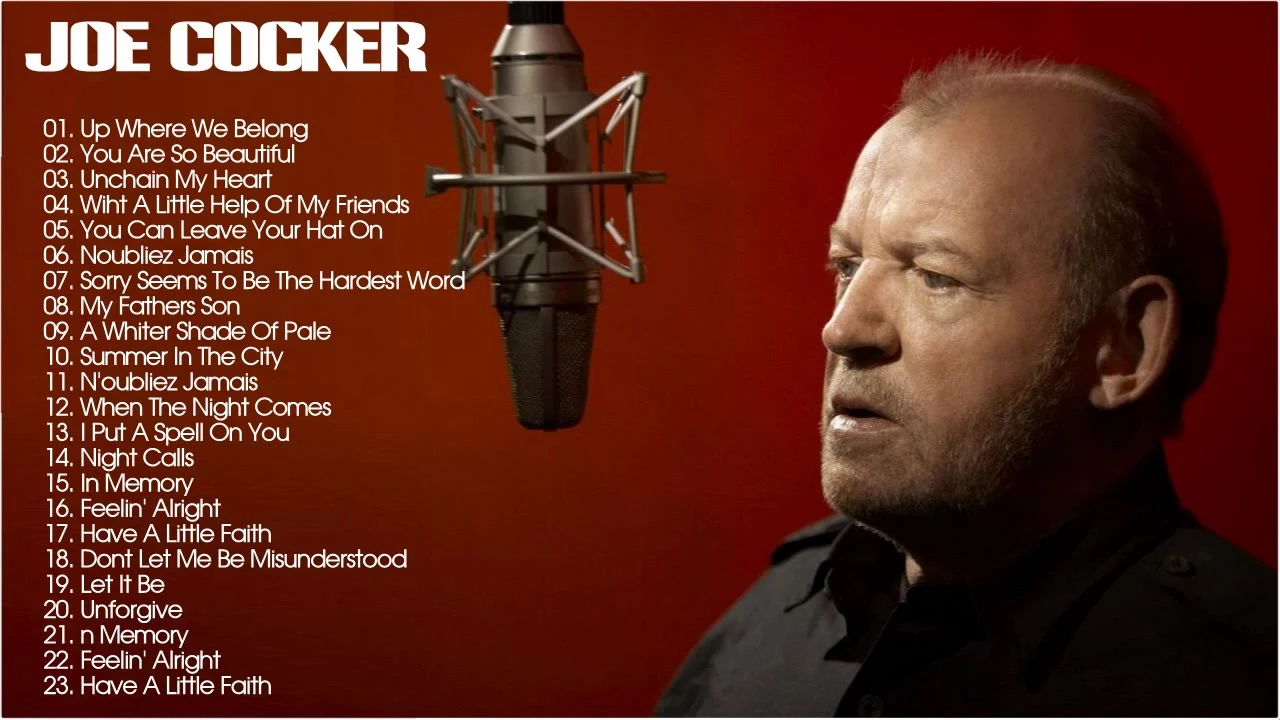
During the 1980s, Cocker found renewed success. He recorded Sheffield Steel with the Compass Point All Stars and, in 1982, sang “Up Where We Belong” with American singer Jennifer Warnes for the film An Officer and a Gentleman. The duet topped the US Billboard Hot 100, won the 1983 Grammy Award for Best Pop Performance by a Duo or Group with Vocal, and received the Academy Award for Best Original Song. In 1987, his album Unchain My Heart earned a Grammy nomination.
A long career beyond the breakthrough
Cocker’s recording career extended well beyond his best-known early performances. He released 22 studio albums over 43 years, including Sheffield Steel, Night Calls, Hymn for My Soul and Fire It Up. Many of his best-known singles were interpretations of other writers’ songs, among them “Feelin’ Alright” and “Unchain My Heart”. He also wrote original material, often working with Chris Stainton.
His touring took him through Europe, Australia and the United States. In 1993, he was nominated for a Brit Award for Best British Male Solo Artist. At the Party at the Palace concert for Elizabeth II’s Golden Jubilee in 2002, he performed “With a Little Help from My Friends” with Phil Collins on drums and Brian May on guitar. He received an OBE for services to music in the 2007 Birthday Honours, and Sheffield marked his achievements with a bronze Sheffield Legends plaque outside the town hall.
Cocker continued recording and touring in his later years. Fire It Up, released in 2012, was his final studio album; its supporting tour included an extensive European run in 2013. His last live performance took place that September at the Loreley Open Air Theatre in Germany. He died from lung cancer in Crawford, Colorado, on 22 December 2014, aged 70. In 2025, he was inducted posthumously into the Rock and Roll Hall of Fame.
Why Joe Cocker deserves a place in British Legacy
Joe Cocker’s place in British music history rests on the particular force of his interpretations. “With a Little Help from My Friends” began as a Beatles song; Cocker’s recording recast it as an impassioned performance that reached number one in Britain and became inseparable from his name. His work shows how a singer can alter a song’s character through arrangement, phrasing and delivery, rather than relying on original songwriting alone. The same interpretive instinct shaped his versions of “You Are So Beautiful”, “Feelin’ Alright” and “Unchain My Heart”.
His story also connects a specific British beginning with a genuinely international career. Cocker grew up and developed as a performer in Sheffield, playing local pubs before reaching the Marquee Club, Woodstock and stages across several continents. His return to Sheffield for concerts after receiving his OBE, and the city’s Sheffield Legends plaque, make that connection more than a biographical detail: his international reputation remained linked to his home city. Cocker’s career brought British performance and recording into a global popular-music conversation, while his collaborations and honours show the breadth of that reach. Remembering him in British Legacy means recognising both the local routes through which a musician can emerge and the distinctive artistry that can carry those beginnings far beyond them.
Sources
Joe Cocker — Wikipedia revision 1379611782
Adapted in part from Joe Cocker by Wikipedia contributors, under CC BY-SA 4.0. Text has been edited and combined with the existing article; this adapted text is shared under the same licence. Contributor history.
.jpg)