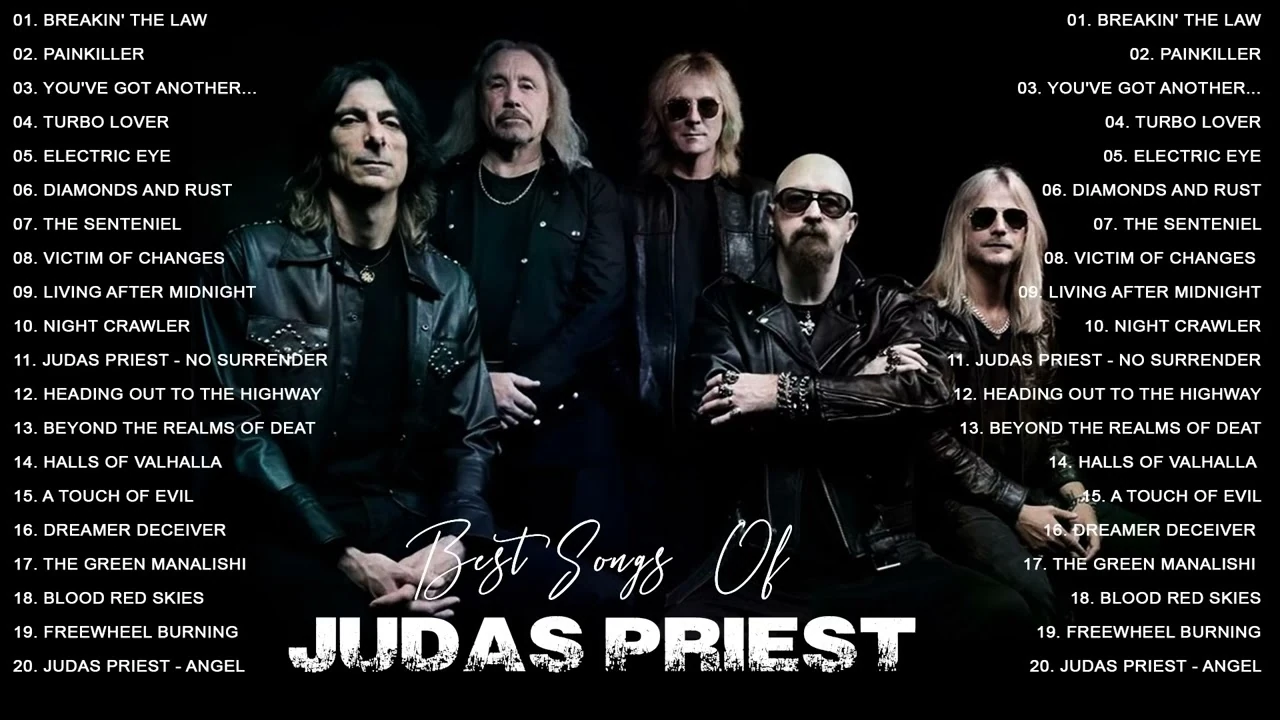
Judas Priest’s story begins in Birmingham, but its sound travelled far beyond the city. Formed there in 1969, the band helped shape heavy metal through the interplay of two guitars, Rob Halford’s wide-ranging vocals and a visual identity that made leather and studs part of the genre’s shared vocabulary. Their route to a defining record was not immediate: after several years of modest commercial fortunes, British Steel brought them wider attention in 1980.
From an early line-up to a distinctive sound
The first Judas Priest line-up, formed by singer Al Atkins and bassist Brian “Bruno” Stapenhill, did not make it on to the band’s early recordings. The group split in 1970. Later that year, Atkins joined a Birmingham band called Freight, whose members included guitarist K. K. Downing, bassist Ian Hill and drummer John Ellis. They took the Judas Priest name, and after Atkins left, the group brought in singer Rob Halford and drummer John Hinch. Guitarist Glenn Tipton joined in 1974, completing the pairing with Downing that would become one of the band’s defining features.
Their first album, Rocka Rolla, appeared in 1974. Its mix of rock, heavy riffs and progressive passages was a long way from a settled formula. Sad Wings of Destiny (1976) brought more complex arrangements and heavy guitar work; its centrepiece, “Victim of Changes”, combined material associated with Atkins and Halford. The band’s early albums were varied, but the 1970s also brought the elements that would carry through their later work: forceful riffs, two lead guitars and a voice capable of moving from lower registers to high, sustained screams.
Success came unevenly. Money was tight while the band recorded Sad Wings of Destiny, and it was the album’s reception that helped attract the attention of CBS Records. The major-label move brought a larger budget for their next record. Sin After Sin (1977), Stained Class (1978) and Killing Machine (released in North America as Hell Bent for Leather) developed the sound further. “Dissident Aggressor”, first recorded for Sin After Sin, became one of the songs associated with the band’s technically demanding attack; a live performance of it later won a Grammy Award.
How British Steel changed their fortunes
Judas Priest’s sixth studio album, British Steel, arrived in 1980 and brought the band mainstream attention. Its shorter songs and strong hooks made a direct connection with radio without abandoning heavy-metal weight. “Breaking the Law”, “Living After Midnight” and “United” became defining tracks. The first two remain useful illustrations of the band’s range: one built around a forceful, instantly recognisable riff and chorus, the other with a more melodic, hard-rock drive.
The record’s influence was not confined to its commercial breakthrough. It has been described as a work that helped codify what listeners mean by heavy metal. In the next few years, Judas Priest kept refining the balance between accessible songwriting and a heavier approach. Screaming for Vengeance (1982) reached the UK top 20 and the US top 20; “You’ve Got Another Thing Comin’” became a major North American radio success. Defenders of the Faith followed in 1984. With Turbo (1986), the band added guitar synthesisers and adopted a more colourful presentation, while Painkiller (1990) returned to a faster, more aggressive style.
That change over time matters to the band’s history. Judas Priest did not simply repeat one sound: their records moved between progressive arrangements, streamlined songs, synthesisers and high-speed metal. The band’s dual-guitar writing and Halford’s voice gave those shifts a recognisable centre. “Painkiller”, the title track of the 1990 album, is one of the clearest examples of the faster, more technically intense side highlighted in the original account.
Leather, studs and a stage identity
Judas Priest’s influence was visual as well as musical. The band initially wore the loose styles common in the early 1970s, then moved towards simpler stage clothes as that decade ended. Halford adopted a leather-and-studs look for the 1979 tour, drawing on punk fashion and leather culture; the other members followed. The image became closely associated with the band and was taken up by other metal acts.
Halford’s motorcycle entrances made that stage identity especially vivid. At a Toronto show in 1991, he was seriously injured after colliding with a drum riser obscured by dry ice, but returned to perform the set before going to hospital. The incident is a reminder that this was not merely a costume or album-cover aesthetic: the band built its performance around a striking, physical visual language. The wider meaning of the look has also been discussed in connection with Halford’s later public disclosure that he was gay, though he said audiences at the time did not necessarily read a queer subtext into the clothing.
Changes in the line-up, and a return
Personnel changes repeatedly altered the band’s circumstances without ending its history. Halford left in 1992, and Judas Priest spent four years looking for a replacement. Tim “Ripper” Owens joined in 1996; with him, the band recorded Jugulator (1997) and Demolition (2001). Halford returned in 2003, and the reunited band released Angel of Retribution in 2005. The later albums Nostradamus (2008), Redeemer of Souls (2014), Firepower (2018) and Invincible Shield (2024) show a career that continued across changing musical eras.
Downing retired in 2011 and was replaced by Richie Faulkner. Tipton, who had Parkinson’s disease, stepped back from touring in 2018 while remaining an official member; Andy Sneap took his place on the road. The supplied reference records Ian Hill’s retirement in 2026, with Dave Rimmer announced as his replacement. Across these changes, the band’s continuity has rested less on an unchanged personnel list than on an enduring musical identity and a willingness to keep recording and performing.
Recognition and influence
The band’s influence is often discussed in relation to the New Wave of British Heavy Metal and the development of later metal styles, including speed, thrash and power metal. Their work has been cited as an influence by a broad range of acts. That reach was built over time, from the early records’ complex arrangements to the sharply focused songs of British Steel and the faster playing of Painkiller.
Judas Priest received the Grammy Award for Best Metal Performance in 2010 for “Dissident Aggressor”. They were inducted into the Rock and Roll Hall of Fame in 2022, receiving its Award for Musical Excellence; an earlier nomination in 2018 had not resulted in induction. Their other recognition includes the Kerrang! Hall of Fame Award in 2007 and a 2018 induction into the Hall of Heavy Metal History. These distinctions sit alongside a substantial recording career: the supplied reference reports more than 50 million albums sold and eleven UK top-30 albums.
Why Judas Priest deserves a place in British Legacy
Judas Priest belong in British Legacy because their work connects a specific place and a lasting cultural contribution. Formed in Birmingham in 1969, they developed a sound that helped define heavy metal internationally. The twin-guitar partnership of Downing and Tipton, Halford’s distinctive vocal range and the band’s changing approach to songwriting can be followed across records from Sad Wings of Destiny to British Steel and Painkiller. Their achievement was not simply to make heavy music louder: they could shift from complex arrangements to concise, memorable songs while retaining a recognisable identity.
Their legacy also reaches beyond recordings. The leather-and-studs image, developed as the 1970s ended, became a visible part of heavy metal culture, while Halford’s motorcycle entrances made stagecraft central to the band’s presentation. Later musicians drew on both the sound and the look, and the band continued to record and tour through major changes in its line-up. The Birmingham connection is therefore more than a point of origin: it anchors a British band whose music and performance helped shape an international genre. Their awards, including the 2010 Grammy and 2022 Rock and Roll Hall of Fame induction, recognise part of that contribution; the longer account lies in the songs, the evolving sound and the influence on metal’s musical and visual language.
Sources
Adapted in part from Judas Priest by Wikipedia contributors, under CC BY-SA 4.0. Text has been edited and combined with the existing article; this adapted text is shared under the same licence. Contributor history.