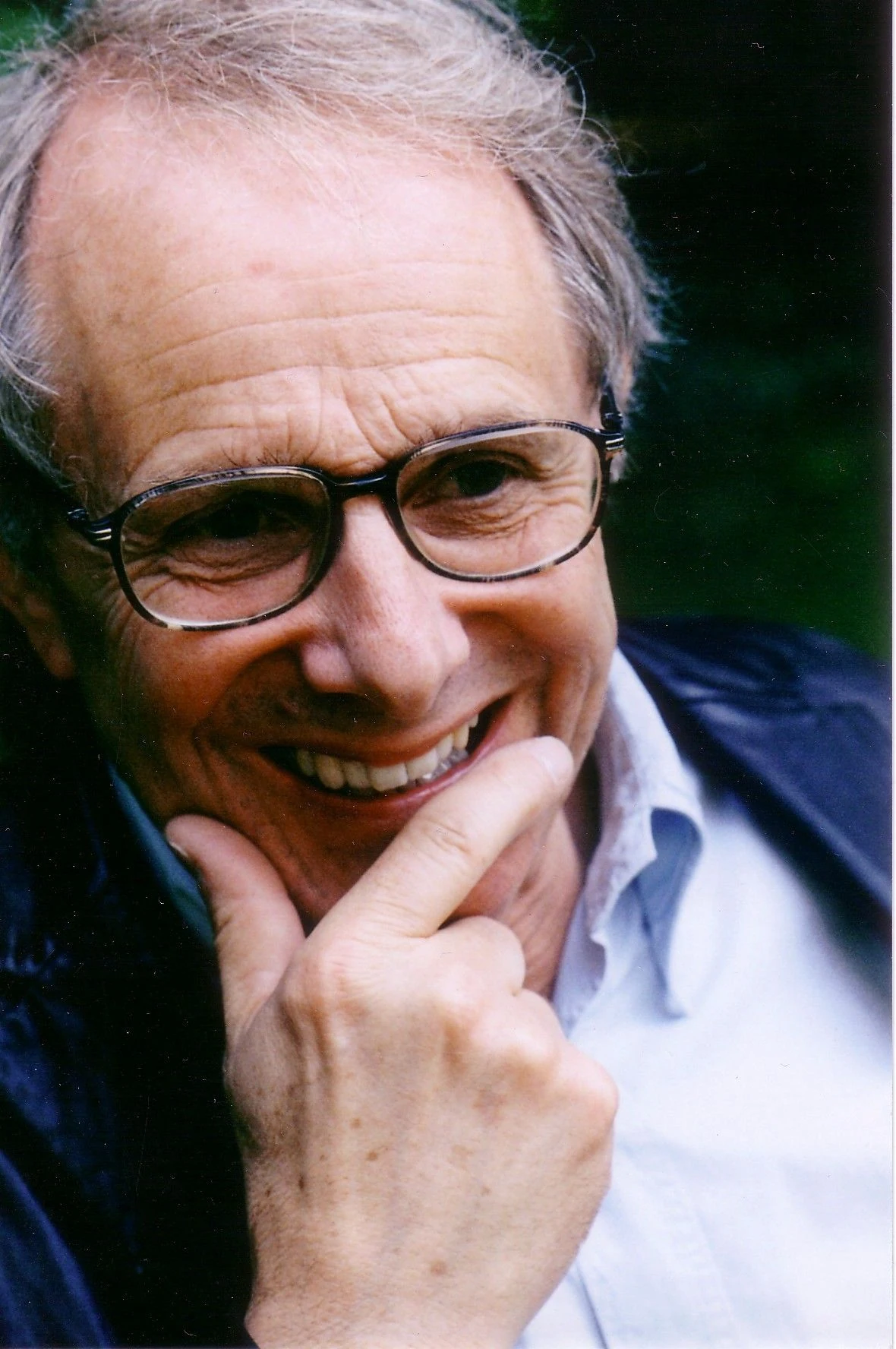
Ken Loach built a long filmmaking career around people negotiating forces larger than themselves: unemployment, housing insecurity, workplace conflict and public institutions. His films range from television dramas about homelessness and mental health to features set amid political upheaval. They made social questions part of the drama rather than a backdrop, while a directorial career stretching from the early 1960s to 2024 brought him two Palme d’Or awards and a place among the most recognised British filmmakers of his generation.
From Nuneaton to television drama
Born Kenneth Charles Loach in Nuneaton, Warwickshire, on 17 June 1936, he attended King Edward VI Grammar School before joining the Royal Air Force at 19. He later read law at St Peter’s College, Oxford, where he took part in the Experimental Theatre Club. In 1959 he directed an open-air production of Bartholomew Fair for the Shakespeare Memorial Theatre and also acted in it. After working with regional theatre companies as an actor, he became a director for BBC Television.
Loach’s early television work established a method and a subject. Among his contributions to the BBC anthology series The Wednesday Play were Up the Junction (1965), Cathy Come Home (1966) and In Two Minds (1967). Each placed working-class characters in conflict with authorities or systems affecting their lives. Nell Dunn’s story for Up the Junction dealt with illegal abortion; Jeremy Sandford’s Cathy Come Home followed characters affected by homelessness, unemployment and social services; and David Mercer’s In Two Minds concerned a young woman’s experience of the mental health system. Loach’s role was not only to bring these subjects to television, but to make institutional pressures visible through individual lives.
He moved between television and cinema, directing his first feature, Poor Cow, in 1967, followed by Kes in 1969. Based on Barry Hines’s novel A Kestrel for a Knave, Kes tells of a troubled boy who finds purpose in caring for a kestrel. The film’s use of Yorkshire dialect was integral to its setting, although it restricted distribution in some markets. The British Film Institute later placed it seventh in its list of the greatest British films of the twentieth century.
Work, politics and people
Loach’s films did not follow a single format. Across decades he made intimate dramas, political histories, documentaries and television work. Raining Stones (1993), for example, follows an unemployed man trying to buy a communion dress for his daughter. Land and Freedom (1995) examines Republican resistance during the Spanish Civil War, while Carla’s Song (1996) moves part of its story to Nicaragua. In My Name Is Joe (1998), an alcoholic struggles to stay sober; Bread and Roses (2000) centres on a Los Angeles janitors’ strike; and The Navigators (2001) turns to labour rights.
Even when a film addressed a large political conflict, Loach often worked through relationships between family members, friends or people acting together. He described politics as embedded in character and narrative. His films’ use of local dialects—from Yorkshire speech in Kes to Glaswegian in My Name Is Joe—also made place and voice central to the storytelling. In discussing dialect, he argued that changing how people speak would change more than their voices; subtitles, he suggested, could be preferable to losing that character.
His television and documentary work also included subjects that became contentious. The BBC drama series Days of Hope (1975), written by Jim Allen, drew controversy for its critical depiction of the military in the First World War. A Question of Leadership (1981) interviewed steelworkers about their union’s handling of a strike. A planned follow-up series, Questions of Leadership, was not broadcast after complaints and disputes involving union leaders and the broadcaster. Which Side Are You On? (1985), about songs and poems of the miners’ strike, was initially rejected by The South Bank Show as politically unbalanced; it was later transmitted on Channel 4.
Loach’s career was not one of uninterrupted production or easy access to his work. During the 1970s and 1980s, several films suffered from poor distribution, limited interest or political censorship. In the 1980s he concentrated more on television documentaries, some of which later became difficult to obtain. From the late 1980s he returned more regularly to feature filmmaking, with films including Hidden Agenda (1990), about political troubles in Northern Ireland, and Riff-Raff (1991), which won the European Film Award for Best Film.
Two Palme d’Ors and a continuing career
The Wind That Shakes the Barley (2006), set during the Irish War of Independence and the subsequent Irish Civil War, won the Palme d’Or at Cannes. Loach received the festival’s top award again for I, Daniel Blake (2016). The latter follows a carpenter with a heart condition as he encounters the welfare system. Its subject returned Loach to a concern visible throughout his career: how decisions made by institutions shape the options available to ordinary people. The film also won the BAFTA for Outstanding British Film.
His later films continued to shift between broad political settings and personal stories. Looking for Eric (2009) centres on a depressed postman whose conversations involve former Manchester United footballer Eric Cantona appearing as himself. The Angels’ Share (2012), about a young Scottish troublemaker given a chance to avoid prison, won the Jury Prize at Cannes. After announcing his retirement in 2014, Loach resumed filmmaking following the 2015 UK general election. He directed Sorry We Missed You in 2019 and, in April 2024, confirmed that The Old Oak (2023) would be his last film.
Loach’s political activity accompanied, but was distinct from, his filmmaking. He joined the Labour Party in the early 1960s, left by the early to mid-1990s, and later became involved in Respect and Left Unity. He rejoined Labour by 2017 and was expelled in 2021 after the party said he had failed to disown members who had been expelled. His public campaigning and political views attracted disputes, including over his support for boycotts of Israeli state cultural institutions. In 2012, he turned down an award from Turin’s National Museum of Cinema after learning that cleaning and security services had been outsourced following a dispute with workers. He said the refusal was an act of solidarity with them.
Recognition and a working method
Loach’s honours include the BAFTA Fellowship in 2006, the Honorary Golden Bear at the Berlin International Film Festival in 2014 and honorary degrees from several universities, including Oxford, Bath and Birmingham. His films have also won Cannes Jury Prizes, European Film Awards and other international recognition. Such distinctions sit alongside a career that repeatedly involved disputed broadcasts, distribution problems and arguments over whose accounts of political events reached the screen.
His approach depended on the details of speech, place and human connection. The stories could be set in a political struggle or a family crisis, but the larger forces were encountered through what happened to the people within them. This gives films as different as Kes, Land and Freedom and I, Daniel Blake a common interest without making them versions of the same story. They ask viewers to see social conditions not as abstractions but as pressures felt in daily life.
Why Ken Loach deserves a place in British Legacy
Ken Loach deserves a place in British Legacy because his work made British social experience a sustained subject of drama across television and cinema. Cathy Come Home brought homelessness, unemployment and social services into a widely seen television play; Kes gave a boy’s attachment to a kestrel the force of a story about limited opportunity; and I, Daniel Blake returned to the individual’s encounter with public systems. These are not interchangeable films, but each shows how institutions and economic circumstances can enter the most personal parts of life. Their continuing recognition, including the BFI’s high placing for Kes and the Cannes and BAFTA honours for later work, testifies to their reach.
His legacy also lies in the range of voices and settings he brought to the screen. Dialect, regional life and relationships between people in conflict were not incidental decoration: they helped make social experience specific. His documentaries and television work examined labour disputes and the miners’ strike as well as fictional stories, while his features moved from Yorkshire to Scotland and from Britain to Spain, Nicaragua and the United States. Across that body of work, Loach demonstrated how filmmaking could examine political questions through character and consequence. That achievement gives British Legacy a reason to remember him not simply as an award-winning director, but as a filmmaker whose long career asked audiences to pay attention to people often placed at the margins of public debate.
Sources
Adapted in part from Ken Loach by Wikipedia contributors, under CC BY-SA 4.0. Text has been edited and combined with the existing article; this adapted text is shared under the same licence. Contributor history.