
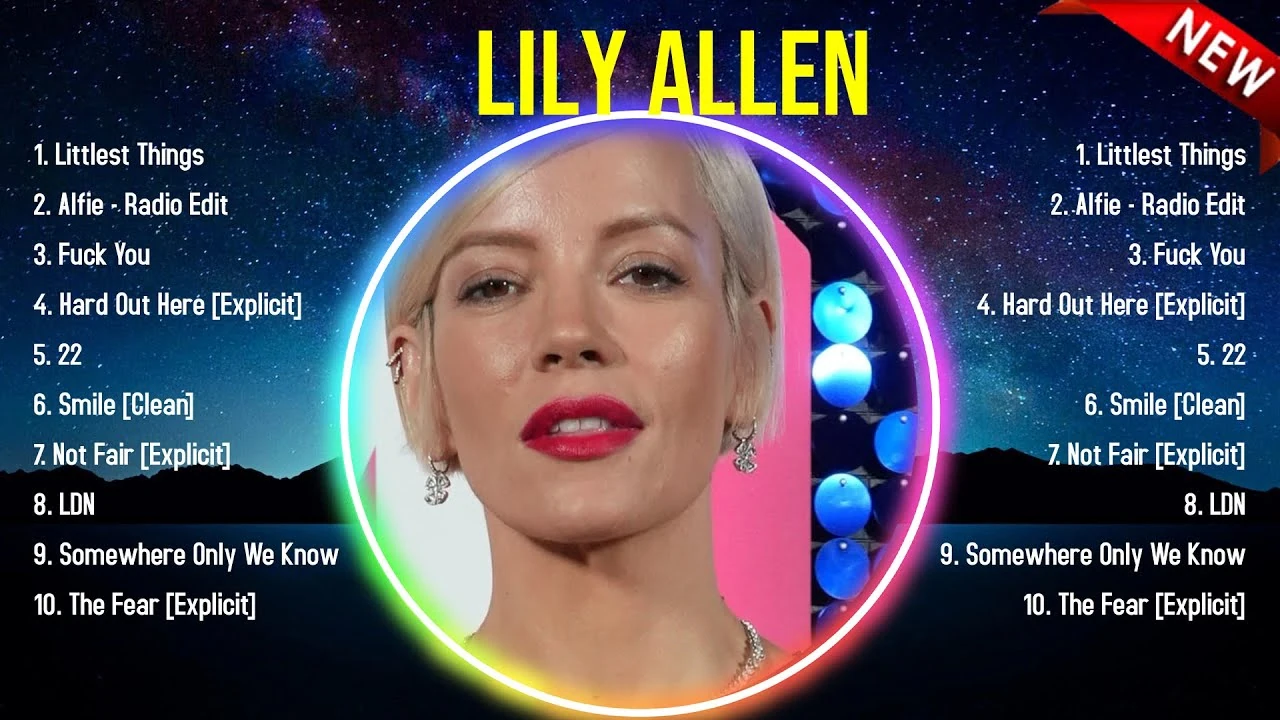
Lily Allen’s early songs often made their point through contrast. “Smile” set a reggae-influenced pop sound against a story of personal betrayal; “LDN” looked beyond a jaunty surface to the city’s harsher details; and “The Fear” turned the language of money and celebrity into satire. That mix of accessible melodies and observant lyrics carried her from posting demos online to the top of the UK charts, and through a career that has also taken in acting, broadcasting and writing.
Finding an audience online
Born Lily Rose Beatrice Allen in Hammersmith, west London, on 2 May 1985, she began her musical career in 2005. After signing with Regal Recordings, she posted vocal recordings on Myspace. The demos attracted thousands of listeners, and their popularity brought airplay on BBC Radio 1. In 2006, a profile in The Observer Music Monthly helped extend her reach beyond the label’s immediate circle.
Allen’s debut commercial single, “Smile”, reached number one on the UK Singles Chart in July 2006. Her first studio album, Alright, Still, followed that year. It brought together pop melodies with ska and reggae influences, and included “LDN”, “Knock ’Em Out” and “Alfie”. The album reached number two on the UK Albums Chart and, according to the supplied Wikipedia account, sold more than 2.6 million copies worldwide. It also received a Grammy nomination for Best Alternative Music Album.
The route to that release was not instant. Allen had recorded demos and been turned down by several labels before a deal with London Records in 2002; after the executive who signed her left, the label lost interest and she departed without releasing the songs. She later returned to music, began writing her own songs and worked with the production duo Future Cut. When Regal signed her, the label provided funding for an album, though the account says its attention was directed towards other releases. Allen’s Myspace audience helped persuade the label to give her greater creative control, including the use of songs she had written.
Satire in the singles
“LDN” makes its setting central to its point: the song’s buoyant manner sits against a less comfortable view of London. That tension between sound and subject became still more pronounced on It’s Not Me, It’s You, released in 2009. Allen worked with producer Greg Kurstin, co-writing the songs with him. The album moved away from the retro sound of her debut towards electropop and broader, more expansive arrangements.
Its lead single, “The Fear”, reached number one in the UK and uses the pursuit of money and celebrity as satirical material. The album also produced “Not Fair” and “Fuck You”; the latter, described in the existing article as a satire on homophobia and right-wing politics, carries its subject in a bright pop setting. The record topped the UK Albums Chart and the Australian ARIA Charts. At the 2010 Brit Awards, Allen won British Female Solo Artist. She and Kurstin also received three Ivor Novello Awards for their work on the album, including Songwriters of the Year and awards for “The Fear”.
Allen’s success did not mean that she followed a straight line from one record to the next. After touring through 2010, she said she had no plans to make another album and turned her attention towards acting and other work. In 2012, she returned to the studio; for a period she performed under the name Lily Rose Cooper before reverting to Lily Allen. The change of direction, and then the return, form part of a career in which her public identity and creative plans have shifted over time.
Albums, writing and performance
Allen’s third album, Sheezus, was released in 2014 and reached the top of the UK Albums Chart. After a period in which she questioned the music she was being asked to make, she returned with No Shame in 2018. Its electropop sound draws on dancehall and reggae, while its lyrics address personal and social subjects. The album was shortlisted for the Mercury Prize and reached number eight on the UK Albums Chart.
Her work has extended beyond recording. In 2008 she hosted the BBC Three television programme Lily Allen and Friends. She launched the record label In the Name Of in 2011, with financial backing from Sony Music; the label released Tom Odell’s debut album before closing in 2014. Allen published her memoir, My Thoughts Exactly, in 2018, bringing her account of her experiences into book form.
On stage, Allen made her West End debut as Jenny in 2:22 A Ghost Story at the Noël Coward Theatre in 2021. The role earned her a Laurence Olivier Award nomination for Best Actress and a WhatsOnStage Award. She later played Katurian in a 2023 revival of Martin McDonagh’s The Pillowman at the Duke of York’s Theatre, and Hedda Gabler in Hedda at the Ustinov Studio in Bath in 2025. On screen, her roles include Elizabeth Taylor in How to Build a Girl and Mel in the television comedy-drama Dreamland.
A later chapter in music
Allen’s fifth studio album, West End Girl, was announced in October 2025 and released four days later, her first album in seven years. It reached number two on the UK Albums Chart. The album’s lead single, “Madeline”, reached the UK top 20, while “Pussy Palace” reached number eight, giving Allen her first UK top-ten single in more than a decade. Its arrival showed that music remained central even as her working life had expanded into theatre, television and publishing.
The supplied account records a career of repeated changes in sound and form: from the ska- and reggae-inflected pop of Alright, Still, through the electropop of It’s Not Me, It’s You and No Shame, to a return to albums with West End Girl. Across those shifts, her writing has continued to draw on observation, satire and personal subject matter. Her awards include a Brit Award and three Ivor Novello Awards for songwriting; her acting recognition includes the Olivier nomination and WhatsOnStage win.
Why Lily Allen deserves a place in British Legacy
Allen’s place in British Legacy rests on identifiable achievements in British music and performance, rather than on broad claims of influence. Her early Myspace recordings found listeners before conventional mainstream recognition had arrived; “Smile” then reached number one on the UK Singles Chart, and Alright, Still became a substantial international success. The shift to It’s Not Me, It’s You showed that her early profile did not confine her to one sound. Its UK number-one album and “The Fear” gave her a new musical setting for the sharp attention to public behaviour that had marked her first songs.
Her contribution also reaches beyond records. Allen’s West End work brought her a WhatsOnStage Award and an Olivier nomination, while her memoir and broadcasting work gave her other ways to address an audience. The British connection is specific: she was born in Hammersmith, built her early career through British chart and radio routes, and has performed in London theatres and on stages across the country. The lasting value of her career lies in that combination of popular songwriting, formal change and work across music, books and theatre. Her songs can be immediately inviting while still asking listeners to look again at what they describe.
Sources
Lily Allen — Wikipedia revision 1379208938 · Lily Allen — Wikipedia
Adapted in part from Lily Allen by Wikipedia contributors, under CC BY-SA 4.0. Text has been edited and combined with the existing article; this adapted text is shared under the same licence. Contributor history.
_(cropped).jpg)