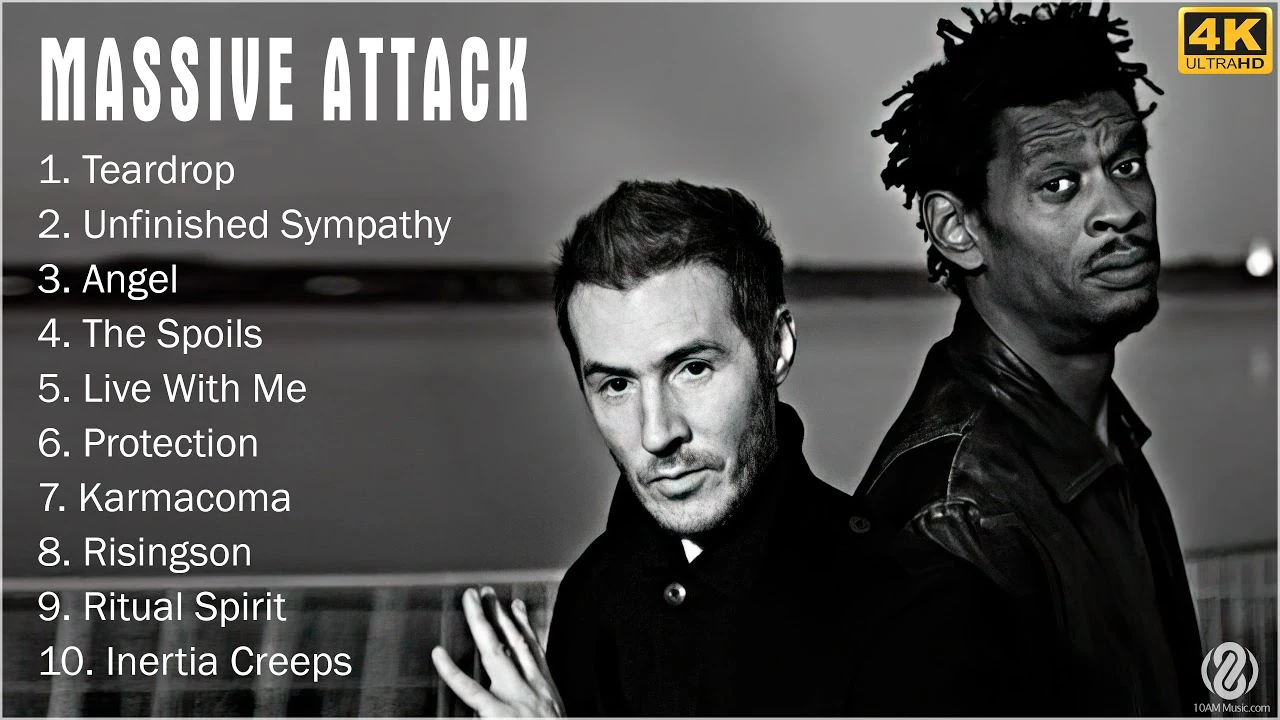
Massive Attack emerged from Bristol’s club culture with a sound that refused to stay in one lane. Hip-hop, soul, reggae and electronic production met in music that could be slow, spacious and unsettling, with guest singers and carefully built arrangements at its heart. Their 1991 debut, Blue Lines, helped establish what came to be called trip hop; Mezzanine, seven years later, took the group towards a darker, guitar-edged sound. Across both records, the collective turned Bristol’s musical cross-currents into work that travelled well beyond the city.
From the Wild Bunch to a Bristol group
The story began with the Wild Bunch, a sound-system and partying collective that took shape in Bristol in the early 1980s. DJs Grant Marshall, known as Daddy G, and Andrew Vowles, or Mushroom, met rappers Robert Del Naja (3D) and Adrian Thaws (Tricky) through the collective. The Wild Bunch became a major presence in Bristol’s club scene, drawing on varied records and styles rather than treating musical boundaries as fixed.
In 1988, the four formed Massive Attack as a spin-off. Their first single, “Any Love”, appeared before they had signed a record deal and was co-produced by Bristol duo Smith & Mighty, with vocals by Carlton McCarthy. The group’s early work grew from the same collaborative environment as the Wild Bunch, but gave its members room to develop a distinct identity. They were not simply a band in the conventional sense: their records brought together the group’s own voices and production with contributions from singers, musicians and producers.
That approach became particularly clear on Blue Lines. Released by Virgin Records in April 1991, the album drew on hip-hop, soul and reggae, among other influences, and set guest performances against the members’ spoken and rapped delivery. Horace Andy and Shara Nelson were among its vocalists; Neneh Cherry sang backing vocals on “Hymn of the Big Wheel”. Cherry and her partner, Cameron McVey, helped the group make the record, with McVey serving as executive producer and manager. Producer and programmer Jonny Dollar also contributed to its writing and production.
Blue Lines, Protection and a new vocabulary
Blue Lines is widely treated as a defining early album of trip hop, although the term itself came into use later. “Unfinished Sympathy”, with its prominent strings, became one of the group’s best-known songs. The arrangement, composed by Dollar and later arranged by Wil Malone, placed orchestration within a production shaped by sampling and electronic music. For a short period the group released music under the name Massive, following advice that the longer name might attract controversy during the Gulf War; they returned to Massive Attack for “Safe from Harm”.
The group’s second album, Protection, appeared in 1994. Its guest vocalists included Tracey Thorn of Everything but the Girl and Nicolette. Production duties were shared among the group and collaborators, including Nellee Hooper, the Insects and 3D. A dub reinterpretation, No Protection, followed in 1995, produced by Mad Professor. The album won the Brit Award for Best Dance Act. Meanwhile, “trip hop” had become a label used by the media for a wider Bristol scene. Daddy G later said the group disliked being placed in that category, preferring to regard its music as distinctive rather than confined to a genre.
Tricky left the group in 1995 to pursue a solo career. The remaining members were also establishing Melankolic, a label distributed by Virgin and EMI. Its artists included Craig Armstrong and Horace Andy. The group described its approach as non-interference: allowing the musicians they signed to make records on their own terms. These activities reflected an interest in collaboration that extended beyond the band’s own albums.
The darker turn of Mezzanine
For the third album, 3D took a leading role in production, working with producer Neil Davidge. Released in 1998, Mezzanine became Massive Attack’s first UK number-one album and their most commercially successful, selling nearly four million copies according to the supplied account. Its sound shifted towards more prominent guitar and a brooding intensity, without abandoning the group’s attention to rhythm, atmosphere and guest voices. Elizabeth Fraser of the Cocteau Twins sang “Teardrop”; Horace Andy appeared on three tracks, including “Angel”.
“Teardrop” became a top-ten single in the UK. Its video, directed by Walter Stern, showed an animatronic singing fetus. Mezzanine won the Q Award for Best Album and was nominated for the Mercury Prize. The long touring and promotion period brought the group to more than 150 shows and appearances. During that period, tensions over the band’s musical direction came to a head, and Mushroom left after the tour. Daddy G took a break from the group in 2001, leaving 3D and Davidge to develop the next album.
100th Window, released in 2003, featured Sinéad O’Connor and Horace Andy and was made without samples or cover versions. Its reception in Britain was less strong than that of the earlier records, though the supplied account notes a warmer response internationally. The group toured extensively, including a sold-out concert at Bristol’s Queen Square. In 2006 it issued Collected, a compilation accompanied by a second disc of previously released non-album material and unreleased sketches.
Further records, collaborations and live work
After several years of work, the group completed its fifth studio album with Daddy G back in the process. Heligoland was released in 2010, with guest contributions from Tunde Adebimpe, Damon Albarn, Martina Topley-Bird and Hope Sandoval. It followed the Splitting the Atom EP, which included tracks featuring Adebimpe, Topley-Bird and Elbow’s Guy Garvey. Massive Attack also worked on film scores: 3D and Davidge scored Danny the Dog and Bullet Boy, among other projects.
The group continued to test different ways of presenting music. In 2013, 3D and filmmaker Adam Curtis created a live event in Manchester that combined Curtis’s film with music from Massive Attack. In 2019 they collaborated again on a live presentation related to Mezzanine, using film, machine-learning imagery and reworked material to question the pull of nostalgia. That year also brought a tour marking the album’s twentieth anniversary.
Later releases included the Ritual Spirit EP in 2016, featuring Tricky for the first time on Massive Attack material since 1994, and the Eutopia audiovisual project in 2020. Eutopia was created across five cities during the COVID-19 lockdown period and combined music, film and contributions from artists and public-policy figures. In 2024 the group returned to live performance, including a Bristol show presented as a climate-action event. The group said it worked with local businesses to reduce the event’s environmental impact.
Why Massive Attack deserves a place in British Legacy
Massive Attack’s place in British musical history rests on more than the success of individual singles. The group developed from a distinctly Bristol setting: the Wild Bunch’s sound-system culture, the city’s club life and a willingness to bring unlike influences into the same piece of music. Blue Lines helped give trip hop an early, influential album form, while the band’s reluctance to be defined by that label points to the wider ambition of its work. Its records joined hip-hop, soul, reggae, orchestral writing and electronic production without making any one ingredient the whole story.
The group’s influence is also visible in the range of people it brought into its music, from Shara Nelson and Horace Andy to Elizabeth Fraser, Tracey Thorn and Sinéad O’Connor. Its members built a label, worked across film and live art, and returned repeatedly to Bristol as a place of performance and collaboration. Their later environmental projects connect that creative history with practical questions about touring and climate impact. For British Legacy, the story matters because it shows how a local musical network can produce work with international reach without losing its roots. Massive Attack made Bristol central to a sound that changed how British popular music could be assembled, performed and heard.
Sources
Adapted in part from Massive Attack by Wikipedia contributors, under CC BY-SA 4.0. Text has been edited and combined with the existing article; this adapted text is shared under the same licence. Contributor history.