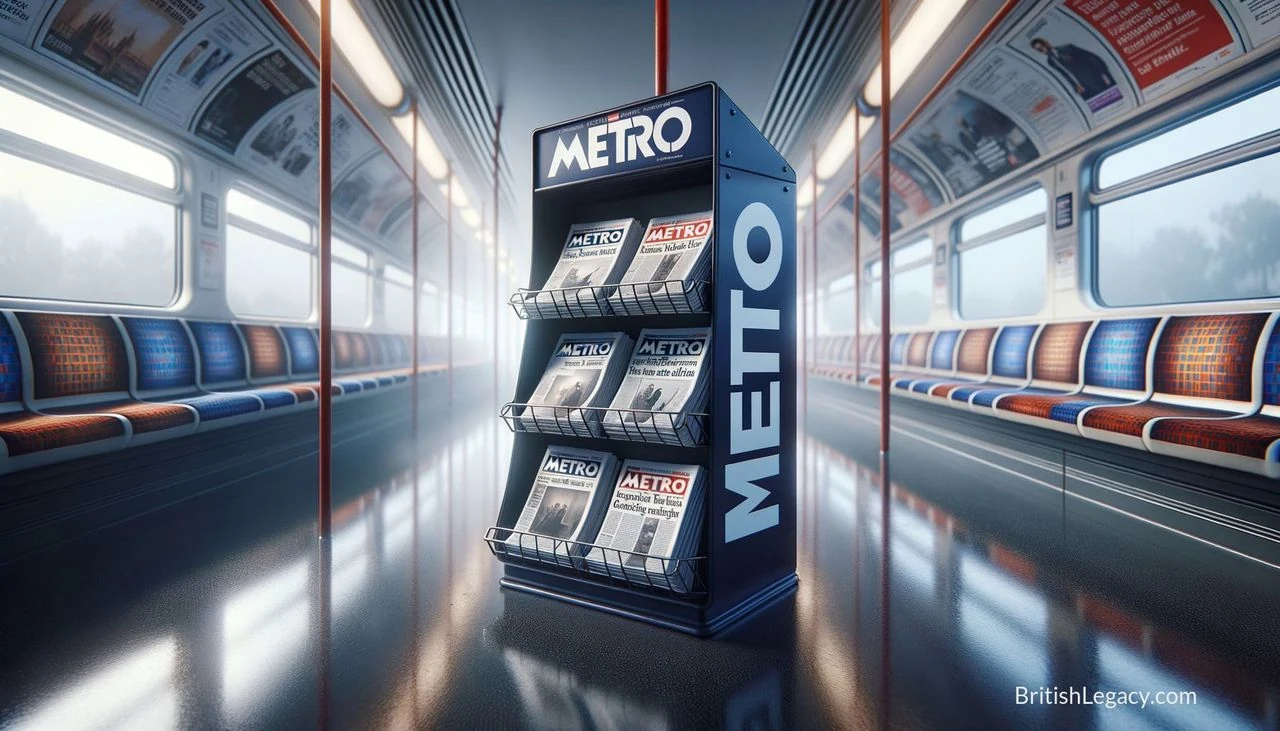
Metro launched in Britain on 16 March 1999 with a clear proposition: a free newspaper for people on the move. Published by Associated Newspapers, it aimed to reach commuters with concise coverage and copies distributed in urban centres and on public transport. Rather than asking readers to set aside time for a paid newspaper, its model placed news within the everyday journey.
A newspaper for readers on the move
Associated Newspapers saw commuters as an audience for whom a short, accessible newspaper could be useful. Metro’s reported distribution included trains, buses and underground networks, as well as urban centres. The setting was integral to the offer: the paper was intended for readers travelling through the places where copies were made available.
Free newspapers were not a new idea when Metro appeared. The supplied account distinguishes Metro by its nationwide reach and the quality of its content, though it offers no circulation figures or comparisons to quantify either claim. What it describes more specifically is a title combining free access, commuter-focused distribution and concise news coverage. Those features give a clearer account of its approach than broad claims that the launch transformed newspaper publishing.
The paper’s marketing included the phrases “News but not as you know it” and “Fast, free news for your commute”. The source gives no dates or campaign details for these lines, so they are best treated as examples of its branding rather than as a chronology of particular advertisements. Both make the newspaper’s intended qualities legible: a different, readily available news product, suited to the limited time of a journey.
Short-form coverage and reader features
Metro’s reported subject range was broad. It included local and international news, entertainment, sport, technology and lifestyle, presented in a concise format. The aim, according to the supplied article, was to let readers take in information efficiently while commuting. Brevity did not mean a single subject: the paper’s mix offered readers several kinds of material within the same publication.
Puzzles, horoscopes and reader contributions also appeared. These features sat alongside news and other coverage, giving the paper material beyond conventional reporting and inviting forms of reader participation. The source describes the editorial staff as committed to accuracy and timely reporting, but supplies no examples with which to assess that characterisation. It is therefore more precise to record the range of coverage and features than to repeat general claims about journalistic excellence as independently established fact.
Beyond the printed edition
The supplied account says Metro developed a digital presence through Metro.co.uk and an associated mobile application. It presents these as carrying the concise character of the print edition into online and mobile reading. No launch dates, readership figures or other measures are provided, so the scale of the digital services and their effect on the paper’s audience cannot be established from this material.
The original article also claims that Metro maintained high circulation, adapted to changes in the media landscape and inspired similar free newspapers in Britain and internationally. It gives no figures, examples or named publications to substantiate those points. They are claims made by the supplied text, not conclusions that can be confirmed from its detail. Retaining that distinction matters: Metro’s described model is specific, while the extent of its influence and continuing success is not demonstrated here.
Why Metro deserves a place in British Legacy
Metro deserves a place in British Legacy for the particular way its format and distribution addressed the British commute. Launched in 1999, it offered free, concise coverage and was distributed in urban centres and on trains, buses and underground networks. Its reported contents ranged from local and international news to sport, entertainment, technology and lifestyle, with puzzles, horoscopes and reader contributions alongside them. Together, those details describe a newspaper organised around where its readers travelled and the varied material they could encounter in a short reading session.
The supplied account does not establish that Metro invented the free newspaper, transformed British journalism or influenced particular competitors. Its more grounded contribution is the combination it records: commuter-focused distribution, a brief and varied editorial offer, and later services through a website and mobile application. That connection to public transport and everyday news consumption gives Metro a specific place in Britain’s media history. Recognising it on that basis preserves the useful story without turning unsubstantiated claims about circulation, influence or lasting success into settled fact.