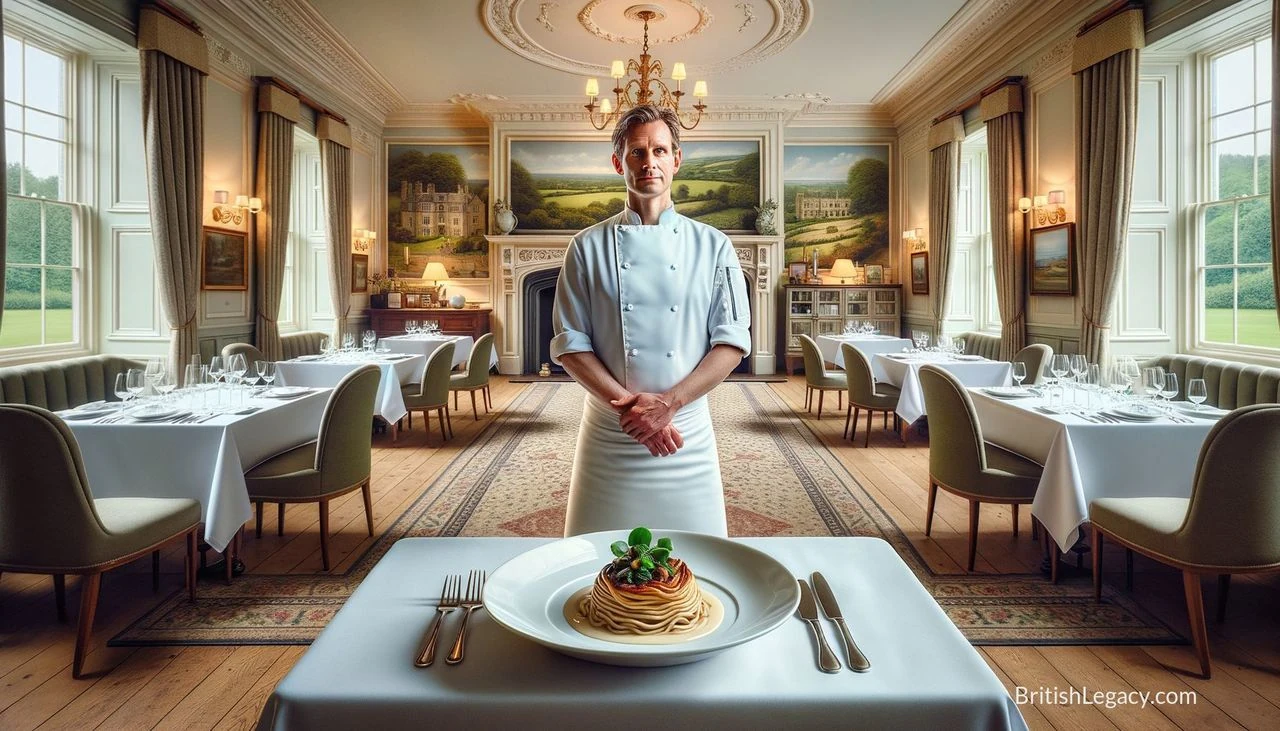
Michael Caines’s career has connected some of Devon’s best-known kitchens with a broader story of British hospitality. He became head chef at Gidleigh Park in 1994, returned to work after losing his right arm in a car accident soon afterwards, and went on to lead kitchens, develop hotel businesses and open Lympstone Manor near Exmouth. His cooking draws on French training, while his work in Devon has included restaurants, a hotel, a vineyard and a chef-training academy.
Training in Britain and France
Born in Exeter on 3 January 1969, Caines studied catering at Exeter College. His professional training began at the Grosvenor House Hotel in London, where he worked from 1987 to 1989. He then spent three years at Le Manoir aux Quat’ Saisons in Oxfordshire, working under Raymond Blanc, before continuing his development in France with Bernard Loiseau in Saulieu and Joël Robuchon in Paris.
That combination of British experience and French training formed the background to his appointment as head chef at Gidleigh Park, a country-house hotel in Devon, in 1994. Soon after taking the role, he was involved in a car accident in which he lost his right arm. He returned to the kitchen and continued his career as a chef. In 1999, Gidleigh Park received a second Michelin star. Caines remained head chef until January 2016, when he left the hotel.
His work at Gidleigh Park established him as a prominent figure in regional dining, but his career was not confined to one kitchen. In 2000, a partnership with hotelier Andrew Brownsword led to the purchase of Exeter’s Royal Clarence Hotel. Caines and Brownsword developed the ABode Hotels concept, while Caines also held senior roles in food and beverage and worked as executive chef at The Bath Priory. The Royal Clarence closed after a major fire in 2016.
Restaurants, television and training
Michael Caines Restaurants Ltd was founded in 1999. A restaurant bearing his name opened at the Bristol Marriott Royal in 2003, and his work later extended to other venues. He became involved in catering for the Williams Formula 1 team in 2013. On television, he represented the south-west of England in the BBC series Great British Menu in 2006, reaching the final round after competing against chef John Burton Race.
Training the next generation became another part of his work. In 2011, Caines launched The Michael Caines Academy at Exeter College, linking his career in professional kitchens with the college where he had studied. The academy made education and skills development a concrete part of his professional activity, alongside restaurant and hotel work.
Lympstone Manor and Devon produce
In 2016, Caines opened Lympstone Manor, a hotel and restaurant near Exmouth. The Georgian country house looks out over the River Exe and became the setting for his own approach to country-house hospitality. The restaurant holds one Michelin star. Its menus have been presented as modern British cooking, with local seafood, estate produce and seasonal ingredients among the features of the dining offer.
The estate’s work has also expanded beyond the kitchen. Caines established a vineyard there, with the aim of producing sparkling wine using the méthode traditionnelle, the bottle-fermentation method also used for Champagne. The first harvest was in 2020. The vineyard’s Triassic Pinot Noir received a gold medal at the 2023 International Wine Challenge and a bronze at the International Wine and Spirit Competition. In October 2023, the estate launched its Classic Cuvée sparkling wine. From January 2025, Lympstone Manor also offered private cookery masterclasses.
Caines’s other restaurant ventures have included The Cove in Maenporth, Cornwall, which he relaunched in March 2020. Its planned opening was quickly interrupted by the COVID-19 lockdown, and he later sold the restaurant; it reopened under new management in February 2025. His Porthleven restaurant, The Harbourside Refuge, closed in August 2023. Other Exmouth businesses he owned or operated, including Mickeys Beach Bar and Restaurant and Cafe Patisserie Glacerie, also passed to new management. These changes show the range—and the changing fortunes—of a career built across different kinds of hospitality business.
A distinctive approach to cooking
Caines’s cooking combines classical technique with ingredients associated with the south-west. Dishes described during his career include Dartmoor lamb with Jerusalem artichoke purée and red-wine jus, and Cornish turbot with caviar, cauliflower and Champagne velouté. His desserts have included Amedei chocolate delice with salted-caramel ice cream. These examples bring together local produce and more elaborate preparations, while illustrating the range of his menus from savoury courses to pastry and chocolate.
At Lympstone Manor, that approach sits within a wider experience of food and place. Seafood, meat and seasonal produce connect the restaurant’s offer to its Devon setting; the vineyard extends that attention to local production into drinks. Caines’s work has therefore reached beyond the individual plate, encompassing the sourcing and presentation of food, the running of a country-house hotel and the development of a site’s own products.
Recognition and public service
Caines won Chef of the Year at The Catey Awards in 2001. In 2006, he was appointed a Member of the Order of the British Empire for services to the hospitality industry. He became a Deputy Lieutenant for Devon in 2019. Those honours reflect recognition both of his work in hospitality and of his connection to the county where he was born and has established his principal hotel venture.
His career has included setbacks as well as expansion: the serious accident early in his time at Gidleigh Park, the closure of the Royal Clarence after the 2016 fire, and restaurant businesses that later closed or changed ownership. His return to professional cooking after the loss of his arm is a defining part of his public story, but his record also rests on sustained work in kitchens, hotels and training. The combination is more informative than a portrait built on resilience alone.
Why Michael Caines deserves a place in British Legacy
Michael Caines deserves a place in British Legacy because his career has made a lasting contribution to hospitality in the south-west of England. At Gidleigh Park, he led a Devon kitchen that gained a second Michelin star in 1999 and remained there as head chef until 2016. At Lympstone Manor, he created a hotel and restaurant near Exmouth that holds a Michelin star, and developed the estate’s food and drink offer to include a vineyard and its own sparkling wine. These are specific achievements rooted in Devon, rather than a general claim to represent British cooking.
His influence also reaches beyond his own restaurants. The Michael Caines Academy at Exeter College gave training a place within his wider professional work, while his hotel partnerships and restaurant ventures show how a chef’s role can extend into the development of hospitality businesses. His return to the kitchen after a car accident in which he lost his right arm is part of that story, but so too are the everyday disciplines of leading a kitchen, building teams and maintaining standards over time. Together, these contributions connect culinary skill with education, employment and regional enterprise. They make Caines a significant figure in the story of contemporary British food and hospitality.
Sources
Michael Caines — Wikipedia, revision 1363448587
Adapted in part from Michael Caines by Wikipedia contributors, under CC BY-SA 4.0. Text has been edited and combined with the existing article; this adapted text is shared under the same licence. Contributor history.