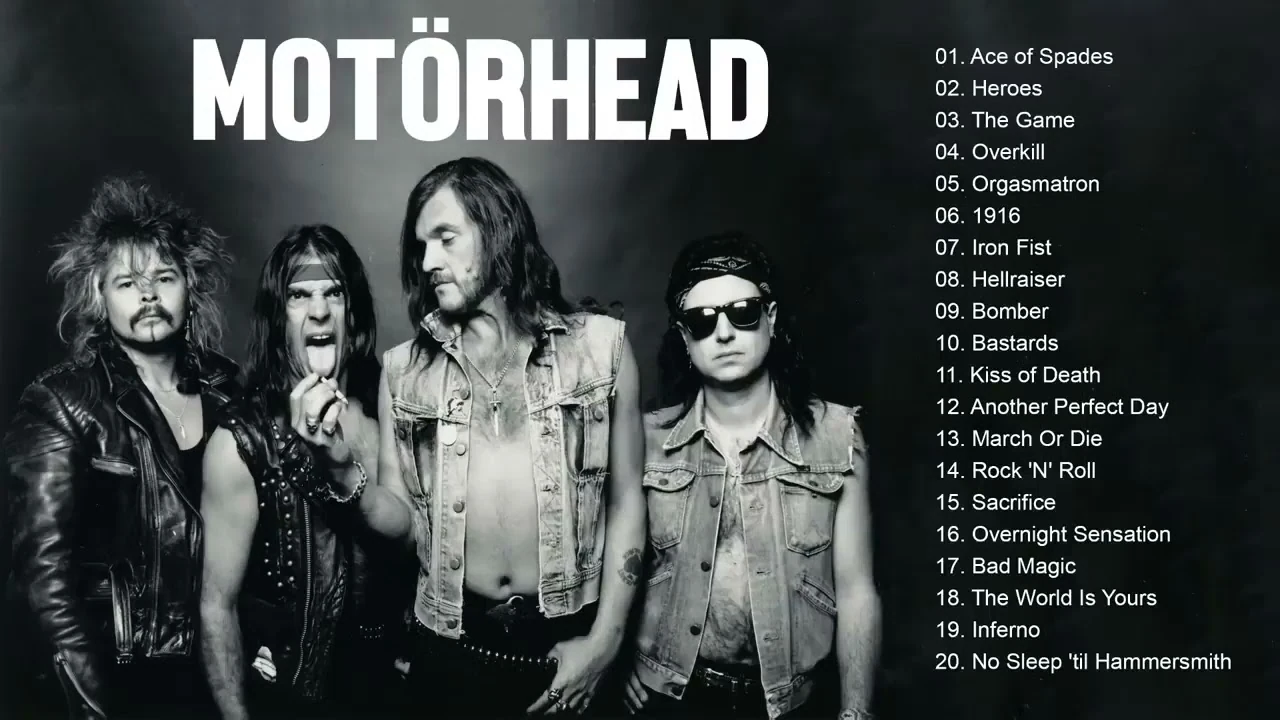
Motörhead’s identity was built around speed, volume and a forceful approach to rock and roll. Formed in London in 1975, the band became closely associated with the gravelly voice of bassist and vocalist Ian Fraser “Lemmy” Kilmister. Its best-known songs include “Ace of Spades”, while the live album No Sleep ’til Hammersmith reached number one on the UK Albums Chart in 1981. The supplied account also identifies Motörhead’s fast, aggressive sound as an influence on the development of thrash metal.
From the first line-up to the classic trio
Lemmy founded Motörhead with guitarist Larry Wallis and drummer Lucas Fox. The original line-up changed before the band recorded its debut album: Phil “Philthy Animal” Taylor took over on drums, and “Fast” Eddie Clarke joined on guitar. Lemmy, Taylor and Clarke formed the trio most closely associated with the band’s classic line-up.
The original account describes the group’s ambition as making music louder, faster and more aggressive. That description captures the sound it came to be known for, without requiring the broader claim that nothing comparable had come before. Lemmy’s gravelly vocals and distinctive presence were central to the band’s public identity; the combination of voice, guitar and drums gave its music a direct, high-energy character.
Songs, records and recognition
Released in 1980, “Ace of Spades” is the best-known track named in the supplied material. Its brisk pace, memorable riff and Lemmy’s rough-edged vocals made it a concise expression of Motörhead’s approach. The song begins, “If you like to gamble, I tell you I’m your man”. The account calls it the band’s most definitive song; it is more measured to describe it as one of the defining tracks associated with the group.
“Overkill”, “Bomber” and “Iron Fist” are also among the songs highlighted in the original article. Their inclusion alongside “Ace of Spades” gives a sense of the repertoire through which Motörhead established its reputation for forceful music and live energy. Lemmy’s reported line, “Rock and roll ain’t worth the name if it don’t make you strut”, conveys the swagger attached to that sound.
The live album No Sleep ’til Hammersmith was released in 1981 and reached number one on the UK Albums Chart. It is the clearest chart achievement in the supplied account and a marker of the band’s success with British listeners. In 2005, Motörhead won the Grammy Award for Best Metal Performance for its cover of Metallica’s “Whiplash”. The source mentions other nominations and accolades but does not specify them, so they cannot be described individually here.
Lemmy and the band’s wider influence
Motörhead’s sound is often credited with helping lay groundwork for thrash metal, later associated with bands including Metallica, Slayer and Megadeth. That is a claim about influence, not sole authorship of a genre: the supplied text describes Motörhead’s fast, aggressive music as a model for later musicians, but does not provide individual testimony or examples tracing that influence. Its contribution can therefore be stated without making it the single origin of thrash metal.
Lemmy became a prominent figure associated with Motörhead’s look and dedication to music. He died in 2015. The band’s music continued to be heard by metal fans after his death, according to the source, although it supplies no specific account of later releases, performances or commemorations. The group’s story in this material is consequently most clearly told through its London formation, its songs and records, and the musical approach linked to its influence.
Why Motörhead deserves a place in British Legacy
Motörhead’s place in British Legacy begins with specific achievements: the band formed in London in 1975, and its live album No Sleep ’til Hammersmith reached number one on the UK Albums Chart in 1981. Those details connect the group directly to British music-making and to a significant chart milestone. Its named songs—“Ace of Spades”, “Overkill”, “Bomber” and “Iron Fist”—also show how a clear musical identity could be sustained across a body of work rather than resting on one track alone.
The band’s wider significance lies in the account of its speed and aggression as an influence on thrash metal. That influence should not be overstated as sole invention, but it places Motörhead in a story of musicians carrying a sound forward. The 2005 Grammy for “Whiplash” offers another concrete point of recognition. Together, London origins, a UK number-one live album, celebrated songs and a stated influence on later heavy metal explain why Motörhead belongs in a British cultural record: its impact was rooted in a British band and reached beyond its own recordings.