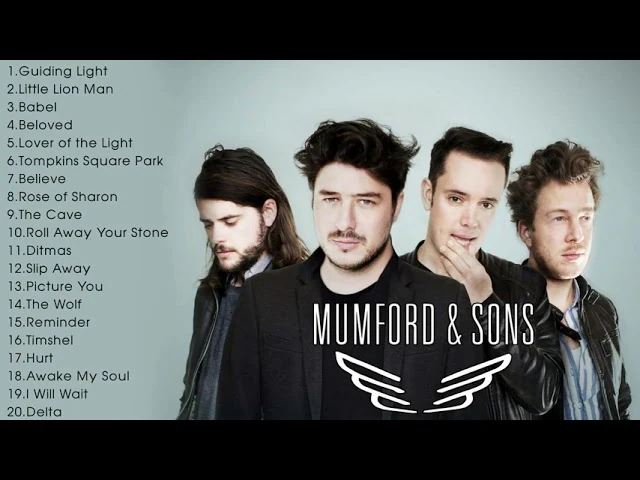
Mumford & Sons began in Greater London with acoustic instruments, close harmonies and songs drawing on folk and bluegrass. Within a few years, the band had moved from small venues and an early Glastonbury appearance to albums at the top of the UK and US charts. Its success made the group strongly associated with a banjo-led sound, but that was only one stage in a career shaped by touring, literary influences, collaborative projects and a marked turn towards electric instrumentation.
Formation in a London music community
The band formed in December 2007 with Marcus Mumford, Ben Lovett, Ted Dwane and Winston Marshall. Its name reflected Marcus Mumford’s role as the most visible member, organising the band and its performances. Lovett later said the name was meant to suggest an antiquated family business. The musicians combined acoustic guitar, banjo, piano and double bass with a rhythmic approach drawing on alternative rock and folk.
Other southern English acts working around the same time were sometimes grouped into a “West London folk scene”. Mumford disputed the idea that this was a formal or exclusive movement, describing it instead as a community of musicians operating in the same broad area. Their music was compared with that of acts including Noah and the Whale, Johnny Flynn and Laura Marling; Marshall, Mumford and Dwane had also played in Marling’s backing band.
In 2008, the group toured extensively in the UK, played Glastonbury Festival for the first time and toured Australia with Marling. Its first project, the EP Love Your Ground, took a year to complete and was released in November 2008. The members’ early work in small and moderate venues helped them develop an audience before their debut album appeared.
Sigh No More and the breakthrough
Recorded with producer Markus Dravs, the band’s debut album, Sigh No More, was released in October 2009. Its songs included “Little Lion Man” and “The Cave”. The title came from Shakespeare’s Much Ado About Nothing, and the title track uses lines from the play. Other songs draw on literary sources including Macbeth, The Odyssey and novels by John Steinbeck. The group said it financed the album itself to avoid artistic and technical compromises associated with studio-financed projects.
Radio play and touring carried the record to a wider audience. BBC Radio 1 DJ Zane Lowe named “Little Lion Man” his “Reaction Record” and later his “Hottest Record in the World”. The band made its US network television debut in February 2010. Its international profile grew further after it performed with Bob Dylan and the Avett Brothers at the 2011 Grammy ceremony; the supplied account records a 99 per cent increase in US sales of Sigh No More in the period after the performance. The album eventually reached number two on both the UK Albums Chart and the US Billboard 200.
The band also worked with Laura Marling and the Dharohar Project on an EP recorded in Delhi with Rajasthani musicians, released in December 2010. In 2011, Sigh No More won the Brit Award for British Album of the Year. The band received a Mercury Prize nomination and six Grammy nominations overall during this period, while its growing following brought larger shows and festival appearances.
Babel, awards and the live stage
The second album, Babel, arrived in September 2012, led by the single “I Will Wait”. It debuted at number one in both the UK and the US. The record became the fastest-selling album of 2012 in the UK, according to the supplied account, and won the Grammy Award for Album of the Year in 2013. That year, the band also won the Brit Award for British Group.
Live performance remained central to the group’s work. After headlining Glastonbury in June 2013, the band continued touring and staging multi-day events. In 2009, its members had founded Gentlemen of the Road, a live promotions company, record label and organiser of Stopover Festivals. These events were intended to bring performances to towns and villages less commonly visited by touring acts, with supporting musicians chosen by the band. Lewes, in East Sussex, hosted a Stopover in July 2013. The events combined music with other activities and aimed to bring visitors and business to their host communities.
The 2013 Glastonbury appearance followed a serious interruption to the band’s summer schedule. After two shows in Austin, Texas, Ted Dwane was admitted to hospital; surgeons found a blood clot on the surface of his brain and operated to remove it. The group cancelled the remaining dates of its Summer Stampede tour while he recovered. He was able to join the band for its Glastonbury headline performance later that month.
Changing the sound and the line-up
With Wilder Mind in 2015, Mumford & Sons moved away from the banjo-centred style associated with its first two albums. The banjo was absent from the record; electric guitar and a full drum kit helped create a broader, heavier sound. Lovett described the shift as a natural departure after years with the same core instruments. The album debuted at number one in the UK, the US and Australia. The band followed it with the EP Johannesburg in 2016.
Delta, released in 2018, continued the group’s development. Produced by Paul Epworth and recorded mainly at The Church Studios in London, it included contributions from Maggie Rogers, Yebba and Gill Landry. The band’s tour in support of the album was cut short by the COVID-19 pandemic; it later issued a six-track live EP drawn from tour recordings.
In 2021, Marshall announced that he was leaving the band. His departure followed criticism of a social-media post praising a book about the antifa movement. In his statement, Marshall said he wanted to speak about controversial issues without his bandmates and their families facing the consequences. Marcus Mumford released a solo album in 2022. The band released “Good People”, a collaboration with Pharrell Williams, in January 2024, its first new music since Marshall’s departure.
The group returned with Rushmere in March 2025, its first studio album in seven years. Prizefighter, its sixth studio album, followed in February 2026. The chronology records a band that continued to make music after a major change in membership, rather than relying solely on the sound and success of its early records.
Memorable quotes
The imported article attributes this reflection on music and its audience to Marcus Mumford: “It's not about fame, and it's not about views and clicks and likes. It's about people living their lives and our music being a part of that.” The quotation is included as supplied; its provenance is not established by the Wikipedia material provided.
Why Mumford & Sons deserves a place in British Legacy
Mumford & Sons deserves a place in British Legacy because its documented career links a London musical community to an international audience. The band formed in Greater London, developed through UK touring and played Glastonbury in its early years. Its first two studio albums then reached number one in both the UK and the United States, while Sigh No More and Babel brought major British and international recognition, including Brit Awards and a Grammy for Album of the Year. Those achievements show how a group working with folk and bluegrass instrumentation could make that sound part of contemporary chart music without remaining confined to a single style.
The group’s British connection also has a practical, live dimension. Through Gentlemen of the Road, Mumford & Sons organised Stopover Festivals designed to take music to towns and villages outside the usual touring circuit; Lewes was one of the documented UK locations. The band’s subsequent move from banjo-led arrangements to the electric sound of Wilder Mind, followed by further albums and a changed line-up, makes its history one of adaptation as well as early success. Taken together, its London origins, UK performances, awards, changing musical choices and efforts to stage events beyond major centres give the band a specific place in the story of modern British popular music.
Sources
Mumford & Sons — Wikipedia revision 1375228740
Adapted in part from Mumford & Sons by Wikipedia contributors, under CC BY-SA 4.0. Text has been edited and combined with the existing article; this adapted text is shared under the same licence. Contributor history.