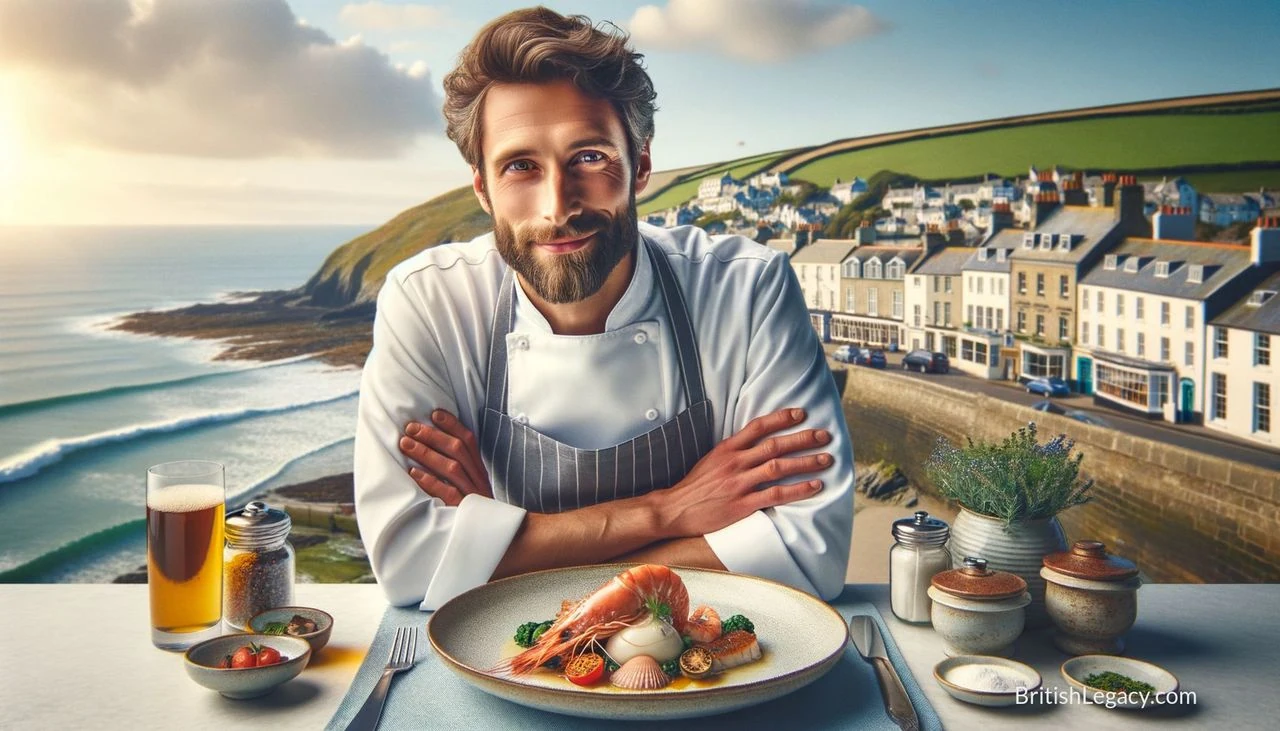
Nathan Outlaw’s career has followed a clear thread: cooking fish with care for the ingredients and the people who produce them. After training in Kent and working in some of Britain’s best-known kitchens, he established restaurants in Cornwall, where seafood became the focus of his cooking. His rise—from buttering toast in his father’s restaurant to opening his own kitchens—has also brought him to television and cookbook publishing.
First steps in the kitchen
Born in Kent on 7 March 1978, Outlaw encountered restaurant work early. His first task, at the age of eight, was buttering toast at his father’s restaurant. At 14, he began working with his father, who was a chef. He later trained for two years at Thanet College in Broadstairs, gaining an NVQ Level 2 in Food Preparation.
His first job as a chef was with Peter Kromberg at the InterContinental London Park Lane. He then held positions alongside Gary Rhodes and Eric Chavot. From 1998 to 2000 he worked with Rick Stein and Paul Ripley in Padstow, Cornwall; Outlaw and Stein remained friends. Outlaw went on to work at Lords of the Manor, a two-Michelin-starred restaurant, under head chef John Campbell.
Those kitchens gave him experience across different settings before he began building a restaurant career of his own. His time in Cornwall, particularly, would become a defining part of his working life and the place where his interest in seafood took a distinctive direction.
Building a restaurant career in Cornwall
In May 2003, Outlaw opened the Black Pig. His stated approach was to use quality ingredients from small producers and farmers around Britain, turning them into dishes with a modern style. The restaurant earned him his first Michelin star the following January, when he was 28.
In 2006 he took over the restaurant at Marina Villa in Fowey, Cornwall, and opened Restaurant Nathan Outlaw there in 2007. The Good Food Guide placed the restaurant at number 11 in 2009, describing him as making “discreet but powerful waves”. In 2010 it moved into the guide’s top ten. That year, he also opened the Nathan Outlaw Seafood Bar and Grill at the St Enodoc Hotel in Rock.
The next step in his Michelin career came in the 2011 guide, which awarded his restaurant a second star. The restaurants have since changed: the account of his current work identifies Outlaws New Road and Outlaws Fish Kitchen in Port Isaac as his two-Michelin-starred restaurants. This is a more precise picture than describing an eponymous Port Isaac restaurant as having continuously held two stars.
Across these ventures, Outlaw’s work has centred on fish and seafood. The earlier account of his cooking describes a preference for simplicity and for letting the quality and freshness of ingredients lead. It names turbot with Porthilly sauce, seared scallops with hazelnut and truffle, and fish stew among his dishes. Those examples suggest different ways of approaching seafood: pairing fish with a sauce associated with Cornish oysters, setting scallops against richer flavours, and using a mixture of seafood in a stew.
Ingredients, books and television
Outlaw’s founding philosophy at the Black Pig emphasised ingredients from small producers and farmers. His later seafood cooking has likewise been associated with attention to sourcing. He has been described as working with Cornish fishermen, although the available evidence does not establish that every fish and seafood ingredient in his restaurants is caught by sustainable methods. The more careful point is that local producers and the quality of ingredients have been part of the account of his approach, rather than that all sourcing can be characterised in one way.
He has taken his cooking beyond the restaurant through books and television. His first cookbook appeared in 2012, and his 2023 book was Fish for Dinner. Earlier accounts also name Nathan Outlaw’s Fish Kitchen and Nathan Outlaw’s British Seafood; those titles are not confirmed by the biographical account used here, so they are not presented as established bibliographic details.
On television, Outlaw has appeared on the BBC’s Great British Menu, including as a competitor in 2010, and on Saturday Kitchen. These programmes put his knowledge of fish before a wider audience, while the restaurants and books provide other routes into his work. He also supported Cornwall Fire and Rescue Service’s Christmas campaign to prevent cooking-related fires, a practical contribution beyond the kitchen.
Why Nathan Outlaw deserves a place in British Legacy
Outlaw’s place in British culinary life rests on a career built through kitchens, restaurants and a sustained focus on seafood. He began with basic work in his father’s restaurant, trained at Thanet College, and gained experience with chefs including Gary Rhodes, Eric Chavot and Rick Stein. He then established restaurants of his own, starting with the Black Pig and building a substantial career in Cornwall. Michelin recognition marked important stages in that development, but the progression matters too: from working in other people’s kitchens to shaping restaurants around his own approach.
His British connection is concrete. His training and early work were in England, and Cornwall became the setting for several of his restaurants and for a cooking identity centred on fish. His emphasis on quality ingredients and small producers offers a particular way of connecting restaurant food to the people and places that supply it. Television appearances and cookbooks have extended that work beyond restaurant diners, while his support for a local fire-prevention campaign shows a separate, practical engagement with the community where he worked. Outlaw’s legacy is therefore not just a tally of stars or a list of dishes: it is a body of work that has brought seafood cooking, Cornish restaurant life and public food culture together.
Sources
Nathan Outlaw — Wikipedia revision 1365167497
Adapted in part from Nathan Outlaw by Wikipedia contributors, under CC BY-SA 4.0. Text has been edited and combined with the existing article; this adapted text is shared under the same licence. Contributor history.