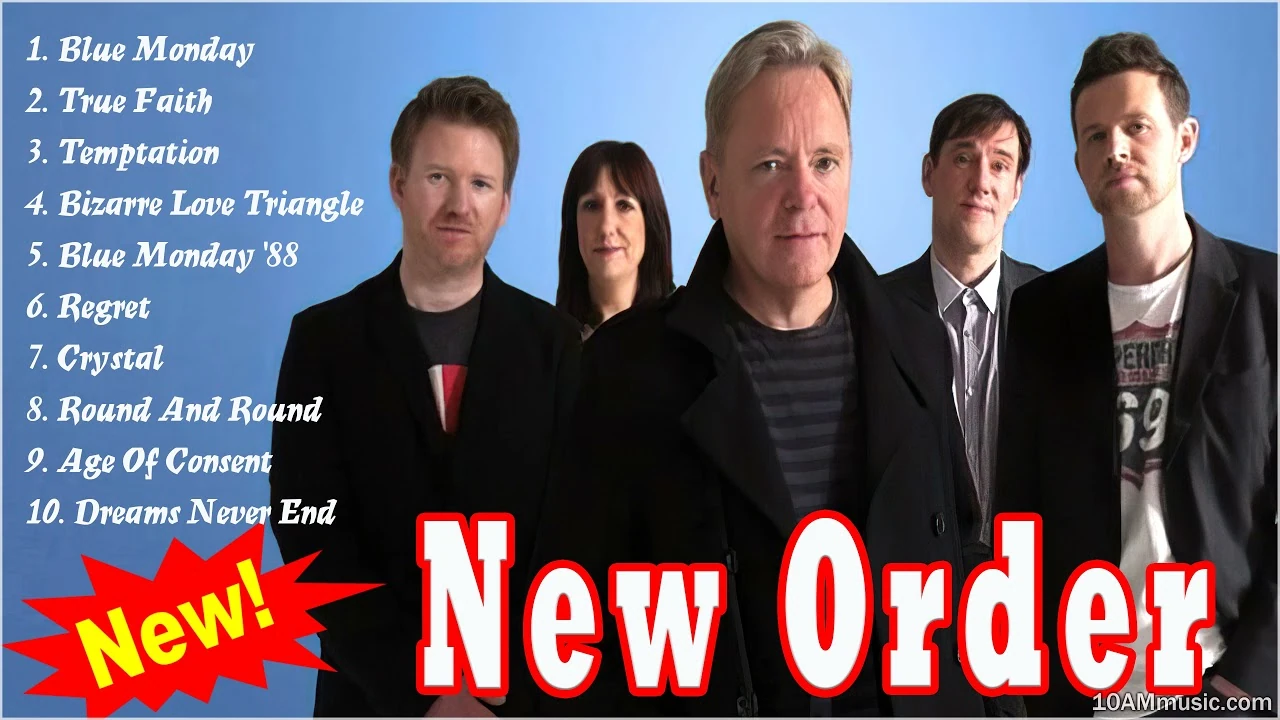
New Order’s music was built on a meeting of opposites: the weight of post-punk guitars and bass, the precision of electronic sequencing and the movement of dance rhythms. The Manchester band emerged from the end of Joy Division in 1980, but did not simply continue under a different name. Its members explored a new musical direction, producing records such as “Blue Monday”, “True Faith” and Technique that helped establish New Order as a leading force in alternative dance.
Starting again after Joy Division
Bernard Sumner, Peter Hook and Stephen Morris had been members of Joy Division, whose singer Ian Curtis died in May 1980. The surviving musicians decided to continue, but under a new name. They made their live debut as an unnamed trio at Manchester’s Beach Club in July that year. Gillian Gilbert, Morris’s partner, joined as keyboardist and guitarist in October, completing the early line-up.
The first release as New Order was “Ceremony”, issued in 1981 with “In a Lonely Place” as its other track. Both songs had been written shortly before Curtis’s death. Their debut album, Movement, followed that November. It retained a dark, melodic quality associated with Joy Division, while synthesizers became more prominent. The band later described this early period as difficult, still close to the loss that had brought their previous group to an end.
A visit to New York in 1981 exposed the musicians to post-disco, freestyle and electro. They also began listening to Italian disco; Morris taught himself drum programming. The change could be heard in the subsequent singles “Everything’s Gone Green” and “Temptation”. New Order were moving beyond the sound of Movement, combining the instincts of a rock band with the possibilities of electronic instruments and dance music.
Factory, the Haçienda and “Blue Monday”
New Order became a central act on Factory Records, the independent Manchester label associated with television presenter Tony Wilson. In May 1982, the band helped finance the label’s Manchester nightclub, the Haçienda. Its opening was marked by a lengthy instrumental piece, an early form of “5 8 6”, whose rhythmic ideas would later surface in other New Order tracks.
The group found its footing on Power, Corruption & Lies, released in 1983. The album joined guitar-based post-punk to synthesizers and early techno influences. Its single “Blue Monday” pushed the electronic side further: a sequenced, four-on-the-floor track shaped in part by disco. The single became the best-selling independent 12-inch single of all time in the UK. Often described more loosely as the best-selling 12-inch single of all time, that wider claim is not what the supplied reference establishes.
New Order continued to move between styles. Low-Life (1985) brought guitar-led and electronic approaches together, including on “The Perfect Kiss”. Brotherhood (1986) placed the two approaches on different sides of the album and included “Bizarre Love Triangle”. The 1987 compilation Substance gathered many of the group’s singles on CD and introduced “True Faith”, whose surreal video found an audience on MTV. The song also became New Order’s first US top 40 hit.
With Technique, released in 1989, the band absorbed the Balearic sounds that had reached the Haçienda. Partly recorded in Ibiza, the album combined acid-house influences with a more traditional rock sound and reached number one in the UK. Its shifting textures captured New Order’s ability to make dance music without abandoning the band’s earlier musical identity.
Hits, a break and a return
In 1990, New Order recorded “World in Motion” for the England national football team’s World Cup campaign, using the name EnglandNewOrder. Co-written with comedian Keith Allen, it featured players’ chants and a guest rap by John Barnes. It became the band’s only UK number one single. The next album, Republic (1993), arrived as Factory Records collapsed under financial pressure. New Order had no formal contract with the label and legally owned its recordings; after Factory’s failure, the band signed to London Records. “Regret”, one of the singles from Republic, became their highest-charting single in the United States.
After promoting the album, the members put New Order on hold to pursue other projects. They reconvened in 1998, returning to live performance and again playing songs by Joy Division. On Get Ready (2001), they shifted towards guitar-led music. The band’s work continued to change with its personnel: Phil Cunningham joined in a live capacity while Gilbert took time away from touring to care for her and Morris’s children. Cunningham became a full member for Waiting for the Sirens’ Call (2005).
After Peter Hook’s departure in 2007, the group reconvened in 2011 with Gilbert back in the line-up and Tom Chapman replacing Hook on bass. New Order released Music Complete in 2015, its first studio album without Hook. A dispute between Hook and the other members over income and royalties was settled in 2017. The band continued to tour and release music, including the 2020 single “Be a Rebel”.
More than a sound: design, collaboration and recognition
New Order’s identity was not confined to its recordings. The band worked over many years with designer Peter Saville, whose sleeves often concealed the group’s name or the record’s title behind colour codes and spare typography. The packaging for Power, Corruption & Lies was among the classic British album covers commemorated on a Royal Mail stamp in 2010. The records’ visual presentation became another way for the group to challenge the conventions of pop promotion.
The musicians also worked beyond the band. Sumner formed Electronic with former Smiths guitarist Johnny Marr, while Gilbert and Morris recorded as the Other Two and worked on television soundtracks. The members used the name BeMusic for production work with artists including Stockholm Monsters, 52nd Street and Section 25. These activities extended New Order’s connections across British independent music, while the band itself remained the main setting in which its members’ contrasting musical interests met.
The supplied reference records a range of recognition. “Blue Monday” and Power, Corruption & Lies won NME Awards in 1983; “True Faith” won the 1988 Brit Award for Best British Video. “Regret” won a Billboard Music Award for Top Modern Rock Track in 1993, and the band received the NME Godlike Genius Award in 2005 and the Q Outstanding Contribution to Music award in 2015. These distinctions are more specific than the original article’s claims of a 1987 Brit nomination and Q Awards for Technique, which the supplied reference does not support.
Why New Order deserves a place in British Legacy
New Order deserves a place in British Legacy because its history shows how a British band could turn a rupture into a new musical language. The group began after Joy Division ended, but its importance lies in what its members built next: a sound that kept the tension and emotional weight of post-punk while making room for synthesizers, drum machines and club rhythms. “Blue Monday” made that combination particularly clear, and the records that followed—from Low-Life and Brotherhood to Technique—showed that electronic and guitar-based music did not have to remain separate worlds.
The band’s contribution also reached beyond its own catalogue. New Order helped finance the Haçienda, linking its work to a Manchester venue that became a significant setting for dance music. Its collaboration with Factory and Peter Saville connected independent music to a distinctive visual identity; its production work and members’ later projects carried those creative relationships further. The band’s UK success, its England football song and the recognition of its records and design give that story a firm British context. New Order’s legacy is not simply that it became influential, but that it made experimentation part of a durable popular-music career: a group could change its sound, move between the club and the rock stage, and still remain recognisably itself.
Sources
New Order (band), revision 1379269593
Adapted in part from New Order (band) by Wikipedia contributors, under CC BY-SA 4.0. Text has been edited and combined with the existing article; this adapted text is shared under the same licence. Contributor history.