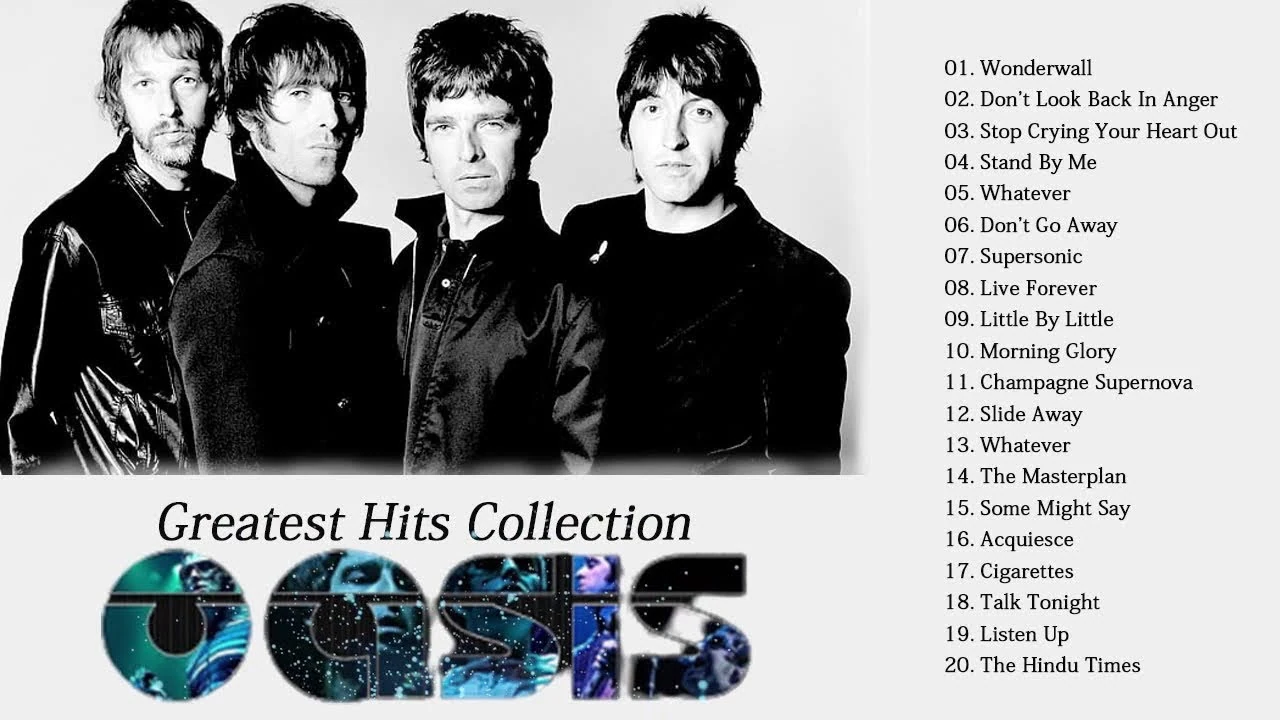
Oasis made no quiet entrance into British culture. Formed in Manchester in 1991, the band paired an unmistakable local identity with songs built for rooms much larger than the pubs where they began. Noel Gallagher supplied the principal songwriting and musical direction; his brother Liam gave the songs their forceful, instantly recognisable voice. Together they made ambition sound less like a hope than a certainty, and gave guitar music a public, communal scale.
Their rise is often told through the swagger, the Gallagher brothers’ public rows and the shorthand of Britpop. Those elements mattered, but they do not explain the music’s endurance. Oasis wrote songs with clear shapes, strong melodies and choruses that invited people in. The result was a catalogue that moved from the charts into everyday life: heard in bedrooms and pubs, taken up by crowds, and returned to when people wanted to sing together.
Manchester ambition at full volume
Oasis were a Manchester band in more than name. The city was part of their identity, not a detail to be smoothed away as their audience grew. The group’s story began in small pub rooms and developed into a career of national prominence. Their manner suggested that music could change their circumstances and that success was a reasonable expectation, not an unlikely prize. That self-belief became part of the appeal: Oasis sounded as if they belonged on the biggest stages before they had reached them.
The band’s central creative partnership was clear early on. Noel Gallagher was the principal songwriter and musical architect, constructing songs around strong chord changes, memorable openings and choruses that opened out decisively. Liam Gallagher was the frontman, bringing a distinctive phrasing and presence to those songs. His delivery could make familiar emotions sound confrontational, while still leaving room for vulnerability. The combination gave Oasis a recognisable centre even as the supporting line-up changed.
Their approach did not depend on musical complexity for its effect. It relied on the craft of choosing the right melody, rhythm and arrangement to make a direct line land. Oasis could be blunt without being emotionally simple: their songs made room for yearning and melancholy alongside defiance. That balance helped them reach listeners who wanted both the force of rock and the immediacy of pop.
Definitely Maybe: a debut with a destination
Released on 29 August 1994, Definitely Maybe went straight to number one in the UK. At the time, it became the fastest-selling debut album in British chart history. The record established the scale of Oasis’s ambition at once. “Supersonic” and “Live Forever” brought together the qualities that would remain central to their music: confidence on the surface, with a strong current of yearning beneath it. The band’s official account gives worldwide sales of more than eight million copies, a measure of how far a sound rooted in a particular place could travel.
The album’s impact came partly from its refusal to apologise for wanting success. Its songs did not present themselves as puzzles that listeners had to solve before they could enjoy them. Instead, the writing relied on directness, well-judged melodies and performances that made each line feel meant. Simplicity, in this setting, was not a lack of craft. It was a way of making the song’s emotional point clear and giving it enough momentum to carry.
That clarity also helped make Oasis more than a passing scene. Their appeal did not require listeners to share a particular background or specialist knowledge of guitar music. The combination of a strong tune, an assured vocal and a chorus designed to expand in performance was accessible without being weightless. The band made self-belief sound like something listeners could borrow for themselves.
(What’s the Story) Morning Glory? and the communal chorus
If the debut announced Oasis, (What’s the Story) Morning Glory? made them unavoidable. The album spent ten consecutive weeks at number one and became one of the biggest-selling records in British chart history. Its success turned a fast-rising band into a permanent presence in popular life. Its songs carried a wider emotional range than the group’s reputation for swagger alone might suggest: bravado and defiance sit alongside melancholy, release and the intimacy of a chorus shared by thousands.
“Wonderwall” shows how a song can outlast its original chart moment. It reached number two in the UK rather than number one, but it became Oasis’s biggest song and their most-streamed track in the UK, according to the supplied Official Charts account. Its life extended beyond the single’s initial release: it could be heard on radio, played on acoustic guitars and sung in gatherings by listeners who had not been there for the album’s arrival. The song’s familiarity did not depend on people treating it as a museum piece. It continued to work as a song people could take up for themselves.
“Don’t Look Back in Anger” offered another kind of reach. Noel Gallagher sang lead on the track, which reached number one. Its place in the band’s catalogue is bound up with its ability to turn an individual voice into a shared one. “Champagne Supernova”, meanwhile, was not issued as a UK single but became one of Oasis’s most enduring and most-streamed recordings. Its drifting atmosphere showed a less immediate, more expansive side to the group. Together, the songs demonstrate that Oasis’s appeal rested on more than impact: they could build atmosphere and leave listeners with an emotional afterglow as well as a chorus to shout.
The success of Morning Glory made the band’s songs part of a common repertoire. That did not mean everyone heard them in the same way. One listener might value the confidence, another the melody, another the feeling of a room joining in. The songs were structured to hold those different responses at once, which helps explain why their audience has continued beyond the generation that first heard them on release.
Britpop, Blur and Knebworth
Oasis were central to Britpop, though their significance was not confined to the movement. In 1995, the release of “Roll With It” and Blur’s “Country House” in the same week became a highly publicised chart contest. Blur won that week’s race. The rivalry was turned into a wider story about class, region, style and cultural ownership, with the two bands made into symbols as well as competitors. Oasis represented an expansive, declarative strand of Britpop, one particularly suited to large choruses and mass singalongs.
The scale of their rise was unmistakable by 1996. Over two nights at Knebworth, Oasis drew a quarter of a million people. The jump from pub rooms to crowds on that scale was more than a striking concert statistic. It showed how quickly songs written by a Manchester band had become a national event. Oasis had moved beyond being a notable group within a music scene: their performances and records now gave large numbers of people a shared cultural reference point.
Their achievement also depended on more than the attention attracted by the brothers’ disagreements or provocative public statements. The music sustained the attention. Noel Gallagher’s efficient structures and strong hooks gave the songs a recognisable framework; Liam Gallagher’s singing gave them physical presence. The band’s direct emotional address meant that a song could feel personal on first listening and expansive when sung by a crowd.
Success, separation and return
Oasis’s recorded success was substantial. The band’s official music page reports more than 70 million albums sold, more than 30 awards and 22 consecutive UK top-ten singles. Be Here Now, released after the first two albums’ breakthrough, became the fastest-selling album in UK chart history on its release, according to the supplied Official Charts account. Those figures describe a long run of mass appeal, not merely the brief heat of a rivalry or a headline.
In 2007, the BRIT Awards gave Oasis its Outstanding Contribution to Music award. The band split in 2009, following years of tension between the Gallagher brothers. The separation ended the group’s run, but it did not end the public life of the songs. Their continued circulation showed that the catalogue had acquired an identity beyond the circumstances of the band’s working relationship.
Later milestones made that persistence visible. In 2024, Definitely Maybe returned to number one in the UK on its thirtieth anniversary. The band’s official site announced the Oasis Live ’25 return in 2025. In 2026, the supplied article reports that Oasis were inducted into the Rock & Roll Hall of Fame. These developments are different kinds of recognition, but together they show that the group’s history continued to attract listeners and public attention long after the original split.
When a song becomes a public voice
The afterlife of “Don’t Look Back in Anger” became particularly visible after the Manchester Arena bombing in May 2017. Crowds in Manchester sang it spontaneously in the days after the attack, using the song as an expression of mourning and solidarity. It also carried weight around the One Love Manchester benefit. The response drew on a song already familiar to many people; it was not a meaning attached by a campaign or a promotional plan.
That moment helps explain what distinguishes a hit from a lasting public song. Oasis wrote music that people could take into their own experiences, including celebration, remembrance and grief. When a crowd sings a familiar chorus together, each person brings a private feeling to it, but the shared performance gives that feeling a public form. “Don’t Look Back in Anger” had acquired this capacity because its musical shape and emotional directness made it available to listeners.
“Wonderwall” and “Don’t Look Back in Anger” show two sides of the same legacy. One has travelled through everyday listening and repeated singalongs; the other has also become a song people have reached for at a moment of collective loss. Their continuing presence is not simply nostalgia for the 1990s. It reflects the way a plainly written, well-made song can remain useful to new audiences, who bring their own associations without needing to know the full story of the band.
Why Oasis deserves a place in British Legacy
Oasis deserves a place in British Legacy because the band turned a specific local identity into music with an unusually broad public reach. Their Manchester origins remained part of the story as their audience expanded, and their rise showed that local accent and ambition did not have to be put aside to achieve national success. Noel Gallagher’s songwriting joined direct language to strong melodies and clear structures; Liam Gallagher’s voice made those songs vivid and forceful. Together they made guitar music feel accessible without making it emotionally thin.
Their contribution is also measurable in the songs’ continuing life. Definitely Maybe and (What’s the Story) Morning Glory? marked the band’s rapid ascent, while “Wonderwall”, “Don’t Look Back in Anger” and “Champagne Supernova” have each found lasting audiences in different ways. Knebworth demonstrated the scale of that connection; the crowds singing “Don’t Look Back in Anger” after the Manchester Arena bombing showed how a song could become part of public mourning and solidarity. These are specific achievements, not generic claims about national character.
Oasis helped make popular British music local in voice and wide in reach. Their songs could be learned, played and sung by people far removed from the band’s beginnings, because the writing invited participation. A chorus that works in a bedroom can also hold a stadium, a pub or a crowd gathered in remembrance. That passage between private listening and collective expression is central to the band’s legacy. Oasis gave listeners a shared musical language for confidence, longing and grief, and the songs continue to benefit those who find a voice in them.