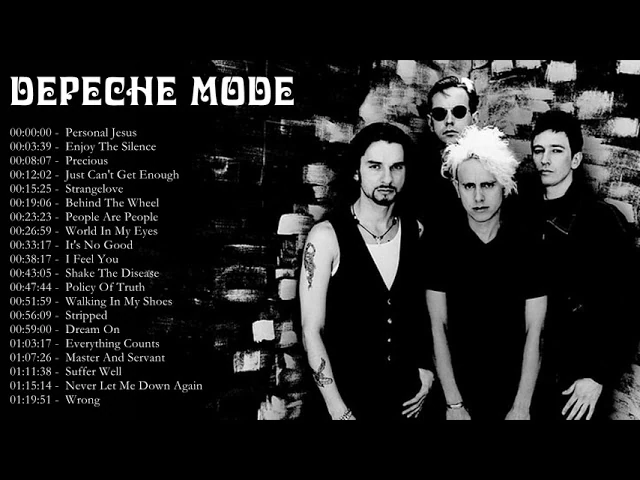
Depeche Mode began in Basildon with synthesisers, school friendships and an appetite for a different kind of pop. Over the decades, the English band moved from the bright, direct synth-pop of “Just Can’t Get Enough” towards music of greater darkness and texture, without abandoning the pull of a strong melody. Their history is also one of changing line-ups: Vince Clarke’s early songwriting, Martin Gore’s long stewardship of the songs, Alan Wilder’s contribution to the band’s sound, and the partnership of Dave Gahan and Gore after the deaths of Andy Fletcher and, much earlier, the departure of Clarke.
Basildon beginnings and a new name
The band’s origins date to 1977, when schoolmates Vince Clarke and Andy Fletcher formed No Romance in China. In 1980 they started a new group, Composition of Sound, with Martin Gore joining as a third instrumentalist. Dave Gahan came aboard later that year after Clarke heard him sing David Bowie’s “’Heroes’” at a local Scout hut session. With synthesisers becoming more accessible, the four began to pursue an electronic direction.
Composition of Sound played its first concert as a four-piece on 14 June 1980 at Nicholas School in Basildon. The band adopted the name Depeche Mode at a concert later that year. Gahan chose it from the name of the French fashion magazine Dé p êche Mode; Gore explained that he liked the sound of the words. The name is often glossed as “fast fashion”, but the more accurate translation of the magazine’s title is “Fashion News” or “Fashion Update”.
The band made an early recording with “Photographic” for the Some Bizzare Album, then caught the attention of Mute Records founder Daniel Miller. Their first single, “Dreaming of Me”, reached number 57 in the UK charts in 1981. “New Life” climbed to number 11, and “Just Can’t Get Enough” became their first UK top-ten hit. Their debut album, Speak & Spell, followed in October 1981, reaching number 10 in the UK album chart.
Changing writers, changing sound
Clarke left in November 1981, after the first album’s release. He had been the band’s principal songwriter, so his departure placed Martin Gore at the centre of the writing. The shift was audible in A Broken Frame (1982), made by the remaining trio. Alan Wilder, initially brought in as a touring musician, became an official member in 1983. His musical role and the band’s use of sampling helped shape the increasingly layered records that followed.
On Construction Time Again (1983), the group sampled everyday objects, creating an industrial-influenced sound; “Everything Counts” reached number six in the UK. Some Great Reward (1984) turned towards subjects including sexual politics, relationships and religion. “People Are People” became a major international success, while “Somebody” introduced Gore as a lead vocalist on a ballad. These records show why the band’s development cannot be reduced to a simple move from cheerful pop to gloom: from early on, its members were testing what electronic instruments could carry, musically and lyrically.
Black Celebration (1986) gave the group a darker, more atmospheric sound. Its visual identity also began a long association with photographer and director Anton Corbijn, whose first Depeche Mode video was “A Question of Time”. Corbijn went on to direct many of their videos, film live performances and design stage sets and record covers. On Music for the Masses (1987), the band continued experimenting, this time largely turning away from sampling in favour of synthesiser work. The album’s singles included “Strangelove” and “Never Let Me Down Again”.
Breaking through on both sides of the Atlantic
Depeche Mode’s growth from a British synth-pop act into a major international band was especially visible on tour. Their 1988 concert at the Pasadena Rose Bowl drew more than 60,000 people. Filmmaker D. A. Pennebaker documented the occasion and the band’s relationship with its fans in 101, a concert film accompanied by a soundtrack album.
The 1990 album Violator brought together wider commercial reach and a distinctive, carefully constructed sound. “Personal Jesus” became one of the band’s biggest-selling singles to that point, while “Enjoy the Silence” reached number six in the UK and won Best British Single at the 1991 Brit Awards. Violator reached number seven on the US Billboard 200 and was certified triple platinum in the United States. Its success made the band’s electronic foundations visible within a global pop context, rather than confining them to a specialist genre.
In 1993, Songs of Faith and Devotion expanded the palette again, mixing synthesisers with distorted guitars, live drums, strings, uilleann pipes and gospel vocals. It debuted at number one in both the UK and the United States. The ambitious Devotional Tour lasted fourteen months and included 159 performances. After the tour, strains within the group and personal difficulties among members marked a turbulent period. Wilder left in 1995, and the band continued as Gahan, Gore and Fletcher.
Reinvention, loss and continuation
Ultra, released in 1997, was the trio’s first studio album after Wilder’s departure. The group did not tour to promote it, but returned to the stage for the 1998 Singles Tour. Subsequent albums carried the band into the new century: Exciter (2001), Playing the Angel (2005), Sounds of the Universe (2009), Delta Machine (2013) and Spirit (2017). Their arrangements and production changed, while Gore remained the principal songwriter and the band continued to release records and tour internationally.
Andy Fletcher died in 2022. Gahan and Gore continued as a duo, releasing Memento Mori in 2023. The album was followed by a tour that concluded in April 2024. Their continued work after Fletcher’s death gives the band’s changing membership a human as well as musical dimension: Depeche Mode has repeatedly had to find a new form without erasing the contribution of those who came before.
Influence beyond the charts
The band’s reach is measurable in records sold, chart appearances and audiences: the supplied account reports more than 100 million records sold worldwide, 54 UK singles-chart entries and 17 UK top-ten albums. It also records their 2020 induction into the Rock and Roll Hall of Fame. Those figures sit alongside a less numerical legacy. Depeche Mode’s use of electronic instruments, sampling and deliberate sonic experimentation offered a model for artists working across pop, alternative rock and electronic music. Musicians including Arcade Fire, the Killers, Nine Inch Nails, Coldplay and Muse have cited the band as an influence.
Their visual work has been part of that influence. Corbijn’s collaboration gave the band a recognisable visual language across music videos, live films, stage design and sleeve art. The live history mattered too: the Rose Bowl concert and 101 presented a large, international audience not as an afterthought but as part of the band’s story. Depeche Mode’s success came not from staying within a single definition of synth-pop, but from revising their sound and presentation while retaining a clear identity.
Why Depeche Mode deserves a place in British Legacy
Depeche Mode deserves a place in British Legacy because its story begins in a particular British setting and traces the transformation of a local band into an international force. Basildon was not merely an address in the group’s biography: it was where Composition of Sound became a four-piece, where Depeche Mode first performed, and where a new electronic pop identity took shape. Their early UK chart success helped carry that sound beyond its starting point, while later records showed that electronic instruments could support complex arrangements and lyrics about personal, political and spiritual subjects.
The band’s British contribution is also visible in its sustained influence. Albums such as Speak & Spell, Black Celebration and Violator mark different stages in an evolving musical language, rather than a single invention frozen in time. Their work with Anton Corbijn connected British popular music to a lasting visual practice, while the group’s changing line-ups show how creative work can continue through departures and loss. With chart success, international audiences and artists across genres acknowledging their influence, Depeche Mode demonstrate how a band formed in Essex helped shape the sound and image of modern popular music well beyond Britain.
Sources
Depeche Mode — Wikipedia, revision 1376508357
Adapted in part from Depeche Mode by Wikipedia contributors, under CC BY-SA 4.0. Text has been edited and combined with the existing article; this adapted text is shared under the same licence. Contributor history.