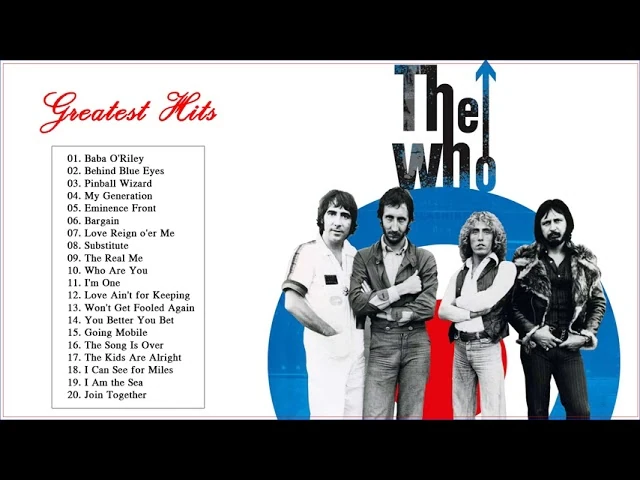
The Who made rock music feel like an event. Their songs could be sharp, impatient pop; their concerts could turn feedback, volume and smashed instruments into part of the performance. At the same time, Pete Townshend’s songwriting carried them beyond the single, towards ambitious works such as Tommy and Quadrophenia. The band’s history began in west London, but its influence reached far beyond Britain.
West London beginnings and the mod years
The group grew out of the Detours, formed by Roger Daltrey in 1959. Daltrey, Pete Townshend and John Entwistle grew up in Acton and attended Acton County Grammar School. Townshend later studied at Ealing Art College. The early Detours played pop and instrumental covers, including material by the Shadows and the Ventures. Entwistle moved to bass after struggling with the guitar, and his melodic approach would become a distinctive part of the band’s sound.
In 1964, the Detours changed their name to the Who. Keith Moon joined that year, completing the line-up that would define the band: Daltrey on vocals, Townshend on guitar, Entwistle on bass and Moon on drums. Before settling on their own identity, they briefly performed as the High Numbers. Manager Peter Meaden dressed them in mod clothes and associated them with a British youth movement whose style included scooters and interests in rhythm and blues, soul and modern jazz. The name and the look were temporary; the connection to mod culture became lasting material for Townshend’s songs and, later, for Quadrophenia.
The Who’s earliest London gigs helped establish a live reputation. Their managers Kit Lambert and Chris Stamp encouraged the slogan “Maximum R&B” and helped turn the group’s stage presence into a distinctive part of its appeal. In 1964, Townshend accidentally broke his guitar against the low ceiling at the Railway Hotel in Wealdstone. After the audience laughed, he smashed it on the stage, then continued with another instrument. Moon soon kicked over his drum kit. What began with mishap and retaliation developed into a performance gesture associated with the band and its interest in pop art’s capacity for destruction.
Singles that sounded like an argument
The Who’s first single under their new name, “I Can’t Explain”, reached the UK top ten in 1965. Its success was helped by airplay on pirate radio and an appearance on television music programme Ready Steady Go! The band followed it with “Anyway, Anyhow, Anywhere”, whose guitar noises and feedback pushed beyond the conventions of polished pop. These early records established Townshend as a songwriter interested in more than familiar romantic themes. His songs gave frustration, identity and the need to break away a place in British pop.
“My Generation”, released in 1965, made that approach unmistakable. Daltrey’s stammering vocal, Entwistle’s bass solo and the forceful playing gave the song an unsettled energy. Townshend later said its line “Hope I die before I get old” was not meant literally. The single reached number two in the UK, the band’s highest-charting single there. Its importance lies not only in its provocation but in the way the group made youth sound restless and defiant rather than neatly packaged.
Their early run of singles continued with “Substitute”, “I’m a Boy”, “Happy Jack” and “Pictures of Lily”. The group also expanded its songwriting beyond Townshend: Entwistle contributed songs including “Boris the Spider”. In 1967, The Who Sell Out turned the idea of radio into the structure of an album, placing jingles and mock commercials between songs. Its playful advertising conceits reflected the band’s pop-art interests while “I Can See for Miles” became their most successful US single, reaching number nine there.
A live sound built for impact
The Who’s stage act was not a substitute for musical invention; the two developed together. Townshend’s windmill-style strumming, Daltrey’s microphone swings, Moon’s restless movement behind the kit and Entwistle’s comparatively still presence made the band visually distinctive. Their live performances also helped normalise feedback as a musical resource, extreme volume and the power chord as a central element of rock guitar. Townshend and Entwistle were early users of Marshall amplification, and the group became associated with large public-address systems.
Moon’s drumming was central to that impact. Rather than simply marking time behind the other musicians, he filled spaces with rolls and cymbal crashes, pushing against the expected role of a rock drummer. Entwistle’s bass could take a similarly prominent, melodic role. The result was a band whose sound could seem turbulent without losing its musical shape.
The Who’s appearances at the Monterey Pop Festival and Woodstock brought them to a much larger American audience. In 1970, they recorded the performance used for Live at Leeds, an album that captured a band able to move between force and precision. The record remains an important document of their live work, not merely a souvenir of the instrument-smashing spectacle. Their concerts helped change expectations of what a rock performance could be: an occasion with its own sound and drama, rather than a reproduction of a studio record.
Tommy and the scale of a rock story
Released in 1969, Tommy made The Who central to the development of the rock opera. Townshend’s concept album tells the story of a deaf, dumb and blind boy and his attempt to communicate. The record gave the band a sustained narrative, recurring ideas and a scale larger than a collection of singles, without surrendering the immediacy of individual songs. “Pinball Wizard” brought the project a particularly accessible hit.
Tommy was both commercially successful and a considerable critical achievement. Its reception showed that a rock group could attempt a long-form work and still reach a broad audience. The album also changed the band’s prospects and placed greater demands on Townshend as its principal songwriter. In 1975, the story was adapted into a film directed by Ken Russell, with Daltrey in the title role and a cast that included Ann-Margret, Oliver Reed, Tina Turner, Elton John and Jack Nicholson. The film brought the work into a different medium; Townshend was nominated for an Academy Award for Best Original Score.
From Lifehouse to Quadrophenia
Townshend’s planned follow-up to Tommy, Lifehouse, was conceived as a multimedia project about the relationship between an artist and an audience. Its complexity caused tensions within the band, and Townshend eventually abandoned the project. Much of its musical material became Who’s Next, released in 1971. “Baba O’Riley” and “Won’t Get Fooled Again” made synthesiser patterns a structural part of rock songs, rather than an ornamental addition. The album reached number one in the UK and number four in the United States.
In 1973, Quadrophenia returned to the mod world from which the band had emerged. Its central character, Jimmy, faces a crisis of identity and struggles with family, friends and the need to belong. Townshend built the album around musical themes associated with the four members of the group, using layered synthesisers alongside Entwistle’s prominent bass and horn parts. The result is a story rooted in British youth culture and its tensions: the pull of a tribe, the limits of style as self-invention and the frustration of feeling misunderstood.
The album’s narrative was not limited to a general portrait of youth. Its setting, characters and recurring musical ideas gave it a strong sense of place and structure. A film adaptation followed in 1979, with Phil Daniels as Jimmy and Sting as the Ace Face. Its success helped connect the work with the mod revival. Quadrophenia remains an unusually detailed account of British youth culture, created by a band whose own beginnings were bound up with that scene.
Change, loss and later performances
The band’s later history was shaped by the deaths of two of its founding members. Keith Moon died in September 1978, shortly after the release of Who Are You. Kenney Jones, formerly of the Small Faces and the Faces, joined on drums, and The Who returned to touring in 1979. Their final years with Jones included the albums Face Dances and It’s Hard. In December 1979, a crowd crush at a concert in Cincinnati killed 11 people. The band were told after the performance and later requested that appropriate safety precautions be taken at future concerts.
The Who officially split in 1983, after Townshend decided he could not produce suitable material for a new album. They subsequently reunited for selected appearances and tours, including Live Aid at Wembley Stadium in 1985 and a 25th-anniversary tour in 1989. A revival of Quadrophenia brought Daltrey, Townshend and Entwistle together for performances in 1996 and 1997. In 1999, the three resumed touring as The Who, with Zak Starkey on drums and John “Rabbit” Bundrick on keyboards.
John Entwistle died in 2002, shortly before a planned US tour. Daltrey and Townshend continued, supported by touring musicians. The first Who studio album of new material since 1982, Endless Wire, appeared in 2006; the band released Who in 2019. Their later activity included major performances in Britain, among them headlining Glastonbury in 2007 and appearing at the closing ceremony of the London 2012 Olympic Games. In 2025, the band announced that their North American dates would be a farewell tour.
Recognition and influence
The Who were inducted into the Rock and Roll Hall of Fame in 1990 and the UK Music Hall of Fame in 2005. Their honours also include a Lifetime Achievement Award from the British Phonographic Industry in 1988 and a Grammy Lifetime Achievement Award in 2001. “My Generation”, Tommy and Who’s Next have each been inducted into the Grammy Hall of Fame.
Their influence is audible across hard rock, punk, power pop and mod revival music. The band’s approach to guitar noise and volume helped shape expectations of hard rock, while groups including the Jam drew on their connection to mod culture. Their work also travelled through recordings, films and television. The film adaptations of Tommy and Quadrophenia carried the band’s long-form storytelling into cinema, and The Who’s music has featured in a range of popular programmes and films. Their importance is not just the number of later acts they influenced: it is the range of ways they demonstrated that a rock band could perform, compose and tell stories.
Why The Who deserve a place in British Legacy
The Who deserve a place in British Legacy because they made particular British experiences carry across borders without stripping them of their local character. Their early years in Acton, Shepherd’s Bush and London clubs connected them to the mod movement and to the ambitions of young people searching for a style and a voice of their own. “My Generation” gave that restlessness a distinctive sound. A decade later, Quadrophenia revisited the mod world with a sustained story about identity, class and belonging. These works are not simply records of fashion: they preserve the tensions and possibilities of British youth culture in music that continues to speak to listeners elsewhere.
Their contribution also changed what audiences could expect from rock. The Who made feedback, great volume and a highly physical stage act part of a band’s artistic vocabulary. They showed that a group known for energetic singles could also make ambitious narrative albums such as Tommy and Quadrophenia, or build synthesiser patterns into the structure of songs on Who’s Next. Those innovations offered later musicians new ways to play and new scales on which to write. Their work has endured through recordings, performances and film adaptations, and their influence reaches across several generations and genres. That combination of musical experiment, British social observation and lasting public reach is why The Who belong in the country’s cultural history.
Sources
The Who — Wikipedia revision 1375587887
Adapted in part from The Who by Wikipedia contributors, under CC BY-SA 4.0. Text has been edited and combined with the existing article; this adapted text is shared under the same licence. Contributor history.