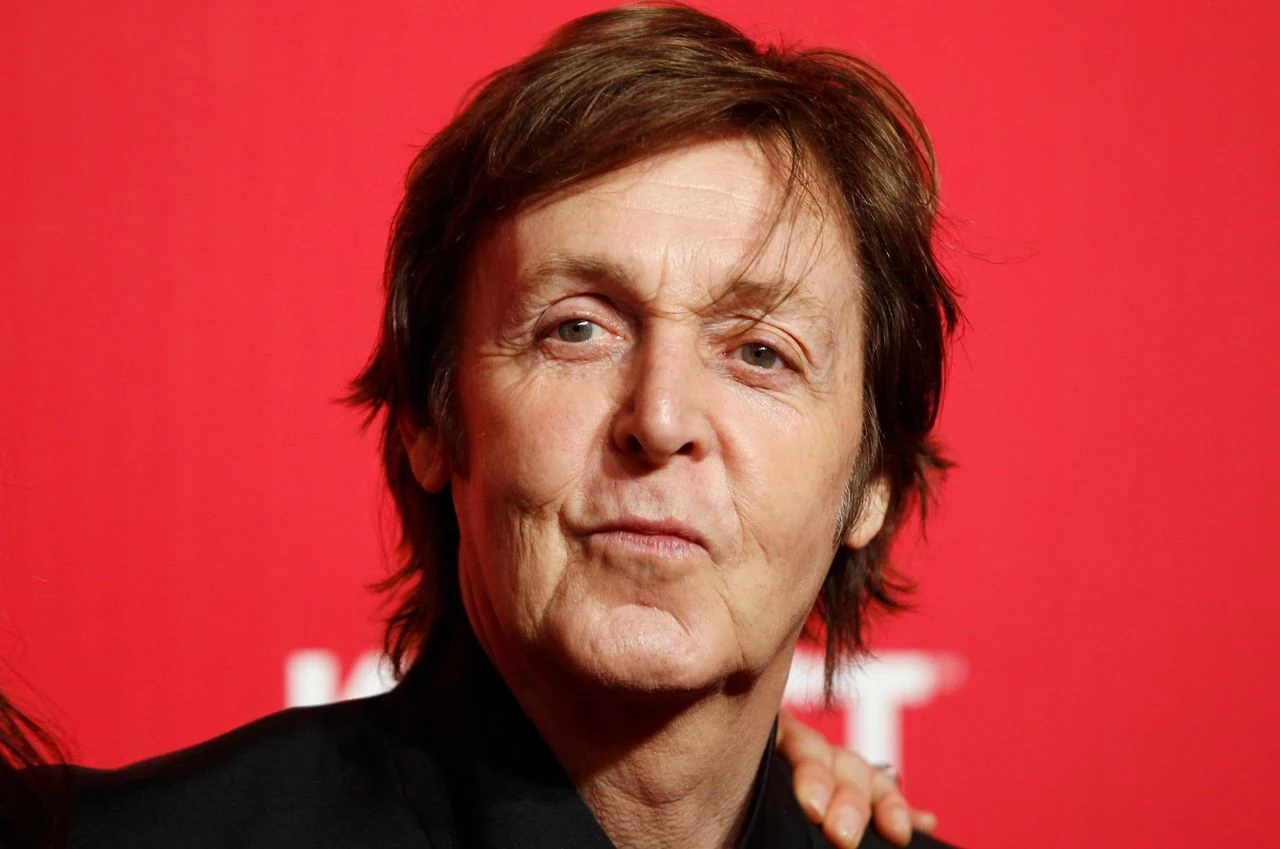
Paul McCartney’s story begins in Liverpool, where a teenager joining John Lennon’s skiffle group helped set in motion one of the most consequential partnerships in popular music. As a Beatle, he became a bassist, singer and songwriter; after the band broke up, he built a second major career with Wings and as a solo artist. His public life has also taken in animal-welfare campaigning, benefit performances and a lasting connection to music education in his home city.
Liverpool, the Quarrymen and the Beatles
James Paul McCartney was born in Liverpool on 18 June 1942. He taught himself piano, guitar and songwriting as a teenager, drawing on the music of his father, a jazz player, and American performers including Little Richard and Buddy Holly. He met Lennon at a church-hall fête in Woolton on 6 July 1957 and joined Lennon’s group, the Quarrymen. George Harrison joined in 1958; after further changes in personnel and name, the Beatles took shape in 1960.
McCartney became the group’s bass player in 1961. His partnership with Lennon supplied the Beatles with many of their best-known songs and placed him at the centre of their singing and songwriting. “Yesterday”, “Eleanor Rigby” and “Blackbird” show the range of his writing; his musical role extended beyond bass to keyboards, guitar, drums and arrangements. As the group moved from concert performances towards ambitious studio work, McCartney helped drive that change. He proposed the fictional band concept behind Sgt. Pepper’s Lonely Hearts Club Band and took a leading role in shaping the record and other late Beatles projects.
The Beatles’ break-up became formal in the years after McCartney announced his departure in April 1970. His first solo album, McCartney, appeared that year. He formed Wings with his wife Linda and musician Denny Laine in 1971. The band’s success was not simply an extension of the Beatles: Wings developed its own identity through touring and a run of popular records, among them Band on the Run, Venus and Mars and Wings at the Speed of Sound. “Mull of Kintyre”, written with Laine, became one of the best-selling singles in British chart history.
A career that kept changing shape
After Wings ended in 1981, McCartney continued to move between forms and collaborators. His 1982 duet with Stevie Wonder, “Ebony and Ivory”, became a transatlantic number one; he also recorded “Say Say Say” with Michael Jackson. In 1991, the Royal Liverpool Philharmonic Society commissioned a work for its 150th anniversary. McCartney collaborated with composer Carl Davis on Liverpool Oratorio, a turn towards orchestral music that widened a catalogue already spanning rock, pop and ballads.
He explored electronic music with Youth as the Fireman, released classical works including Standing Stone and Ecce Cor Meum, and continued to record and tour. His later solo albums include Chaos and Creation in the Backyard, Egypt Station and McCartney III. In 2022, he headlined Glastonbury Festival, becoming its oldest solo headliner. Across these different projects, the thread is not one fixed style but a willingness to keep composing and performing in new settings.
McCartney’s musical reputation rests partly on the scale of his catalogue and partly on the character of his work. His songs can be built around direct melodies and accessible forms, while his playing and studio work show a persistent interest in changing texture and arrangement. He is known for melodic bass lines, a wide vocal range and an eclectic approach to instrumentation. The result is a body of work that has travelled from Beatles recordings to Wings, solo albums, collaborations and concert stages.
Campaigns beyond the stage
McCartney has been a vegetarian since 1975 and has spoken publicly for animal welfare. He and Linda became activists after deciding to stop eating meat, and McCartney has supported People for the Ethical Treatment of Animals as well as other animal-protection organisations. His public campaigning has included opposition to seal hunting and support for efforts to protect wildlife. These activities form part of a sustained commitment, rather than a single charitable appearance.
His involvement in public causes has also included work on landmines, poverty and disaster relief. After marrying Heather Mills, he joined her campaign against landmines and became a patron of Adopt-A-Minefield. He has appeared at benefit events and taken part in charity recordings, including Live Aid, Live 8 and the 1989 Hillsborough disaster appeal recording of “Ferry Cross the Mersey”. Following the September 2001 attacks, he took a leading role in organising the Concert for New York City. Such events have used his public standing and musical work to direct attention and funds towards particular causes.
His advocacy for vegetarianism has included Meat Free Monday, a campaign encouraging people to avoid meat one day a week. The proposal is a practical invitation rather than a demand for everyone to adopt the same diet. His animal-welfare work has also been expressed through campaigning and public communication, including support for PETA. Claims that any one campaign changed public opinion worldwide are difficult to establish; the evidence here is the sustained activity itself and the organisations and causes he has supported.
Keeping music education close to home
McCartney’s contribution to music education has a particularly clear Liverpool connection. He co-founded the Liverpool Institute for Performing Arts (LIPA) in 1996, and has served as its lead patron. The institution occupies the former Liverpool Institute for Boys, the school building McCartney attended. Its focus extends beyond performance to the training of people working across the performing arts and music industries.
The project links his own route into music with opportunities for others to develop creative and professional skills. McCartney’s support for LIPA is therefore more concrete than a general endorsement of arts education: it is an enduring relationship with a Liverpool institution based in a building tied to his own education. That local commitment sits alongside his wider campaigning and international career, giving his public work a direct connection to the city where his musical life began.
Honours and a continuing legacy
McCartney’s honours reflect both his British musical standing and his international reach. He was appointed a Member of the Order of the British Empire in 1965 and knighted in 1997 for services to music. He has received 19 Grammy Awards and was inducted into the Rock and Roll Hall of Fame twice: with the Beatles and as a solo artist. In 2017, he was appointed a Member of the Order of the Companions of Honour.
Recognition, however, is only one measure of a career that has continued to produce work. McCartney has recorded across decades, returned repeatedly to the concert stage and pursued projects beyond popular song, including orchestral composition, books and visual art. His long association with Liverpool is visible not only in songs and biographical landmarks, but in LIPA and the institution’s continuing work with students.
Why Sir Paul McCartney deserves a place in British Legacy
McCartney’s place in British Legacy rests first on the scale and durability of his contribution to music. From his early partnership with Lennon to the Beatles’ studio innovations, the independent success of Wings and his continuing solo work, he has repeatedly helped shape popular music rather than simply preserve one period of it. Songs such as “Yesterday” and “Hey Jude” have travelled far beyond their original audiences, while his musicianship and willingness to cross between pop, rock and orchestral forms have made his career unusually broad. His honours, including a knighthood for services to music, recognise a contribution rooted in British cultural life and heard around the world.
His legacy also has a practical, civic dimension. McCartney has used performances and public advocacy to support animal welfare, landmine campaigns and humanitarian causes, and his work with LIPA connects his name to opportunities for future performers and arts professionals in Liverpool. That combination matters: a celebrated artist has directed attention not only towards his own work but towards institutions, campaigns and causes beyond it. The Liverpool connection is specific and lasting, from the city where the Beatles began to an educational institution in his former school building. Together, these achievements show how musical influence can be joined to public engagement and investment in the next generation.
Sources
Adapted in part from Paul McCartney by Wikipedia contributors, under CC BY-SA 4.0. Text has been edited and combined with the existing article; this adapted text is shared under the same licence. Contributor history.