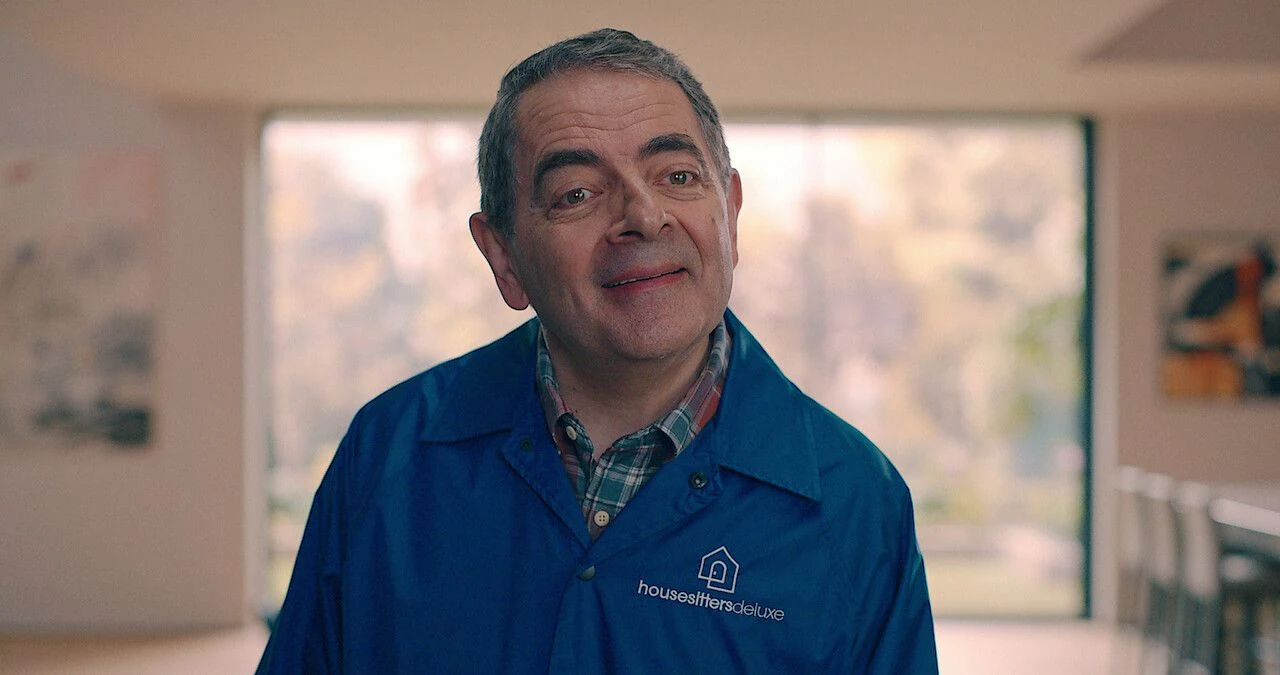
Rowan Atkinson’s comedy can work with almost no words. As Mr Bean, a glance, pause or badly judged attempt at an ordinary task can carry a whole scene; as Edmund Blackadder, a sentence can turn into a weapon. The contrast between those characters captures the range of a performer who has moved between visual comedy, satire, television drama, film and the stage.
Engineering and an early turn to performance
Rowan Sebastian Atkinson was born on 6 January 1955. The supplied reference gives his birthplace as either Consett, County Durham, or Gosforth, Newcastle upon Tyne, so a definite choice between the two would overstate what it establishes. He was the youngest of four sons of Eric Atkinson, a farmer and company director, and Ella May Atkinson. He attended Durham Chorister School and St Bees School, then studied electrical and electronic engineering at Newcastle University, graduating in 1975.
Atkinson continued at The Queen’s College, Oxford, where he began doctoral study before concentrating on acting. He completed an MSc in electrical engineering; his master’s thesis, published in 1978, concerned the application of self-tuning control. Oxford also gave him a route into performance. He wrote and performed sketches for the university’s Experimental Theatre Club and Dramatic Society, and met writer Richard Curtis and composer Howard Goodall, with whom he would collaborate in later years.
In August 1976, Atkinson attracted national attention with the Oxford Revue at the Edinburgh Festival Fringe. He toured with a stage show in 1980 and appeared in The Secret Policeman’s Ball, a London benefit for Amnesty International, in 1979. These live performances sat alongside his first television work and established the combination that would shape his career: carefully constructed writing and a physical presence capable of carrying a joke without explanation.
Sketch comedy and the making of Blackadder
Atkinson’s first major television success came with the BBC sketch show Not the Nine O’Clock News, which ran from 1979 to 1982. He performed alongside Griff Rhys Jones, Mel Smith and Pamela Stephenson and was one of the principal sketch writers. Its material ranged from verbal satire to largely wordless routines, including sketches built around an invisible drum kit or piano. He also wrote and performed in the BBC Radio 3 series The Atkinson People in 1979, playing fictional interview subjects in satirical conversations.
Atkinson’s next defining television role was Edmund Blackadder. The first series, The Black Adder (1983), made its title character naïve and unintelligent in a medieval setting. Later series reimagined Blackadder as a more calculating figure in different historical periods: Elizabethan England in Blackadder II (1986), the Regency era in Blackadder the Third (1987), and the First World War in Blackadder Goes Forth (1989). Richard Curtis co-wrote the first series with Atkinson; Ben Elton joined Curtis as a writer for the second.
The character’s clipped insults and strategic self-interest gave Atkinson a markedly different comic instrument from the largely silent Mr Bean. The series also depended on its ensemble, including Tony Robinson as Baldrick, Tim McInnerny, Stephen Fry and Hugh Laurie. Specials extended the story, among them Blackadder’s Christmas Carol and Blackadder: The Cavalier Years in 1988, and Blackadder: Back & Forth in 1999. Atkinson later returned to the character for a 2012 Prince’s Trust comedy gala sketch, playing Blackadder as a bank chief executive facing an enquiry into the banking crisis.
Mr Bean: physical comedy with a worldwide reach
Mr Bean first appeared in a half-hour Thames Television special on New Year’s Day 1990. The character relies on expression, movement and an often self-centred approach to everyday problems rather than extended dialogue. Atkinson has identified French comedian Jacques Tati’s Monsieur Hulot as a major inspiration; the visual tradition also places the character in conversation with performers such as Charlie Chaplin and Buster Keaton. Mr Bean’s lack of reliance on spoken language helped the character travel across language markets, though the comedy rests on precise timing and an intensely particular performance rather than on anonymity.
The television stories continued until 1995. Atkinson then took Bean to the cinema in Bean (1997) and Mr. Bean’s Holiday (2007), and voiced him in Mr. Bean: The Animated Series. The character also appeared in television advertising and public events. At the London 2012 Olympic Games opening ceremony, Atkinson played Bean in a sketch accompanying “Chariots of Fire”, turning a single repeated synthesiser note into a comic interruption of the runners’ imagined race.
Atkinson has spoken at different times about reducing or ending his work as Mr Bean, and later said he would not retire the character. Rather than treating those remarks as a single settled announcement, the record shows a performer weighing the demands of a physically exact role against its continuing popularity. In 2018, his Mr Bean channel received YouTube’s Diamond Play Button after passing ten million subscribers; the character also became a prominent presence on Facebook. The figures underline the scale of the audience, while the character’s construction remains rooted in a simple comic problem: what happens when someone with little awareness of others tries to impose his will on the world around him?
Film, stage and other television roles
Atkinson’s career has never been confined to his two best-known characters. His film debut came in the James Bond film Never Say Never Again (1983), followed by a leading role in Dead on Time. He appeared in The Witches (1990), Four Weddings and a Funeral (1994) and Rat Race (2001), among other films. In Disney’s The Lion King (1994), he voiced Zazu and sang “I Just Can’t Wait to Be King”. He later appeared in Richard Curtis’s Love Actually (2003) and played Father Julius in Wonka (2023).
His screen roles have included Inspector Raymond Fowler in the BBC sitcom The Thin Blue Line (1995–96) and the French police commissioner Jules Maigret in ITV’s Maigret television films (2016–17). The Johnny English films made a different kind of leading role from the hapless Bean: Atkinson played an error-prone secret agent in a series beginning in 2003. The character drew on a spy persona he had played in advertising for Barclaycard. Atkinson also appeared in the Netflix comedies Man vs. Bee (2022) and Man vs. Baby (2025).
The stage offered another outlet. In 1981, Atkinson performed in Rowan Atkinson in Revue in the West End, a performance that earned him an Olivier Award. He appeared in The Nerd in 1984 and in Anton Chekhov adaptations in The Sneeze and Other Stories in 1988–89. In 2009 he played Fagin in the West End revival of Oliver!, receiving an Olivier Award nomination. He later took the title role in Simon Gray’s Quartermaine’s Terms, which played in London in 2013. Across these roles, stage performance kept a visible place in a career often associated with television characters.
Recognition and public engagement
Atkinson’s television work brought him two BAFTA awards for performance: one in 1981 for Not the Nine O’Clock News and another in 1990 for Blackadder. His honours also include the Olivier Award for Rowan Atkinson in Revue. In 2013 he was appointed Commander of the Order of the British Empire for services to drama and charity.
His public work has included appearances for charitable events. In 1986 he performed in a Comic Relief sketch with Kate Bush, and in 1979 he took part in The Secret Policeman’s Ball for Amnesty International. Those documented contributions show engagement with particular events; they do not, by themselves, establish the broader claims about sustained charity support or education advocacy made in the earlier account. Atkinson has also taken part in public debates about freedom of expression. In 2005 he joined performers and writers calling for review of the Racial and Religious Hatred Bill, arguing that it could restrict artistic expression. His remarks in later disputes about speech and religion drew criticism, an indication that his public interventions, like his comedy, have not been free of controversy.
Why Rowan Atkinson deserves a place in British Legacy
Atkinson’s place in British cultural history rests on more than the reach of Mr Bean. His work spans sketch writing, situation comedy, film, radio and live theatre, with a distinctive achievement in creating characters that operate by different comic rules. Blackadder’s sharp verbal manoeuvres and Mr Bean’s physical misadventures are not variations on one routine: they show how the same performer can use language, silence, posture and timing to build separate comic worlds. His work with Richard Curtis and other collaborators also places that achievement within the shared craft of British television comedy rather than presenting it as a solitary accomplishment.
There is a practical legacy in the breadth of that career. Atkinson began with engineering studies, but moved into performance through university societies and the Edinburgh Fringe, then developed his skills across formats and generations of audiences. His stage work, including Rowan Atkinson in Revue and Oliver!, matters alongside the globally circulated screen characters; his roles in The Thin Blue Line, Maigret and the Johnny English films show a willingness to work beyond the two parts most readily associated with him. For British Legacy, the connection is specific: Atkinson helped shape enduring British comedy characters, while his career illustrates the range of routes through which performance, writing and television can reach both domestic and international audiences.
Sources
Rowan Atkinson (revision 1379157693)
Adapted in part from Rowan Atkinson by Wikipedia contributors, under CC BY-SA 4.0. Text has been edited and combined with the existing article; this adapted text is shared under the same licence. Contributor history.