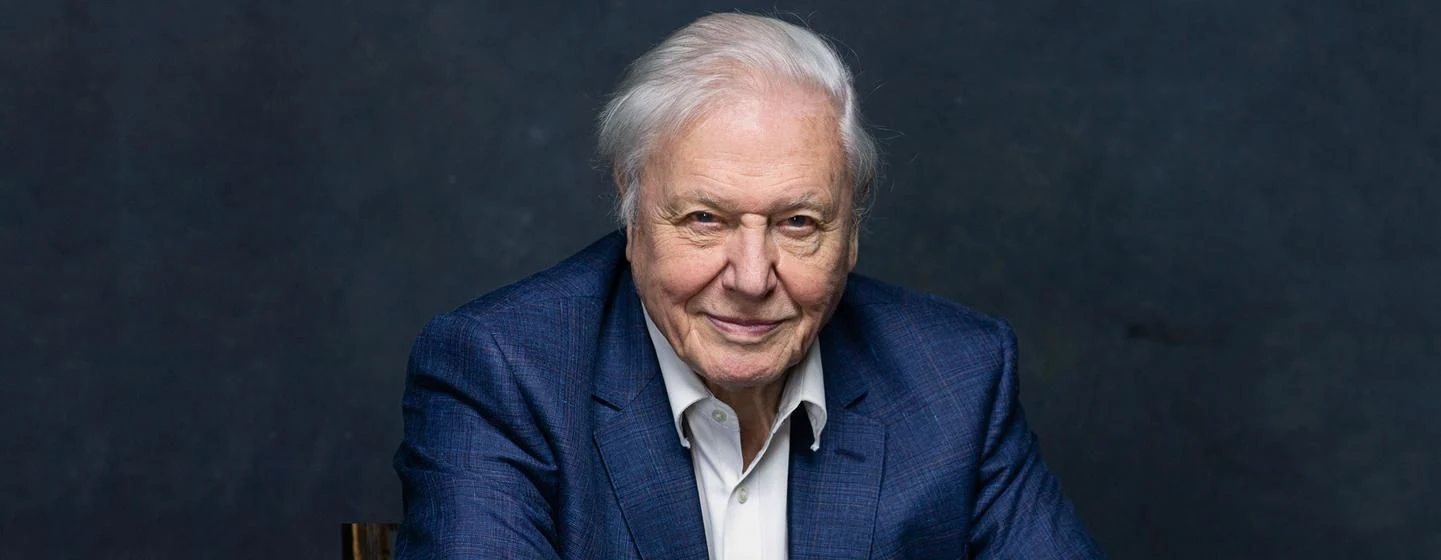
David Attenborough’s broadcasting career has taken him from producing factual television to presenting some of the BBC’s most ambitious natural history series. In programmes including Zoo Quest, Life on Earth and Planet Earth, he helped make the behaviour and habitats of animals a subject for mass audiences. His work as a BBC executive also shaped the range of programmes offered by BBC Two. Over time, his documentaries have given more attention to the environmental effects of human activity.
A naturalist’s route into broadcasting
Attenborough was born in Isleworth, Middlesex, on 8 May 1926, and grew up in Leicester, where his father was principal of University College Leicester. As a child he collected fossils, stones and other natural specimens. A lecture in 1936 by the conservationist Grey Owl, attended with his brother Richard, made an early impression on him.
After attending Wyggeston Grammar School for Boys, Attenborough studied geology and zoology at Clare College, Cambridge, graduating in natural sciences. He completed two years of national service in the Royal Navy and then worked editing children’s science textbooks. In 1950, he applied unsuccessfully for a radio-talks job at the BBC. His application nevertheless attracted the attention of Mary Adams, who invited him to train with the television service. He joined the BBC full-time in 1952, initially producing non-fiction programmes.
His first work in natural history television included Animal Patterns, a studio programme featuring animals from London Zoo. It led to a collaboration with the zoo’s reptile-house curator, Jack Lester, and to Zoo Quest. When Lester became ill, Attenborough took over as presenter shortly before the series began in 1954. He later formed the BBC’s Travel and Exploration Unit, allowing him to continue presenting and producing programmes without moving from London to join the Natural History Unit in Bristol.
From BBC Two to Life on Earth
In 1965, Attenborough became Controller of BBC Two. The channel had launched the previous year, and he set out to give it a distinctive range of programmes. His commissions and scheduling helped establish a broad identity for the channel, encompassing science, natural history, arts, music, drama, sport and comedy. Among the programmes commissioned during his tenure were Monty Python’s Flying Circus, The Old Grey Whistle Test, Chronicle and The Money Programme.
Attenborough was promoted to director of programmes in 1969, with responsibility for the output of both BBC television channels. The management role kept him from presenting a natural-history series he had been developing with producer Christopher Parsons. He left the post in 1973 to return to programme-making. After presenting travel and exploration projects, he began work on the series that became Life on Earth.
First broadcast in 1979, Life on Earth traced the history of life, from early organisms to more complex forms. Its 13 episodes combined scientific research with filming across multiple locations, and helped establish a model for ambitious, authored natural-history television. Attenborough limited his time on screen to leave more room for the animals and events being filmed. The production also relied on new filming techniques to capture behaviour that had rarely been recorded.
He followed it with The Living Planet (1984), which explored how living things adapt to their environments, and The Trials of Life (1990), about animal behaviour at different stages of life. Further series broadened the scope: Life in the Freezer surveyed Antarctica, The Private Life of Plants used time-lapse photography to show plant growth, and later programmes examined birds, mammals and invertebrates. With Life in Cold Blood in 2008, the collection covered the major groups of terrestrial animals and plants.
A changing natural-history screen
Attenborough’s work extended well beyond the series bearing the Life name. He narrated the long-running BBC wildlife programme Wildlife on One and presented or narrated programmes including The First Eden, Lost Worlds, Vanished Lives and Natural World. From the 2000s, he worked with BBC Natural History Unit producer Alastair Fothergill on productions including The Blue Planet and Planet Earth. The latter was the BBC’s first wildlife series filmed in high definition.
Later projects made use of further changes in production and camera technology, including 3D documentaries and the 4K production Life Story. Attenborough returned as narrator and presenter for Planet Earth II, and presented Blue Planet II, which brought marine life to a large television audience. Other projects have ranged from the polar regions in Frozen Planet to the behaviour of animal families in Dynasties, and prehistoric life in Prehistoric Planet.
The form of his environmental advocacy also developed over his career. Programmes such as State of the Planet, The Truth about Climate Change and How Many People Can Live on Planet Earth? addressed human effects on the natural world. In 2019, Climate Change – The Facts examined climate change, while Extinction: The Facts addressed biodiversity loss. Our Planet placed greater emphasis on the destructive effects of human activity than many of his earlier natural-history programmes. In 2020, David Attenborough: A Life on Our Planet reflected on his work and set out hopes for the future.
Conservation beyond the camera
Attenborough’s conservation work has included support for campaigns and organisations as well as documentary-making. He backed efforts to reduce the killing of albatross by longline fishing and to protect rainforest in Borneo. He has held roles with conservation groups including Butterfly Conservation, Fauna and Flora International and the Leicestershire and Rutland Wildlife Trust. He also helped launch ARKive, a project to gather natural-history media in a digital library, and supported the World Land Trust’s appeal to establish a rainforest reserve in Ecuador in memory of producer Christopher Parsons.
He has spoken at international climate events, including the 2021 United Nations Climate Change Conference in Glasgow, where he urged leaders to act. The United Nations Environment Programme named him a Champion of the Earth in 2022, citing his work documenting and advocating for the protection and restoration of nature. His environmental message has not been without debate: some critics have argued that wildlife programmes can present wilderness as more separate from human pressures than it is, while Attenborough has also cautioned against making repeated warnings so prominent that audiences turn away.
Honours and public recognition
Attenborough’s work has received honours in Britain and internationally. He was appointed CBE in 1974, knighted in 1985 and made a Member of the Order of Merit in 2005. His awards include the BAFTA Fellowship, the Royal Society’s Michael Faraday Prize and, in 2024, the Stephen Hawking Medal for Science Communication. He has received honorary degrees from numerous universities, including Cambridge, Oxford and Durham.
His influence also reflects a long relationship with British public-service broadcasting. As a BBC producer and executive, he helped shape both the range of programmes on BBC Two and the development of natural-history television. As a presenter and narrator, he made those programmes accessible to viewers who might otherwise have had little contact with the places, species and scientific ideas they describe.
Why David Attenborough deserves a place in British Legacy
David Attenborough’s place in British Legacy rests on achievements that are both creative and institutional. His natural-history programmes brought sustained scientific storytelling to British television, from the international scope of Life on Earth to later series using new filming techniques to reveal animal behaviour. The scale and continuity of that work helped establish a recognisable form of British wildlife broadcasting and influenced later documentary-makers. His contribution was not limited to presenting: as Controller of BBC Two and then director of programmes, he helped shape the channel’s range at a formative point in its history.
His legacy also lies in connecting public attention with the living world. Across decades of broadcasting, audiences have encountered species and habitats through programmes that explain how organisms live and interact. Attenborough’s later work has increasingly addressed climate change, extinction and other pressures caused by human activity, while his conservation roles have extended beyond television. These are specific contributions to Britain’s cultural and broadcasting history, with a wider public benefit: making natural history understandable to large audiences and bringing questions about conservation into everyday discussion. His career shows how public-service broadcasting can combine education, exploration and a continuing account of changes in the natural world.
Sources
David Attenborough — revision 1377734588
Adapted in part from David Attenborough by Wikipedia contributors, under CC BY-SA 4.0. Text has been edited and combined with the existing article; this adapted text is shared under the same licence. Contributor history.