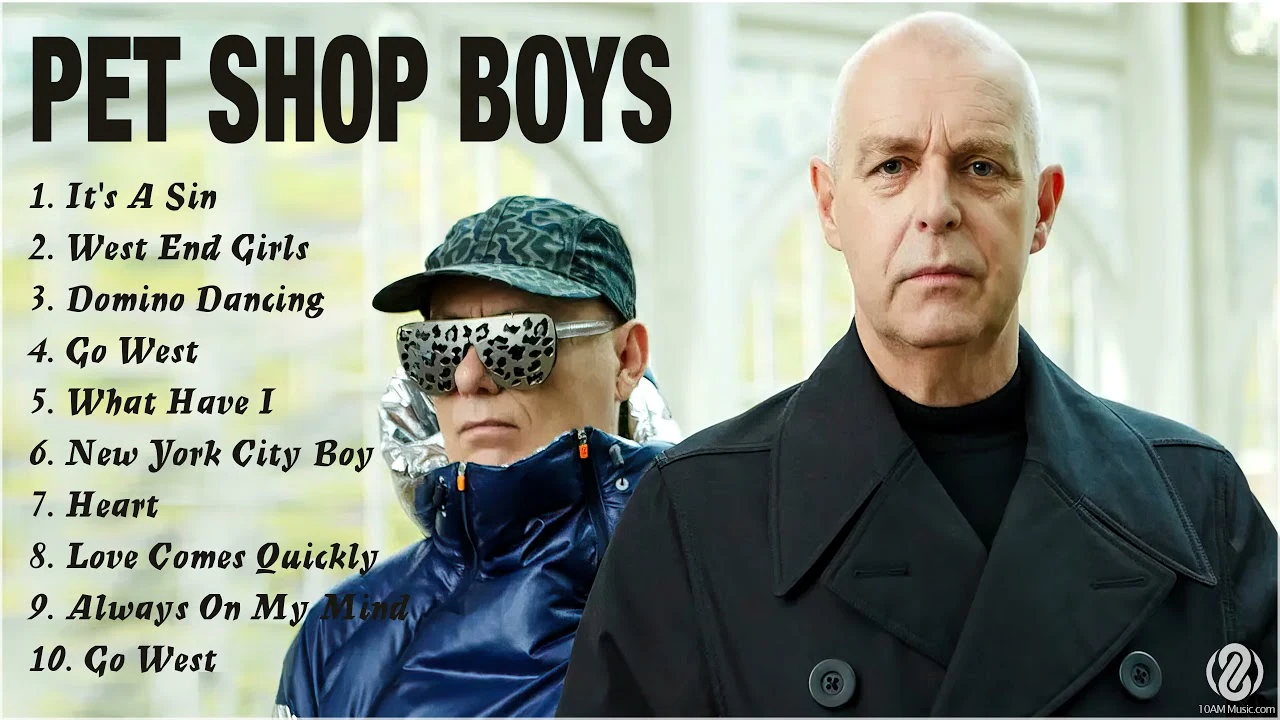
Pet Shop Boys began with a conversation in a London hi-fi shop and became one of Britain’s most successful and distinctive pop acts. Neil Tennant’s literate, often oblique songs and Chris Lowe’s keyboard-led music joined the dance floor to a coolly observant view of city life. Their career has moved between chart singles, experimental records, collaborations and stage work, while the duo have kept a close hand on how their music is presented.
A meeting in Chelsea, a sound in development
Tennant and Lowe met on 19 August 1981 at the Chelsea Record Centre, a hi-fi shop on the King’s Road. Tennant had gone in search of a connector for a Korg MS-10 synthesiser. Their shared interest in disco and electronic music brought them together; influences included Soft Cell, Orchestral Manoeuvres in the Dark, Kraftwerk, the Human League and Depeche Mode, as well as Hi-NRG and the emerging New York hip-hop scene.
They started writing together in Tennant’s Chelsea flat, then moved to a small studio in Camden Town. Early demos briefly used the name West End before the pair settled on Pet Shop Boys, a name they said came from friends who worked in an Ealing pet shop. In 1983, while in New York to interview Sting for Smash Hits, Tennant arranged a meeting with producer Bobby Orlando and gave him a demo that included “It’s a Sin” and “Opportunities (Let’s Make Lots of Money)”. Orlando recorded a number of tracks with the duo in 1983 and 1984.
The first release of “West End Girls” came in April 1984. It became a club hit in Los Angeles and San Francisco and received attention elsewhere, but was not then a UK chart breakthrough: in Britain it was available only as a 12-inch import. After ending their arrangement with Orlando and signing to Parlophone, the duo re-recorded the song with producer Stephen Hague. Released in October 1985, this new version climbed gradually to number one in the UK in January 1986 and went on to top the US chart as well. The distinction between the early release and the later hit matters: the breakthrough was the result of a revised recording and a longer route to a wide audience.
From chart momentum to a theatrical pop language
The success of “West End Girls” opened a run of singles that established the duo’s reach and range. “It’s a Sin” became their second UK number one in 1987; “What Have I Done to Deserve This?”, featuring Dusty Springfield, reached number two; and their version of “Always on My Mind” became the Christmas number one that year. “Heart”, released in 1988, was their fourth UK number one. Their songs could work as immediate pop while carrying themes of desire, money, memory, identity and social observation.
Their second album, Actually, followed in 1987. In the same year, “West End Girls” received a BRIT Award and an Ivor Novello Award. The group’s growing profile extended beyond records: their film It Couldn’t Happen Here, made with director Jack Bond and featuring Barbara Windsor, Joss Ackland and Gareth Hunt, developed from a project built around songs from their first two albums. Released in 1988, it received mixed reviews. The film was one early sign that Tennant and Lowe were interested in pop as a complete presentation, not simply a sequence of singles.
That interest shaped their live shows. Their first tour, in 1989, followed the more ambitious staging they had previously been unable to afford. Derek Jarman directed and supplied films projected during the performances. For the 1991 Performance Tour, designers David Alden and David Fielding, associated with the Royal Opera House, created the staging and costumes. Rather than reproduce a standard rock-band set-up, Pet Shop Boys used theatrical images, movement and electronic arrangements to make the concert itself part of the work.
The studio albums also resisted a single formula. Introspective (1988) gathered six extended new tracks and remixes; Behaviour (1990) took a more subdued direction and included “Being Boring”, a song connected to the AIDS epidemic and Tennant’s friendship with Christopher Dowell, who died of the disease in 1989. Later records moved through house, Latin pop and dance music, among other styles. The duo’s ability to alter the musical setting without abandoning their songwriting partnership became a defining feature of their career.
Collaborators, experiments and stages beyond the chart
Pet Shop Boys have written, produced and performed with artists across different musical worlds. Their work with Springfield continued after the success of “What Have I Done to Deserve This?”: they recorded “Nothing Has Been Proved” for the film Scandal and “In Private”, and contributed extensively to her 1990 album Reputation. They wrote and produced Results for Liza Minnelli, which included “Losing My Mind”, and Tennant later worked with Bernard Sumner and Johnny Marr on the group Electronic. These projects put the duo’s writing and production skills into conversation with other performers, rather than keeping them confined to their own records.
In 1993, Very became their first and only album to reach number one on the UK Albums Chart. Its singles included “Can You Forgive Her?” and a cover of the Village People’s “Go West”. The accompanying videos used computer-generated imagery and vivid visual motifs, making image and music work together. “Go West” later became a football chant at Arsenal, the club supported by Lowe, and spread as a stadium anthem.
Their stage work continued to take different forms. In 1997, they became the first band to hold a residency at a West End theatre, performing at the Savoy Theatre. They later developed the musical Closer to Heaven with playwright Jonathan Harvey; it opened in London in 2001 and closed that October. In 2011, their ballet The Most Incredible Thing, adapted from a Hans Christian Andersen story, opened at Sadler’s Wells. Choreographed by Javier de Frutos, it combined the duo’s music with animation and orchestration. Pet Shop Boys and de Frutos received the Evening Standard Theatre Awards’ Beyond Theatre Award for the production.
They also took on film music and orchestral projects. In 2004 they performed a new score for the silent film Battleship Potemkin with the Dresdner Sinfoniker at Trafalgar Square; further performances followed in Germany, and the soundtrack was released in 2005. In 2013, they premiered A Man from the Future, an orchestral work about Alan Turing, at the BBC Proms. These projects extended their electronic vocabulary into settings that demanded different scales of sound and performance.
Control, craft and a continuing career
The duo’s attention to presentation has included album sleeves, photographs, videos and stage design. They worked closely with designer Mark Farrow on their visual identity, while photographer Eric Watson helped shape their early image. In 2006, the book Pet Shop Boys Catalogue, written by Chris Heath and Philip Hoare, documented their visual work from 1984 to 2004, with a related exhibition at the National Portrait Gallery. Tennant has described an early decision to retain control over how the work was presented, alongside the importance of the songs themselves.
That control has not meant remaining with one label or sound. In 2013 they left Parlophone and released Electric through their own x2 label, with Kobalt Label Services. It became the first of three consecutive albums produced by Stuart Price. Their later albums include Super (2016), Hotspot (2020) and Nonetheless (2024). Alongside recording, the Dreamworld tour brought their hits to audiences from 2022; its reported itinerary included a five-night Royal Opera House residency in 2024 and further UK and European dates in 2025, followed by Japan and South America in 2026.
Their recognition reflects both popular success and a longer influence on British music. They received three BRIT Awards, including the 2009 Outstanding Contribution to Music award, and the Ivor Novello Award for Outstanding Contribution to British Music in 2000. Their work has also crossed into public events: at the 2012 Olympic closing ceremony, Tennant and Lowe performed “West End Girls” in cycle-driven chariots, and in 2024 they received the MTV Europe Music Awards’ Pop Pioneers award.
The duo’s public identity has also been connected to queer culture. Tennant came out in a 1994 interview with Attitude and has spoken about the band’s contribution to gay culture through its music, videos and presentation. Their songs have addressed the AIDS crisis, including “Being Boring”, while gender-neutral language in many lyrics has allowed room for different listeners’ experiences. These elements sit alongside, rather than replacing, the central musical achievement: a durable partnership that can make dance music both accessible and intellectually alert.
Why Pet Shop Boys deserve a place in British Legacy
Pet Shop Boys deserve a place in British Legacy because they made a recognisably British form of electronic pop with international reach, and sustained it without relying on one hit or one fixed style. The chronology of “West End Girls” shows how that success was built: an early release attracted attention, but a new recording and a further year of development turned the song into a UK and US number one. Across albums and singles, Tennant and Lowe paired dance-floor structures with precise writing and a distinctive perspective on city life, relationships and social change. Their awards and chart record are part of the story, but so is their capacity to keep finding new settings for the same creative partnership.
Their contribution also reaches beyond recorded pop. They have treated the music video, album artwork and concert stage as parts of an artistic whole, worked with performers including Dusty Springfield and Liza Minnelli, and made productions for theatre, ballet, film and orchestra. That work has helped make electronic music at home in cultural settings that might otherwise keep it at a distance. Their engagement with queer culture and the AIDS crisis gives the catalogue a further social significance grounded in the songs and the duo’s own statements. British Legacy can recognise the Pet Shop Boys, then, not simply as successful entertainers, but as musicians whose craft, visual ambition and willingness to cross forms have broadened what British pop can do.
Sources
Pet Shop Boys — Wikipedia revision 1379288337
Adapted in part from Pet Shop Boys by Wikipedia contributors, under CC BY-SA 4.0. Text has been edited and combined with the existing article; this adapted text is shared under the same licence. Contributor history.