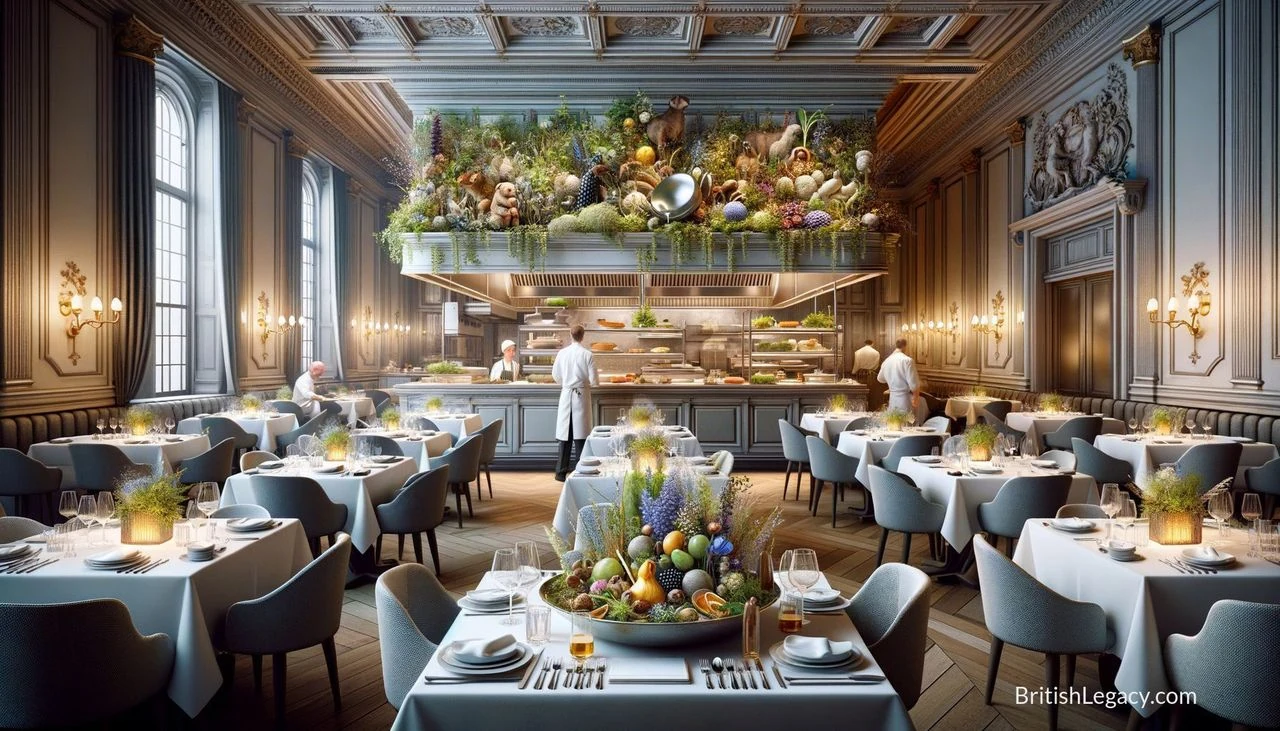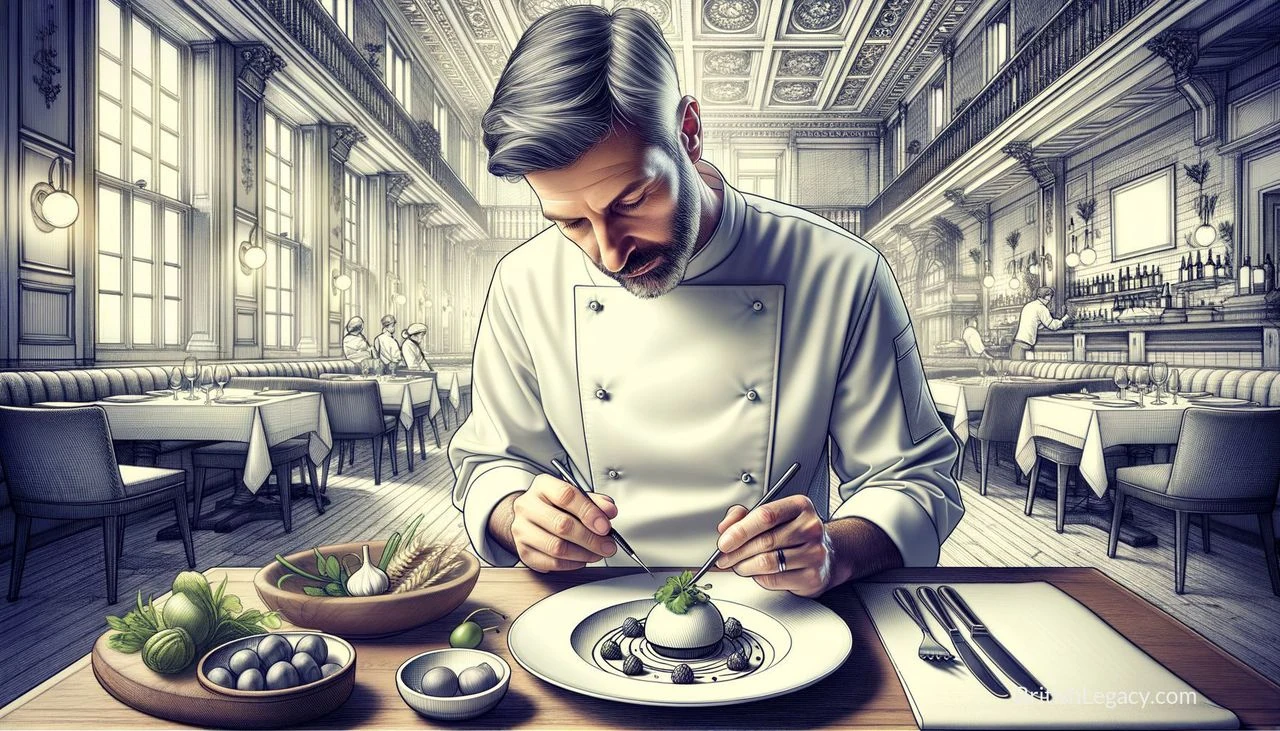
Phil Howard’s career has been shaped by two London restaurants and a consistent interest in cooking that is technically assured without losing sight of flavour. The Square, which he opened with Nigel Platts-Martin in 1991, established him as a leading chef patron of modern fine dining. After selling the restaurant in 2016, Howard began a new chapter at Elystan Street, where a less formal approach carried his cooking into a different kind of dining room.
A degree, then a kitchen
Howard was born in Johannesburg in 1966. He moved to England with his family when he was seven and later studied microbiology at the University of Kent. After graduating, he chose cooking over a career in science, beginning professional work in 1988. His early experience was varied: he spent a summer working at a château in the Dordogne and, during a short period in Australia, waited tables and cooked food to sell from a Volkswagen Kombi.
Back in England, Howard worked for the catering division of Roux Restaurants, the group run by Albert and Michel Roux. He became a chef de partie at Harveys in 1989, working under Marco Pierre White and learning a modernised French style of cooking. His time there lasted nine months. He then joined Bibendum under chef Simon Hopkinson, whose emphasis on the quality and flavour of ingredients, and on simplicity, influenced Howard’s approach.
In 1990, White rehired him with a view to preparing him to become head chef at a planned restaurant. That project changed course when White and his business partner Nigel Platts-Martin ended their partnership. Howard and Platts-Martin went on to open their own restaurant, The Square. Neither had experience running a restaurant, and Howard took on the role of head chef as well as becoming a co-owner and chef patron.
The Square: a restaurant built over time
The Square opened at King Street in St James’s on 13 December 1991. Howard’s cooking there drew on French technique, but the restaurant’s identity was its own: simple, elegant dishes presented with contemporary polish. Its first Michelin star followed in December 1994. After moving to Mayfair in February 1997, it received a second star in January 1998. The restaurant also held four AA Rosettes from 2007 to 2016 and received eight out of ten in the Good Food Guide from 1999 to 2016.
The restaurant’s reputation grew alongside Howard’s tenure. The earlier account of his cooking names dishes including Lune Valley lamb with basil, tomatoes and olive oil, and a lasagne of Dorset crab with a cappuccino of shellfish and Champagne foam. These examples suggest a kitchen interested in layered technique and vivid combinations, while the broader description of Howard’s style emphasises precision, clear flavours and attention to seasonality.
Howard and Platts-Martin sold The Square in March 2016, ending Howard’s 25-year association with the restaurant. The change marked a significant break from the venture that had established his reputation, but not from restaurant life. That September, Howard and business partner Rebecca Mascarenhas opened Elystan Street in Chelsea, in premises previously occupied by one of Tom Aikens’s restaurants.
A different pace at Elystan Street
Elystan Street was less formal and more casual than The Square. Its menu was described as at least a quarter vegetarian and less complex than the food at Howard’s previous restaurant. The shift was not a rejection of technique, but a change in emphasis: the cooking was less intricate, with a focus on directness and the ingredients themselves. The restaurant earned its first Michelin star in 2017, a year after opening, and the Wikipedia account records that it retained the star in subsequent years.
The existing account gives examples of dishes associated with Elystan Street: roasted cod with Jerusalem artichoke and truffle, and chocolate and hazelnut pavé with salted caramel ice-cream. Alongside those plates, the restaurant’s more relaxed setting illustrates how Howard carried experience from The Square into a different format. He continued to work as chef patron, while sharing ownership and restaurant projects with Mascarenhas.
Howard’s work has extended beyond these two kitchens. He was a co-owner of The Ledbury, which opened in 2005 with Brett Graham, formerly sous-chef at The Square, as head chef. He and Mascarenhas opened Kitchen W8 in Kensington in 2009; it earned a Michelin star in 2011. Their restaurant Sonny’s Kitchen later became Church Road. Other projects included the short-lived wine-focused restaurant Gezellig, and Union, a restaurant at the French ski resort of Montalbert that closed in 2024. In 2021 Howard launched a pasta delivery service first called Otto; following a legal dispute over that name, it became Notto, which also opened as a Piccadilly restaurant in 2022.
Books, television and recognition
Howard’s career has also reached audiences beyond his restaurants. He appeared as a guest on programmes including Saturday Kitchen and MasterChef: The Professionals, and competed in the seventh series of Great British Menu. His winning Cornish mackerel dish, served with oysters, mussels, winkles and samphire, formed the fish course at the 2012 Olympians’ banquet at the Old Royal Naval College in Greenwich. He later returned to Great British Menu as a judge for regional heats.
His two-volume The Square: The Cookbook brought the restaurant’s cooking to readers: Savoury appeared in 2012 and Sweet in 2013. Awards have recognised both his cooking and his wider contribution to hospitality. Among them are the 1998 Catey Chef Award, the Craft Guild of Chefs’ Restaurant Chef award in 2005, the Chefs’ Chef award at the 2008–09 AA Hospitality Awards, and the 2016 Chefs’ Chef of the Year at the National Restaurant Awards. In 2022, he received the Michelin Mentor Chef Award. The University of Kent awarded him an honorary Doctor of Arts degree in 2018.
Why Phil Howard deserves a place in British Legacy
Phil Howard’s place in British Legacy rests on a sustained contribution to London’s restaurant culture. At The Square, he and Nigel Platts-Martin built a restaurant from the ground up, with Howard leading the kitchen through a run that included Michelin stars, AA Rosettes and high ratings in the Good Food Guide. That record is more than a list of distinctions: it marks a restaurant that maintained a strong identity over decades, while giving Howard a platform to develop a distinctive approach to contemporary fine dining.
His later work shows that this achievement was not tied to one dining room or a single style of service. Elystan Street carried his experience into a less formal restaurant, with a simpler menu and a significant vegetarian presence; Kitchen W8 and other partnerships extended his work across different kinds of London dining. His cookbooks and television appearances also brought restaurant cooking to people beyond those who could visit his kitchens. Taken together, these strands explain his British significance: Howard helped shape the country’s modern restaurant scene through long-term work as a chef, co-owner, author and broadcaster, while adapting his cooking as the settings and audiences around him changed.
Sources
Phil Howard (chef), revision 1338508959
Adapted in part from Phil Howard (chef) by Wikipedia contributors, under CC BY-SA 4.0. Text has been edited and combined with the existing article; this adapted text is shared under the same licence. Contributor history.