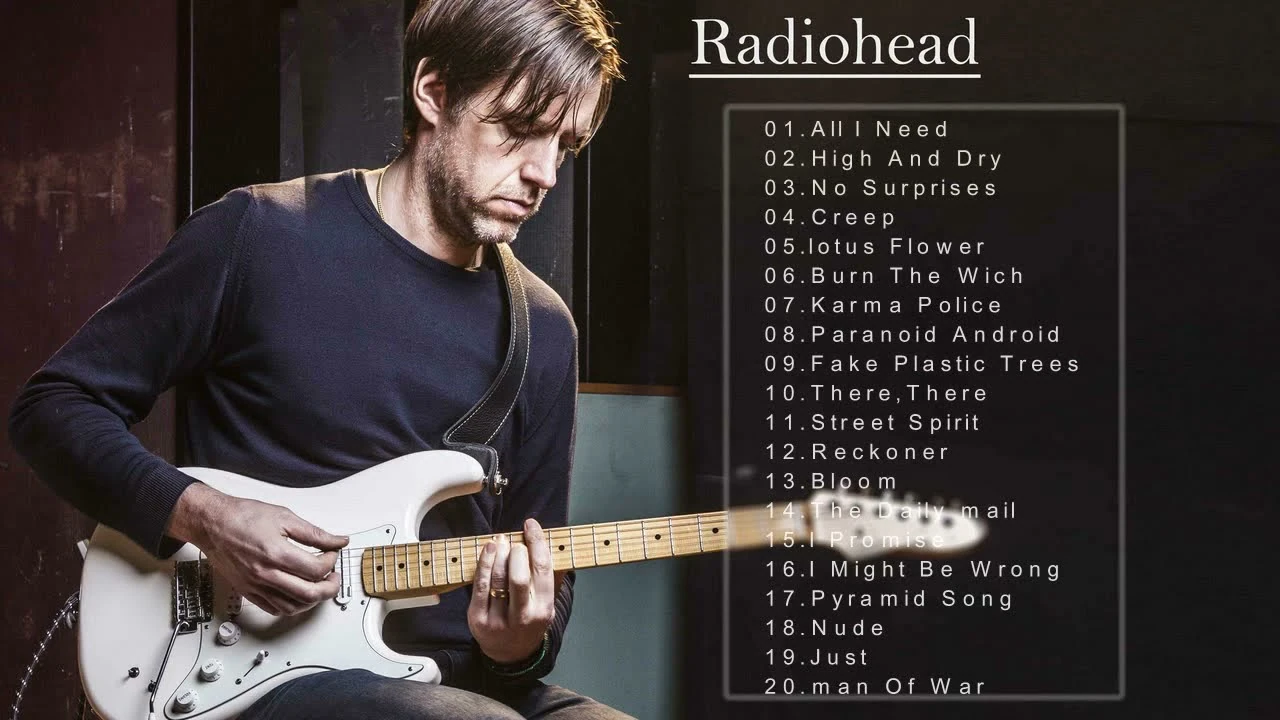
Radiohead’s career has been defined by the decision not to settle on a sound. Formed in Abingdon, Oxfordshire, in 1985, the band moved from the guitar-led songs of Pablo Honey to the widescreen unease of OK Computer, the electronic experiments of Kid A and the self-released, pay-what-you-want In Rainbows. Each change brought new questions about what an English rock band could make, and how it could reach its listeners. The five musicians behind those shifts have also maintained a collective identity through decades of changing styles and individual projects.
School friends, rehearsals and a first record deal
Radiohead began at Abingdon School, where Thom Yorke, Jonny Greenwood, Colin Greenwood, Ed O’Brien and Philip Selway met and played together. In 1985 they formed a band called On a Friday, named for the day they usually rehearsed in the school music room. Yorke and O’Brien were among the founding members; Colin Greenwood joined on bass, Selway joined after an early performance with a drum machine, and Jonny Greenwood, Colin’s younger brother, was the last to join. Yorke became the group’s main songwriter, though the band’s music would develop through contributions and arrangements from all five.
The school’s atmosphere was strict, but the members found a musical home in its music department. They credited their teacher with introducing them to jazz, film scores, post-war avant-garde music and twentieth-century classical music. Those were not the only sounds in their education: post-punk and alternative rock also mattered, and, as their work developed, the members drew on electronic music and hip-hop. Their early years were spent rehearsing and playing relatively few gigs rather than emerging from a large London scene. Their first concert was at Oxford’s Jericho Tavern in 1987.
After university and a period apart, the band regrouped in Oxford in 1991. They recorded a new demo, attracted the attention of local managers Chris Hufford and Bryce Edge, and signed a six-album deal with EMI in December. At the label’s request, they changed their name from On a Friday to Radiohead, taking it from the song “Radio Head” on Talking Heads’ album True Stories. The change in name coincided with the beginning of a professional career, but the group’s working habits still rested on long experience of playing together.
“Creep” and the making of a broader sound
Radiohead’s debut album, Pablo Honey, was released in 1993. Its best-known song, “Creep”, did not bring instant, uncomplicated success at home. The track was blacklisted by BBC Radio 1 as too depressing, and the band received unfavourable attention from parts of the British music press. The single began to find listeners elsewhere, including in Israel and the United States; after its rerelease, it reached number seven on the UK singles chart. The album itself reached number 22 in the UK. That uneven progress gives a fuller picture than the later shorthand of a band launched by one hit: Radiohead’s reputation and audience grew over time, and the group were dissatisfied with aspects of their debut.
Their second album, The Bends, was released in 1995. More confident in its writing and performances, it established a sound that could hold dense guitar parts and open, atmospheric passages together. “Fake Plastic Trees”, “High and Dry”, “Just” and “Street Spirit (Fade Out)” helped broaden the band’s identity beyond “Creep”. The record’s reception improved their standing in Britain, although it did not repeat the single’s international success. Radiohead were often treated as outsiders to the Britpop scene that dominated music coverage, and the album did not simply follow that movement’s conventions.
The Bends also began long-running partnerships with producer Nigel Godrich and artist Stanley Donwood. Godrich had first worked with the band as an audio engineer; he produced their albums from OK Computer onwards. Donwood’s visual work became part of the group’s identity, developing alongside the music rather than serving as a separate afterthought. Their shared work across sound and artwork would continue as Radiohead changed direction.
OK Computer: anxiety in the modern world
Released in 1997, OK Computer was Radiohead’s third album and their first to debut at number one in the UK. The band worked with Godrich, recording songs in their rehearsal space near Didcot and later at St Catherine’s Court, a house near Bath. They experimented with song structures and incorporated ambient, electronic and avant-garde elements, while retaining the tension and release of rock. The resulting album moves between scale and intimacy: a song can suggest machinery and speed, then turn towards a more private unease.
Its subjects helped make that sound legible to a wide audience. “Paranoid Android”, “Karma Police” and “No Surprises” belong to an album concerned with alienation and the pressures of a rapidly changing world. Yorke said its lyrics were inspired by observing the speed of the 1990s. The songs do not tell a single story, but together they make routine, technological change and emotional disconnection feel like parts of the same unsettled landscape.
The album won a Grammy for Best Alternative Album and was nominated for Album of the Year. Its critical standing grew further, and it became a regular presence in discussions of landmark British albums. The response mattered because the work was formally adventurous without remaining a private exercise for musicians. Radiohead had made a record that reached a large audience while asking listeners to spend time with unfamiliar sounds and difficult feelings. It also coincided with the band becoming one of the early groups to establish a website, a small sign of the growing role the internet would play in their relationship with listeners.
Changing direction after success
Radiohead could have tried to repeat the formula of OK Computer. Instead, Kid A, released in 2000, marked a pronounced change in their sound. Electronic beats, sampling, strings, jazz horns and the ondes Martenot entered a more minimalist and textured approach. The members also became more flexible about instruments and recording methods. Yorke, Jonny Greenwood, Colin Greenwood, O’Brien and Selway were no longer working within the familiar division of guitars, bass and drums alone.
The change divided listeners. Some critics and fans wanted the band to return to its earlier guitar sound; others welcomed the new direction. Kid A nevertheless debuted at number one in several countries, including the United States, and won the Grammy for Best Alternative Album. The band had not set out to be difficult for its own sake. Rather, they were finding other ways to arrange music and communicate feeling. The result demonstrated that a major group could take an audience towards unfamiliar forms without giving up the emotional pull of songs.
Amnesiac, released in 2001, drew on additional material from the same recording sessions, but the band presented it as an album in its own right rather than a collection of leftovers. It topped the UK Albums Chart and reached number two in the United States. The two records established an important principle in Radiohead’s development: a successful sound was not a contract to keep reproducing it.
On Hail to the Thief in 2003, the band brought rock and electronic textures together again. Yorke linked its lyrics to what he described as a climate of ignorance, intolerance and panic following the election of US President George W. Bush and the war on terror. The album reached number one in the UK and number three in the US. It was the band’s final album with EMI. In the years that followed, Radiohead members pursued solo projects and other collaborations, without announcing that the band had broken up.
In Rainbows and a different route to listeners
Radiohead’s next major change concerned not only the music but its release. After their contract with EMI ended, they did not agree a new deal. In October 2007, they made In Rainbows available as a download through their website, allowing listeners to choose what to pay, including nothing. The release prompted debate about who controlled music and how artists might reach listeners as the internet disrupted familiar distribution arrangements.
The experiment was not a substitute for the record itself. In Rainbows was a new album, with a warmer and more intimate sound than some of its predecessors. It later reached number one in both the UK and the United States. Its physical release followed through XL Recordings, and the album won the Grammy for Best Alternative Music Album. The band’s approach was influential partly because it joined a change in distribution to music with its own identity, rather than asking the release method to carry the whole story.
Radiohead continued to alter their process on later records. Released in 2011, The King of Limbs developed its rhythms through looping and sampling. A Moon Shaped Pool, released in 2016, gave greater prominence to orchestral arrangements by Jonny Greenwood and included the London Contemporary Orchestra. It reached number one in the UK. Among its songs was “True Love Waits”, which the band had performed in earlier years and worked on in several forms before releasing it on an album. That long development illustrates the group’s willingness to revisit material rather than treating every first version as final.
Five musicians and a wider creative circle
Radiohead’s history is not solely the story of Yorke’s voice or songwriting. Yorke often brings a song sketch; Jonny Greenwood develops harmonic and textural possibilities; and the remaining members shape their parts as the arrangement takes form. Colin Greenwood’s bass, O’Brien’s guitar and effects, and Selway’s drumming contribute to a sound that changes from record to record. The musicians have also switched instruments and used digital tools when those suit a song. Their arrangements are the outcome of group work, and the band’s long life has depended on that shared process.
Their collaborators have helped make that process audible and visible. Godrich has produced every studio album from OK Computer onwards, while Donwood has worked with Yorke on Radiohead artwork since the mid-1990s. The band’s visual presentation, recorded music and live work have therefore developed in conversation. They have also used the internet for more than album announcements: their projects have included online films, videos, archive material and, in 2020, streams of archival concert films.
The band members have made work beyond Radiohead, too. Yorke and Jonny Greenwood formed the Smile with drummer Tom Skinner, debuting the group in 2021. The Smile released albums and toured. Other members have released solo records and worked with other musicians. These projects have given the musicians room to follow different interests while Radiohead remains a distinct group. In 2025, the band returned to touring in Europe after a seven-year gap; the supplied Wikipedia account also reports that dates in Australia and Japan were due in May and June 2027.
Recognition and influence
Radiohead’s position rests on more than critical reputation. Their album OK Computer won a Grammy and received an Album of the Year nomination; Kid A and In Rainbows also won the Grammy for Best Alternative Album. The band’s awards include six Grammy Awards and four Ivor Novello Awards, and they have received five Mercury Prize nominations, more than any other act, according to the supplied Wikipedia article. They were inducted into the Rock and Roll Hall of Fame in 2019.
The band’s influence is audible in the work of later British acts. The supplied account names Coldplay, Keane, James Blunt and Travis among the groups and artists influenced by The Bends and OK Computer. Radiohead’s contribution was not simply to add new sounds to alternative rock, but to show how a band could use studio experimentation, electronic composition and collective arrangement while remaining in contact with a large audience. Their albums have also been studied and ranked by critics and listeners, although the value of their work is not reducible to any one list or award.
Radiohead’s public history has included choices that were not universally welcomed. Their 2017 performance in Tel Aviv drew criticism from artists and campaigners who wanted the band to cancel it. In the supplied account, Yorke argued that playing in a country was not the same as endorsing its government. Later disagreements over the band members’ statements and performances concerning Israel and Palestine further complicated their public image. The group’s history, like its music, cannot be reduced to a single position or a simple story of consensus.
Why Radiohead deserves a place in British Legacy
Radiohead deserve a place in British Legacy because their achievements grew from a particular and well-documented English beginning: five school friends in Abingdon who rehearsed together, kept working as a band and built an international career without losing their identity as a group. Their journey shows how British popular music can develop outside the capital and outside a single fashionable movement. From “Creep” to The Bends, OK Computer and Kid A, they made records that asked different things of their listeners. They turned late-twentieth-century anxiety into popular music, then demonstrated that a large audience could follow a band into electronic and experimental territory.
Their legacy also has a practical dimension. In Rainbows made the band’s relationship with distribution part of the public conversation, offering listeners a direct route to a new album and challenging assumptions about how music might be valued and sold. Their sustained work with Nigel Godrich and Stanley Donwood offers another example: production, visual art and composition can contribute to one coherent artistic project. The band’s influence on later British acts, alongside its own catalogue of albums, gives future listeners and musicians material to hear, question and learn from. Radiohead’s importance lies not in a claim that every experiment succeeded for every listener, but in the example of a group that kept revising its methods and treated its audience as capable of meeting it there.
Sources
Radiohead — Wikipedia, revision 1375321474 · Radiohead — Wikipedia
Adapted in part from Radiohead by Wikipedia contributors, under CC BY-SA 4.0. Text has been edited and combined with the existing article; this adapted text is shared under the same licence. Contributor history.