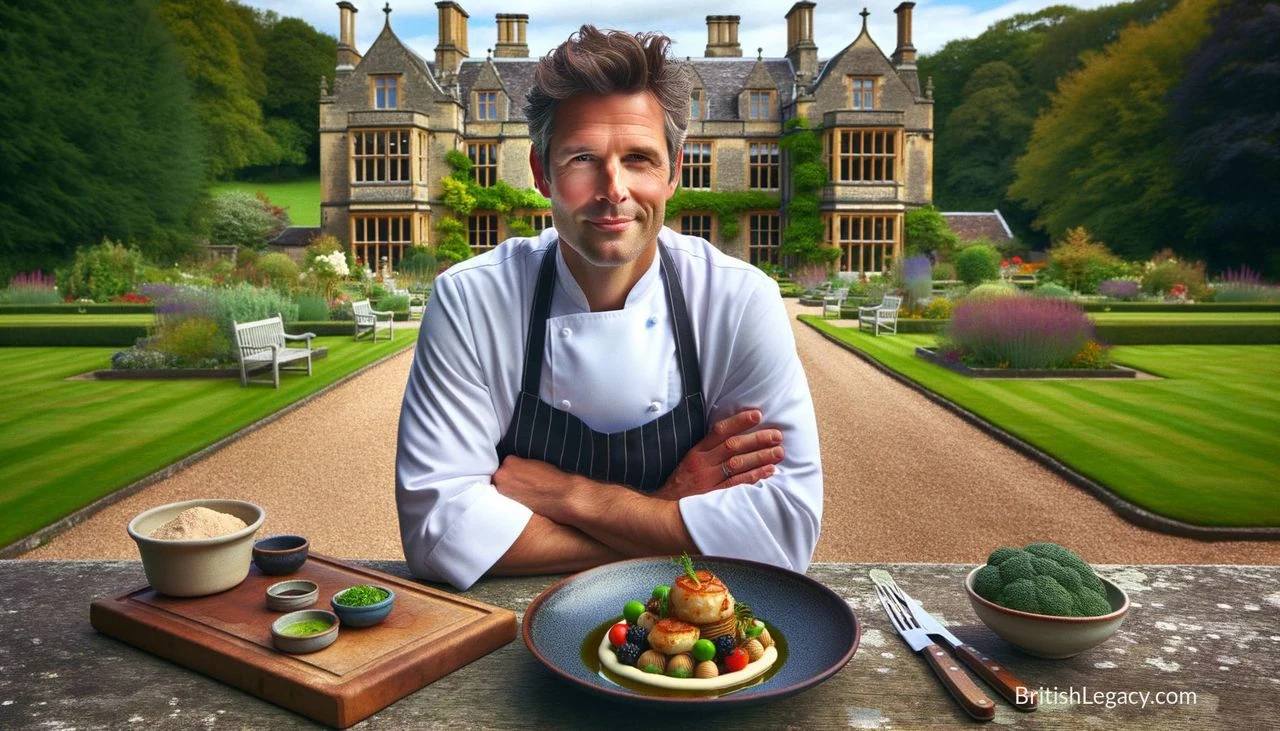
Raymond Blanc arrived in England in 1972 with little command of English and a career in kitchens already under way. More than five decades later, the French chef is closely associated with Oxfordshire: first through a restaurant in Summertown, then through Le Manoir aux Quat’ Saisons, the country-house hotel and restaurant he opened in Great Milton. His British story is one of culinary ambition, business ventures, teaching and television, rooted in French cooking but developed through a long working life in the UK.
From a kitchen garden to Oxfordshire
Blanc was born near Besançon, in eastern France, on 19 November 1949, and grew up in the village of Saône. Food and growing were part of family life. His father worked with him and his brothers in the kitchen garden; Blanc’s mother, known as Maman Blanc, taught him how to cook what he gathered. He later trained as a waiter and worked at the Michelin-starred Le Palais de la Bière in Besançon.
In 1972 he lost that job after offering advice to the head chef. The restaurant’s manager knew of an opening in England, and Blanc travelled to The Rose Revived at Newbridge in Oxfordshire. He did not yet speak English well enough to manage without a notepad. He married the owner’s daughter, Jenny, and they had two sons. Before opening his own restaurant, Blanc also worked under chef-patron André Chavagnon at La Sorbonne, a French restaurant on Oxford High Street.
In 1977 Blanc and Jenny opened Les Quat’ Saisons in Summertown, Oxford. The venture required them to mortgage their home and borrow from others. Its location was modest: a corridor between a lingerie shop and Oxfam. The restaurant quickly attracted attention, receiving the Egon Ronay Guide’s Restaurant of the Year award and two Michelin stars, alongside other distinctions. That early success established Blanc as a chef and restaurateur in Britain, rather than simply as a French cook working abroad.
Le Manoir and a growing restaurant business
Blanc opened the Maison Blanc chain of bakeries, pâtisseries and cafés in 1981. It eventually had 14 branches, including several in London and one in Oxford, and its cakes were sold in Waitrose supermarkets. The chain closed in 2017 under its owners, Kout Food Group. It was one strand of a career that repeatedly moved between fine dining and attempts to make French food available in other settings.
In 1983 Blanc bought a manor house in Great Milton, Oxfordshire. The following year he opened Le Manoir aux Quat’ Saisons as a country-house hotel and restaurant. The restaurant gained two Michelin stars. Its setting and French culinary identity made it distinct from the Oxford city restaurant that had preceded it, while keeping Blanc’s work firmly based in England. The earlier article describes the cooking as seasonal and locally sourced; that emphasis sits alongside the French culinary style identified in the biographical account.
In 1996 Blanc opened Le Petit Blanc in Oxford, the first of a smaller-restaurant chain. He wanted to bring what he described as the French idea that good food is central to good living to the UK, with restaurants intended for both time-pressed business people and families. In June 2003, after the chain had nearly passed to his former wife as part of their divorce settlement, four brasseries—in Birmingham, Cheltenham, Manchester and Oxford—became part of the Loch Fyne Restaurant Group portfolio. Blanc retained a share and continued to contribute to menus, kitchen teams and promotion. The Birmingham branch closed in 2008.
The restaurants expanded beyond those four locations, with branches opening in several English towns and cities from the late 1990s onwards. Some later closed: the supplied chronology, for example, records the closure of Tunbridge Wells in 2009 and Bristol in 2019. The list illustrates the reach of the brasserie business as well as its changing footprint. Blanc’s work in hospitality also included a 2012 appointment as culinary director for Eurostar.
Teaching, public work and television
Blanc’s influence can also be traced through chefs who worked with or learned from him. The biographical account names Heston Blumenthal, John Burton-Race, Michael Caines and Marco Pierre White among them. It also lists Sat Bains, Paul Heathcote and others. That range matters: Blanc’s legacy in Britain is not limited to restaurants bearing his name, but includes people who went on to establish their own careers in food.
His public work extended beyond restaurant kitchens. In 2012 he became president of the Sustainable Restaurant Association. The following year, he joined London mayor Boris Johnson in publicising a scheme to bring young people into food and hospitality; Blanc took on 21 apprentices across the Brasserie Blanc restaurants. He was also a patron of the Children’s Food Festival, held at the Northmoor Trust Estate in south Oxfordshire in 2009.
Television gave Blanc another way to reach cooks outside professional kitchens. His programmes included Food and Drink, Mange: The Mysteries of the Kitchen Revealed, Kitchen Secrets and The Very Hungry Frenchman. In The Restaurant, he presented a competition in which couples tried to prove they could run a restaurant. In 2014 he and Kate Humble presented Kew on a Plate, a series following the growing and preparation of vegetable dishes. Later programmes included Simply Raymond and Raymond Blanc’s Royal Kitchen Gardens. He also appeared as a guest in the BBC sitcom Miranda.
Blanc published books across several decades, including Recipes from Le Manoir aux Quat’ Saisons, Cooking for Friends, Mange, Foolproof French Cookery and Kitchen Secrets. His television and publishing work brought his cooking and explanations into homes, complementing the restaurants rather than replacing the practical work of running them.
Recognition and a complicated public moment
In 2008 Blanc received an honorary OBE. He has two sons and lives in Oxford with his long-term partner, Natalia Traxel. His personal life is not the centre of his public record, but the family he began after arriving in England is part of the chronology of his settlement and career there.
His public profile has not been without controversy. During the fourth series of The Great British Bake Off, Blanc made online comments about contestant Ruby Tandoh, criticising her appearance and her tears. Tandoh responded publicly, and Blanc apologised. The episode belongs in an account of his media presence because it shows how quickly a prominent television figure’s conduct can become part of the public discussion surrounding a programme. It does not erase the work of his restaurants, but neither should a feature about a public career omit the incident.
Why Raymond Blanc deserves a place in British Legacy
Raymond Blanc’s place in British Legacy rests on a career that took root in Britain and helped shape its restaurant culture. After arriving in 1972, he built his first major success in Oxford: Les Quat’ Saisons won two Michelin stars and established the base from which he developed Le Manoir in Great Milton. That country-house hotel and restaurant became the best-known expression of his work here. The story is not simply one of importing French technique. Blanc developed businesses in Oxfordshire and elsewhere in England, from a bakery and pâtisserie chain to brasseries designed to reach diners beyond the rarefied setting of a destination restaurant.
His contribution also travelled through people and public communication. Chefs who worked with or learned from him went on to their own careers; he took on apprentices and held roles connected with sustainable restaurants and hospitality training. Television series, cookbooks and demonstrations made culinary ideas available to people who would never work in a professional kitchen. These strands—restaurants, training and broadcasting—give the British connection substance. Blanc’s achievement was to make a sustained career in the UK while bringing French culinary traditions into dialogue with British places, businesses and audiences. That is a legacy built not on a general claim of excellence, but on identifiable institutions, working relationships and a public record extending across decades.
Sources
Raymond Blanc — Wikipedia revision 1374105720
Adapted in part from Raymond Blanc by Wikipedia contributors, under CC BY-SA 4.0. Text has been edited and combined with the existing article; this adapted text is shared under the same licence. Contributor history.