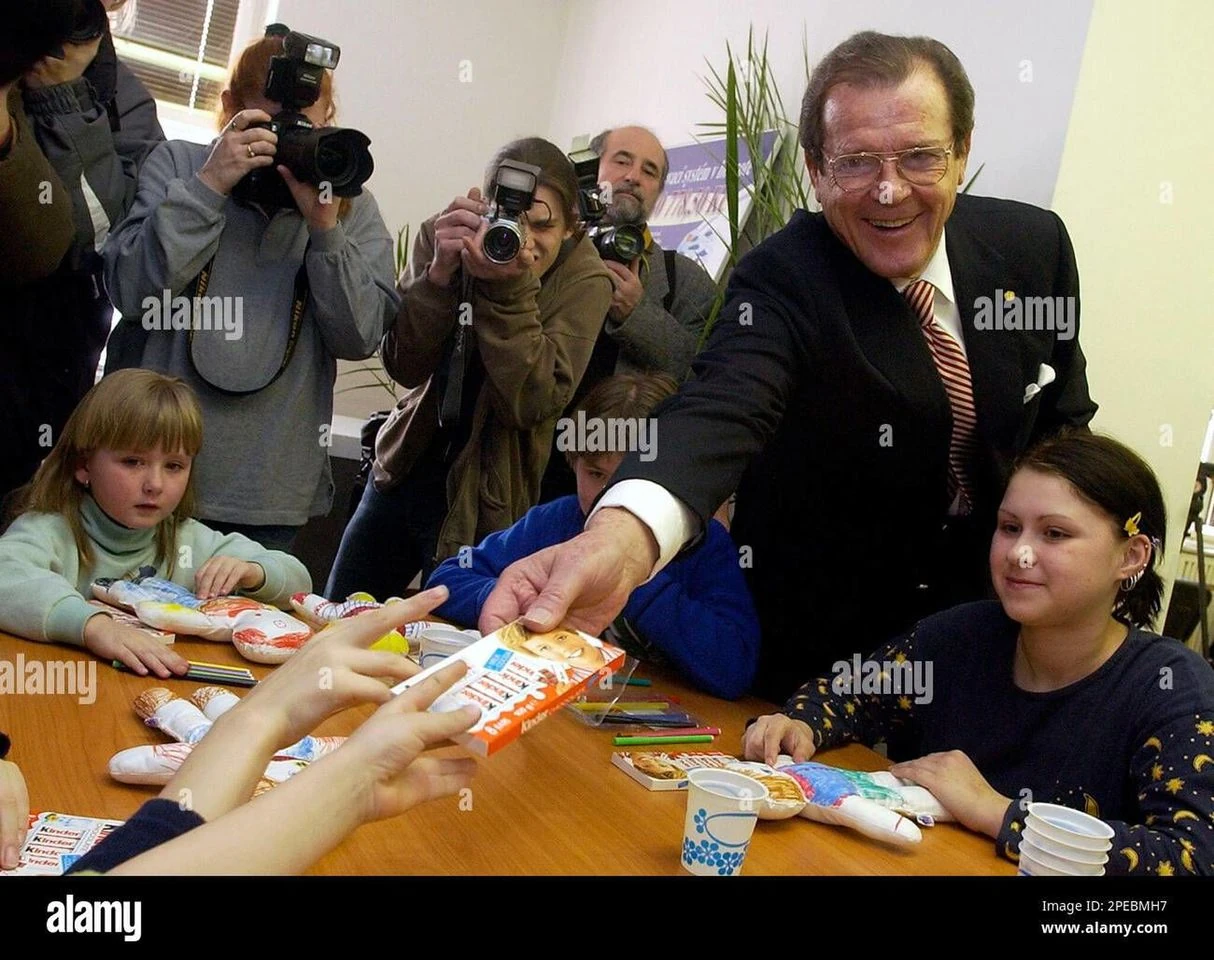
Roger Moore made his most famous roles look effortless. As Simon Templar in ITV’s The Saint, he established the relaxed, quipping style that he later brought to James Bond. Across seven Bond films, he made the secret agent a debonair figure whose humour was as recognisable as his raised eyebrow. Away from the screen, he spent more than two decades as a UNICEF Goodwill Ambassador, using his prominence to support the organisation’s work for children.
A London childhood and an early start in film
Roger George Moore was born in Stockwell, London, on 14 October 1927. His father, George Alfred Moore, was a Metropolitan Police officer; his mother, Lillian Pope, had been born in Calcutta to an English family. Moore attended Battersea Grammar School before wartime evacuation took him to Devon and Cornwall. He later attended Dr Challoner’s Grammar School in Amersham.
His route into acting began with work at an animation studio, where he was dismissed after making a mistake with animation cels. A connection made when his father investigated a robbery at the home of film director Brian Desmond Hurst changed his prospects. Hurst hired Moore as an extra for Caesar and Cleopatra (1945) and paid his fees at the Royal Academy of Dramatic Art. Moore studied at RADA for three terms, graduating in 1945. Lois Maxwell, later known as Miss Moneypenny in the Bond films, was among his classmates.
Moore’s first screen work included small and uncredited film parts, followed by television appearances and a period as a model. After a contract with MGM, he returned to television and took the lead in the adventure series Ivanhoe in 1958–59. The work could be physically demanding: during the filming of the series, he suffered broken ribs and a blow to his helmet from a battle-axe.
Simon Templar and a television-made persona
Moore’s first major success came as Simon Templar in The Saint, based on the novels by Leslie Charteris. Broadcast on ITV from 1962 to 1969, the series brought him an international audience. It ran for six series and 118 episodes, and Moore directed nine episodes. Several episodes were also edited together as the films The Saint and the Fiction Makers (1968) and Vendetta for the Saint (1969).
Templar gave Moore a screen character built around poise, wit and a knowing ease. The raised eyebrow became a signature, while the series’ success helped establish the style he would carry into his next best-known role. After The Saint, he appeared in films including Basil Dearden’s The Man Who Haunted Himself (1970), a part he later singled out as one of his best, and starred alongside Tony Curtis in The Persuaders! (1971–72). The latter paired two wealthy playboys in adventures across Europe. It found particular success in several international markets, including continental Europe and Australia.
Seven films as James Bond
Moore became James Bond in Live and Let Die (1973), taking over from Sean Connery. He was 44 when cast. His seven Eon-produced Bond films, released between 1973 and 1985, were Live and Let Die, The Man with the Golden Gun, The Spy Who Loved Me, Moonraker, For Your Eyes Only, Octopussy and A View to a Kill. No other actor has appeared as Bond in more films in the Eon series.
Moore’s Bond differed from the colder, more dangerous interpretation associated with Connery. He described his own approach as less that of a “cold-blooded-killer” and more inclined to play the part for laughs. The films gave him room for dry one-liners and a debonair manner, with the character often relying on a timely trick or gadget. The Spy Who Loved Me and Moonraker were among the most prominent successes of his tenure.
His final appearance as Bond was in A View to a Kill. Moore announced his retirement from the role in 1985, after more than twelve years. He later explained that he felt too old to play opposite very young leading women. He continued acting, with film and television appearances that included The Quest, Spice World and a final screen appearance in The Saint in 2017. His career therefore extended well beyond the secret agent, even as Bond remained the role most closely associated with him.
UNICEF and animal welfare
Moore became a UNICEF Goodwill Ambassador in August 1991. His friend Audrey Hepburn’s work for the organisation had influenced him, and the appointment gave a public role to a commitment he had begun to express earlier: in 1964, his character Simon Templar made a UNICEF appeal during an episode of The Saint. Moore continued to support the organisation through later appearances and projects. He voiced characters in UNICEF-linked productions, including the 2004 cartoon The Fly Who Loved Me, and read a children’s story for a 2015 app raising money for UNICEF.
His public work also extended to animal welfare. He campaigned with PETA against foie gras, narrated short films and wrote about the issue. In Britain, a campaign he supported led Selfridges to discontinue sales of foie gras in 2009. He also spoke out about wild-animal welfare and helped lead a campaign to ban the use of wild animals in British circuses. These activities were distinct from his acting career, but made use of the same public recognition that had grown through television and film.
Honours and later years
Moore’s honours recognised both his screen career and his charitable work. He was appointed a Commander of the Order of the British Empire in 1999 and knighted in 2003 for services to charity, particularly UNICEF and Kiwanis International. He said the knighthood meant more to him than an honour for acting, because he received it on behalf of UNICEF and its work. In 2012, the University of Hertfordshire awarded him an honorary doctorate for his contribution to British film and television, including productions made in Hertfordshire.
He also received recognition beyond Britain, including a star on the Hollywood Walk of Fame in 2007 and France’s Order of Arts and Letters in 2008. His autobiography, My Word Is My Bond, appeared in 2008. Moore died at his home in Crans-Montana, Switzerland, on 23 May 2017, aged 89. The Roger Moore Stage opened at Pinewood Studios later that year in a ceremony attended by his family and Bond producers Michael G. Wilson and Barbara Broccoli.
Why Roger Moore deserves a place in British Legacy
Moore’s place in British cultural history rests on the distinctive characters he carried from television into cinema. The Saint made him an international star and established a style that audiences could recognise: composed, lightly ironic and alert to the joke within the danger. When he became Bond, he did not simply repeat an earlier interpretation. His seven films offered a version shaped by wit and a debonair manner, and his long run made him one of the defining actors of the Eon series. Those roles connected British television and film to audiences around the world.
His legacy also includes work beyond entertainment. As a UNICEF Goodwill Ambassador from 1991, Moore brought his public standing to an organisation whose work for children had already influenced him through Audrey Hepburn. His later UNICEF projects extended that support into children’s media and fundraising. His campaigning for animal welfare, including efforts against foie gras and the use of wild animals in British circuses, shows another way he used his visibility: to draw attention to causes outside his profession. The honours he received for charitable service, and his own emphasis on accepting his knighthood on UNICEF’s behalf, make that public commitment a substantial part of his story. Together, his screen work and advocacy give his British legacy both cultural reach and a record of service.
Sources
Roger Moore (revision 1377732277)
Adapted in part from Roger Moore by Wikipedia contributors, under CC BY-SA 4.0. Text has been edited and combined with the existing article; this adapted text is shared under the same licence. Contributor history.