Samantha Cameron’s career has moved between British fashion, business and public life. Before her husband became Prime Minister, she was creative director of Smythson of Bond Street, the British accessories brand. She later took on a part-time consultancy role there, served as an ambassador for the British Fashion Council and, after David Cameron left office, founded the London womenswear label Cefinn. Her work for charities has included support for Save the Children and Revitalise.
Education and an early career in design
Born Samantha Gwendoline Sheffield in London on 18 April 1971, she grew up at Normanby Hall estate in North Lincolnshire. She attended St Helen and St Katharine in Abingdon, Oxfordshire, before taking A-levels at Marlborough College. She then completed an Art Foundation course at Camberwell College of Arts and studied Fine Art at the School of Creative Arts, part of the University of the West of England.
In 1997, Cameron became creative director at Smythson of Bond Street, a British accessories business. She held the post until May 2010. Her work brought her recognition in the fashion industry: in 2009 she received a British Glamour Magazine award for Best Accessory Designer. The distinction was for accessory design, rather than the Woman of the Year award attributed to her in some descriptions of her career.
Cameron’s professional connection with Smythson continued after her husband became Prime Minister. She took on a part-time creative consultancy role, a different arrangement from her earlier full-time creative-director post. From 2011 to 2015 she also sat on the judging panel for the Vogue Fashion Fund, alongside Victoria Beckham, Alexandra Shulman and Lisa Armstrong. As an ambassador for the British Fashion Council, she played a prominent part in London Fashion Week.
Public life and fashion beyond Downing Street
David Cameron became Prime Minister in 2010 and served until 2016. Samantha Cameron’s public profile grew during those years, but her working life was not limited to the role of a political spouse. Her fashion appointments and consultancy work continued alongside public engagements. In 2013, she appeared in Tatler’s Top 10 Best Dressed List; in 2015, she was included in Vanity Fair’s International Best-Dressed List.
After David Cameron resigned as Prime Minister, she began a new business venture. She founded Cefinn, a London-based womenswear brand. Its first collection was previewed in the January 2017 issue of British Vogue, published in December 2016, and went on sale in February 2017. The name combines the initials of her four children, Ivan, Nancy, Elwen and Florence, placed between the first and last letters of her own name. The label described its clothes as “trend-free” designs for women moving between roles, made in fabrics that did not need dry-cleaning.
In September 2025, Cameron announced that Cefinn was winding down. The business had experienced intermittent profitability, and the announcement came as high-street fashion chains developed higher-priced ranges. The closure marked the end of a specific commercial project, rather than erasing her longer record in the British fashion industry: she had worked in design at Smythson, supported the next generation of designers through fashion judging, represented the British Fashion Council and then launched a label of her own.
Family and charitable work
Samantha Sheffield and David Cameron married on 1 June 1996 at the Church of St Augustine of Canterbury in East Hendred, England. They have four children. Their eldest, Ivan, was born with a combination of cerebral palsy and severe epilepsy and died in 2009, aged six. This is an important part of the family’s public story, but it does not justify assuming that every charitable role Cameron has undertaken arose from one personal experience.
Her charitable work has included becoming a patron of Revitalise in June 2013. The organisation supports people with disabilities and their carers. She has also volunteered for Dress for Success, which provides free clothing and job-interview advice to unemployed women; in October 2012, she held a benefit for the organisation at Number 10. These activities connect her public position with practical support for people seeking respite or help entering employment.
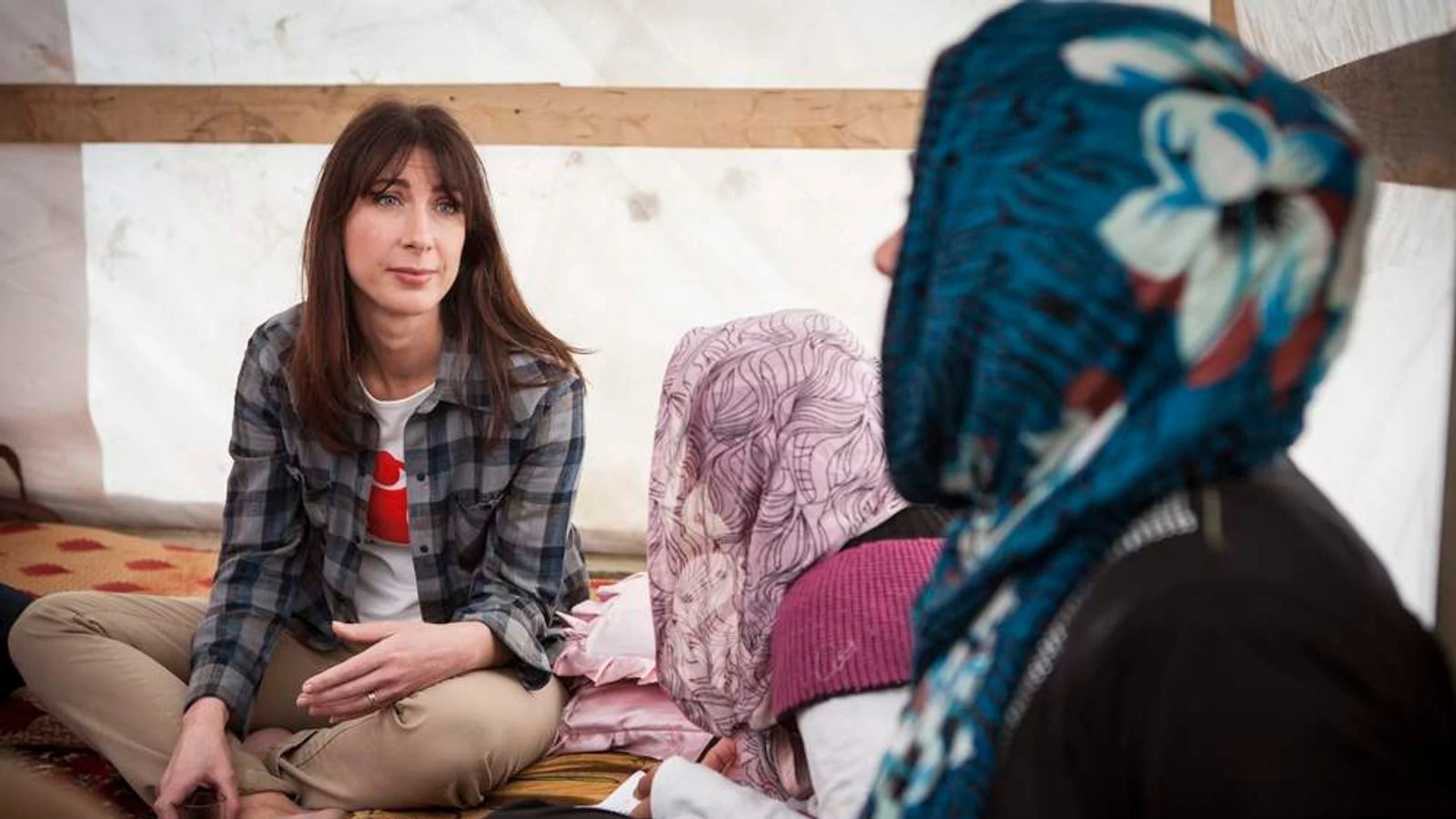
Cameron is an ambassador for Save the Children. In March 2013, after visiting Syrian refugees in Lebanon, she spoke about the harm the conflict was causing children and families. Her public involvement included both charity work in Britain and attention to the experiences of children displaced by war. In 2016, she also took part in the Great Sport Relief Bake Off, a fundraising programme broadcast as part of that year’s Sport Relief campaign.
A public role with its own limits
The title of Prime Minister’s spouse can draw attention to a person’s public appearances while obscuring a separate professional career. Cameron’s record is more specific than a general description of her as a supportive partner: it includes a creative-director position, an industry award, fashion-sector appointments, charity work and the creation of an independent clothing business. Her public role and her employment overlapped, but the two should not be treated as interchangeable.
Her work also offers a view of how fashion institutions operate beyond the design studio. As a Vogue Fashion Fund judge, she participated in a process intended to identify and support designers. Her British Fashion Council ambassadorship put her in a representative role at London Fashion Week. Cefinn, by contrast, required her to establish a label with its own product and commercial prospects. The brand’s later decision to wind down is part of that business history, as well as a reminder that public recognition alone does not guarantee a durable fashion company.
Why Samantha Cameron deserves a place in British Legacy
Samantha Cameron’s place in British Legacy rests on a demonstrable career in British fashion, not simply on her proximity to political power. At Smythson of Bond Street, she worked as creative director from 1997 until 2010 and received a 2009 award for Best Accessory Designer. Her later consultancy, judging work for the Vogue Fashion Fund and ambassadorship with the British Fashion Council extended that involvement across established brands, emerging design talent and London Fashion Week. These roles show several forms of contribution: designing within a British accessories business, helping assess new fashion work and representing the industry publicly.
She also took the risk of building a business herself. Cefinn gave her an opportunity to develop a London womenswear label with a stated focus on versatile clothes for women moving between different roles. Its winding down in 2025 belongs in the account, because a legacy should include the limits as well as the ambitions of a commercial venture. Her charitable activities add a distinct strand: work with Revitalise and Dress for Success, and advocacy for Save the Children, connected public attention with disability support, employment assistance and children’s welfare. Together, these specific contributions make her relevant to a British story of design, enterprise and charitable engagement.
Sources
Samantha Cameron — Wikipedia, revision 1379102752
Adapted in part from Samantha Cameron by Wikipedia contributors, under CC BY-SA 4.0. Text has been edited and combined with the existing article; this adapted text is shared under the same licence. Contributor history.