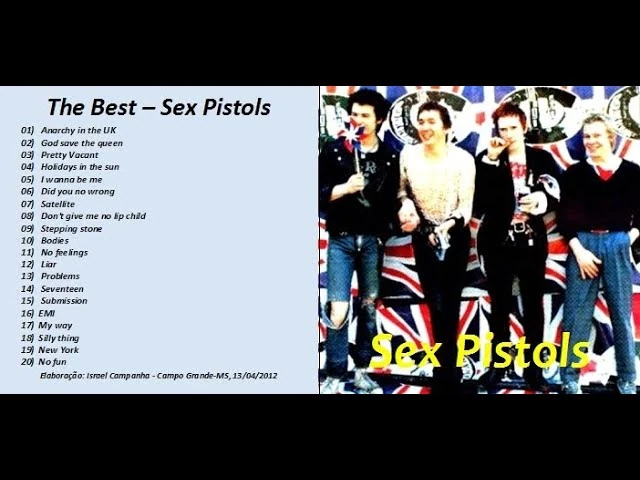
The Sex Pistols did not need a long career to change the sound and appearance of British popular culture. Formed in London in 1975, they made one studio album with their original line-up, released a small run of singles and broke up after a turbulent American tour in January 1978. In that short time, they provoked a television scandal, faced cancelled concerts and record-label reversals, and made punk a subject of national argument. Their work was deliberately abrasive, but it was not simply noise: beneath the confrontation were memorable songs, carefully shaped performances and images that outlasted the band’s first incarnation.
John Lydon, known as Johnny Rotten, Steve Jones, Paul Cook and Glen Matlock became the original line-up; Sid Vicious replaced Matlock in 1977. The group emerged from a London scene in which Malcolm McLaren and Vivienne Westwood’s King’s Road shop, first called Sex, brought together clothes, music and a deliberately antagonistic idea of style. The Pistols’ British significance lies in that meeting of sound, image and public dispute—and in the musicians and independent scenes their example helped encourage.
Making a band in London
The group grew out of the Strand, a band formed in 1972 by Steve Jones, Paul Cook and guitarist Wally Nightingale. By 1974, Jones had asked Malcolm McLaren to manage them. Glen Matlock, an art student who sometimes worked at McLaren and Westwood’s shop, joined as bassist. When Nightingale left, Jones moved to guitar. The search for a singer ended in August 1975, when the 19-year-old Lydon auditioned. Jones gave him the name Johnny Rotten, a joke about his teeth.
The name Sex Pistols took shape around the same period. The band played its first concert at Saint Martin’s School of Art on 6 November 1975, supporting Bazooka Joe. Its early set included covers, but the group soon began developing its own material. Lydon wrote lyrics and Matlock was the principal melody writer; songwriting credit was shared among the four. Matlock’s contribution matters to the sound of the early band: the songs were not assembled from provocation alone, but from melody and structure as well as Lydon’s pointed words.
London’s early punk audience gathered around venues such as the 100 Club and the shops on King’s Road. McLaren and Westwood had reshaped their shop as Sex, moving away from its earlier retro fashions towards an abrasive anti-fashion identity. Jamie Reid developed the band’s visual material, including cut-up lettering and images that treated familiar symbols as something to be torn apart and rearranged. Clothes, graphics and music became connected parts of the Pistols’ public presence.
The band’s first audiences were small, but its concerts helped other musicians imagine a route into performance. In Manchester, the Pistols played the Lesser Free Trade Hall on 4 June 1976, at a concert organised by Buzzcocks members Pete Shelley and Howard Devoto. The audience was small; the later significance of the gig was considerable. People associated with the city’s subsequent punk and post-punk scenes were among those who saw the band, and the performance became an important reference point in accounts of Manchester music. The Pistols were not the only source of punk, but their example helped make it seem possible to form a band and take the stage without waiting for established approval.
Singles, television and the Silver Jubilee
EMI signed the Sex Pistols in October 1976. Their first single, Anarchy in the U.K., was released on 26 November. It reached No. 38 on the UK singles chart, but its importance cannot be read from its position alone. The record announced a new tone in British pop: a sneer in place of deference, an openly confrontational voice and imagery that made punk recognisable. The single’s black sleeve and Reid’s torn, safety-pinned Union Flag design helped establish a visual language as distinctive as the music.
On 1 December 1976, the band appeared on Thames Television’s Today, presented by Bill Grundy. The exchange included profanity, and the tabloid response quickly became bigger than the broadcast itself. Headlines presented the group as evidence of cultural decline; Thames suspended Grundy, and the Pistols became a household name almost overnight. The interview brought punk into the national conversation, but fame brought practical obstacles. The proposed Anarchy Tour was hit by cancellations and political pressure, and the band’s contract with EMI ended in January 1977.
The group’s next record company, A&M, dropped them after a short, troubled period. Virgin signed the band in May. Its first Sex Pistols single, God Save the Queen, appeared on 27 May 1977, during Queen Elizabeth II’s Silver Jubilee celebrations. Reid’s sleeve placed the monarch’s portrait beneath cut-out lettering. The song’s challenge to the monarchy and the timing of its release brought it widespread attention, as well as bans from the BBC and many independent radio stations.
The single reached No. 2 on the official UK chart during Jubilee week. Disputes over chart compilation and the claim that it had been kept from the top position have since formed part of its story; the chart position itself is clear, while claims about the precise effect of sales exclusions should not be treated as settled by the position alone. The controversy became an argument about more than a record: who could criticise national ceremony, what broadcasters should air and how far a pop song could challenge a protected symbol.
On 7 June, McLaren arranged for the band to perform on a boat on the Thames, near the Houses of Parliament, in a gesture directed at the Jubilee celebrations. Police forced the boat to dock; McLaren and others were arrested. The spectacle made the river and the machinery of publicity part of the band’s performance. Newspaper coverage, broadcasters, local authorities and record companies all became entangled in a story that the Pistols could hardly have generated through radio play alone.
One album, built with control
Never Mind the Bollocks, Here’s the Sex Pistols was released on 28 October 1977 and reached No. 1 on the UK album chart. By then, Matlock had left and Vicious had joined. Although Vicious was the new bassist, Jones played most of the bass parts on the album sessions. Chris Thomas produced the record, which gathered the band’s attack into songs that were fast and forceful but also carefully arranged. The music’s reputation for disorder can obscure how much control it took to make the songs land.
Jones’s dense guitar sound, Cook’s driving drumming and Lydon’s sharply timed vocal delivery give the record its shape. Tracks including Pretty Vacant, Holidays in the Sun and Bodies remain distinctive for their hooks and arrangement as much as for their aggression. The album’s directness was a rejection of the elaborate and polished styles then prominent in rock, but it was not an absence of craft. Its lasting force depends on both the sound of attack and the musicians’ ability to give that attack memorable form.
The title brought a dispute of its own. Retailers refused to stock the record, and a Nottingham prosecution was brought after a Virgin shop displayed it. The case was dismissed after the defence argued that bollocks was not indecent in the context at issue. The episode turned a shop display and an album title into a public test of language and obscenity, helping keep attention on the record even as commercial outlets and advertisers resisted it.
The band was not always the cartoon of nihilism that its publicity suggested. At Christmas 1977, the Pistols played two shows in Huddersfield, one for the children of striking firemen. The contrast does not erase the band’s confrontational image; it does make that image less complete. The group could use provocation as a public tactic while also taking part in an event for a local community.
The original band’s story ended abruptly. A difficult American tour in January 1978 brought tensions within the group into the open. At the final concert, in San Francisco on 14 January, Lydon spoke to the audience about feeling cheated. He announced the break-up shortly afterwards. The group had made its mark in a concentrated period, but the drama of its collapse and the later tragedy surrounding Vicious could easily eclipse the music. The album and singles remain the more durable measure of what the band made.
After the break-up: influence and image
After the break-up, the members followed different paths. Lydon formed Public Image Ltd; Jones and Cook continued working together and later formed the Professionals. Matlock played with several groups. Vicious died in 1979, aged 21, after a heroin overdose. The band’s early career also left financial and legal disputes, including Lydon’s proceedings against McLaren and the management company. In 1986, Lydon, Jones, Cook and Vicious’s estate gained control of the band’s heritage and related film material.
The Pistols reunited in 1996 for the Filthy Lucre tour, with further reunions and performances in later years. In 2006, they were inducted into the Rock and Roll Hall of Fame but refused the honour. The induction recognised the band’s lasting influence; their refusal suited the hostility towards conventional approval that had shaped their public identity. Neither development changes the fact that the group’s most concentrated and influential work belongs to its original 1970s period.
Their impact travelled through British music as well as beyond it. The Manchester concert is one vivid example, but the wider point is the route the Pistols helped open: a band could emerge from a local scene, make its own presence felt and prompt others to start playing. Their contribution was not that every later punk or independent act copied their sound, nor that they single-handedly created a movement. Rather, they made the possibility of direct, unpolished, self-starting music visible to a broad audience.
Their visual legacy is equally concrete. Westwood and McLaren’s clothes and Reid’s graphics gave punk a recognisable image: ripped fabric, safety pins, slogans, cut-up lettering and familiar symbols put to unsettling use. These designs did not belong to the music alone. They helped make fashion and graphic design ways of challenging expectation, and their influence outlived the band’s first line-up. The Sex Pistols became a British cultural reference not simply because they were controversial, but because their songs, clothing and graphic work formed an integrated, reproducible language.
Why the Sex Pistols deserve a place in British Legacy
The Sex Pistols deserve a place in British Legacy because they turned a short-lived London band into a lasting force in British music and design. Their singles and sole studio album made punk’s sound audible to a national audience; the Bill Grundy interview and the Jubilee controversy exposed how quickly broadcasters, newspapers, politicians and record companies could become part of a musical event. Their achievement was not that every provocation was admirable, or that they spoke for an entire generation. It was that their work made questions of class, taste, censorship and national ceremony difficult to keep outside popular culture.
Their legacy also includes practical openings for other artists. The Manchester concert became a landmark for musicians who went on to build bands and scenes of their own, while the group’s directness helped show that access to established institutions was not a condition of starting. Alongside the records, Westwood and McLaren’s clothes and Jamie Reid’s graphics changed the visual vocabulary of punk and made design a form of public challenge. Those are specific, enduring contributions: songs with a distinctive musical structure, an independent-minded example for later musicians, and images that still explain how British punk joined sound to style. The story also warrants nuance. The Pistols were managed and marketed, but their music was not reducible to a publicity scheme; their career was brief, but its reach was not. That combination of musical craft, cultural confrontation and influence on later creative work is why their place in British history extends well beyond the headlines that first made them notorious.
Sources
Sex Pistols — Wikipedia, revision 1375172703
Adapted in part from Sex Pistols by Wikipedia contributors, under CC BY-SA 4.0. Text has been edited and combined with the existing article; this adapted text is shared under the same licence. Contributor history.