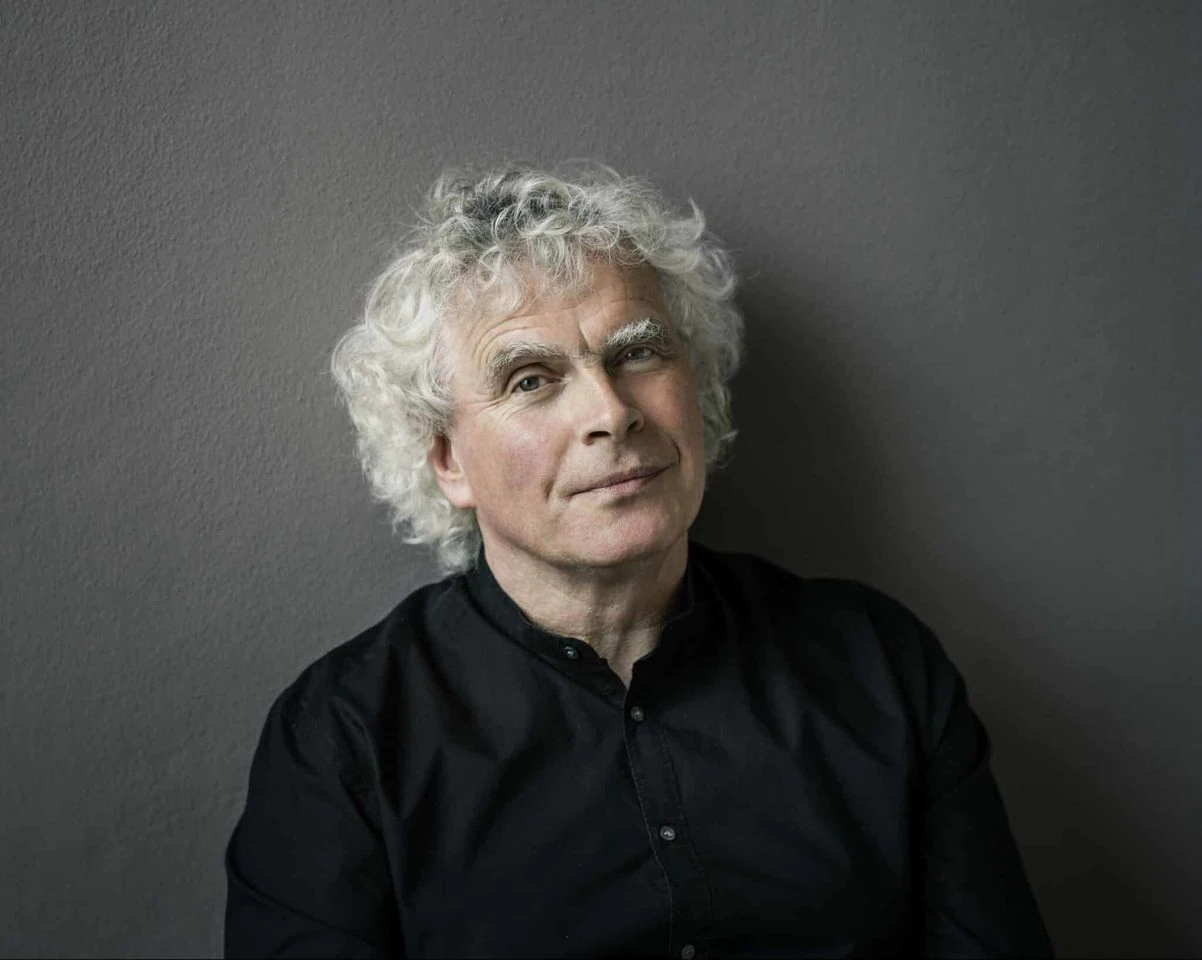
Simon Rattle’s career has repeatedly linked ambitious musical programming with the institutions and audiences around it. His 18 years leading the City of Birmingham Symphony Orchestra (CBSO) brought him to international attention; later, he became principal conductor of the Berlin Philharmonic and music director of the London Symphony Orchestra. Across those roles, he championed contemporary music and youth performance as well as the established orchestral repertoire.
Early training and first appointments
Born in Liverpool on 19 January 1955, Simon Denis Rattle studied piano and violin, but his early orchestral experience was as a percussionist with the Merseyside Youth Orchestra, now the Liverpool Philharmonic Youth Orchestra. He entered the Royal Academy of Music in London in 1971. In his graduation year, 1974, he won the John Player International Conducting Competition. That year he also became assistant conductor of the Bournemouth Symphony Orchestra.
In 1975, aged 20, Rattle joined the music staff at Glyndebourne Festival Opera. Over the following 28 years, he conducted more than 200 performances of 13 operas there and on tour. His first Prom at the Royal Albert Hall, with the London Sinfonietta, followed in August 1976; the programme included works by Harrison Birtwistle and Arnold Schoenberg. He became assistant conductor of the Royal Liverpool Philharmonic in 1977.
Before taking up the CBSO post, Rattle spent the academic year 1980–81 at St Anne’s College, Oxford, studying English language and literature. The combination of early appointments in orchestral, operatic and contemporary music gave him experience across several parts of Britain’s musical life before his best-known British leadership began.
Birmingham: building an orchestra’s profile
Rattle became principal conductor and artistic adviser of the CBSO in 1980, then its music director in 1990. His tenure lasted until 1998 and raised the profile of both conductor and orchestra. The programme “Towards the Millennium”, a long-running series devoted to twentieth-century music, reflected his interest in placing modern works alongside the core repertoire rather than treating them as a separate specialism.
A lasting institutional change came in 1991, when the CBSO moved from Birmingham Town Hall to the newly built Symphony Hall. The move gave the orchestra a new home as its standing grew. Rattle’s work in Birmingham was not limited to the concert platform: in the mid-1990s he helped arrange for the Birmingham Schools’ Symphony Orchestra, of which he is patron.
He also used large-scale public events to draw attention to music-making in schools. In 1996 he led an unsuccessful attempt to set a record for the world’s largest orchestra; a second attempt in 1998 succeeded, bringing together nearly 4,000 musicians. The record lasted until 2000. Both efforts were intended to raise awareness of youth music in schools, making participation itself part of the public argument for music education.
Berlin: a wider artistic and civic role
Rattle first conducted the Berlin Philharmonic in 1987. In 1999 its members voted to appoint him as successor to Claudio Abbado, and he took up the principal conductorship in 2002. He made his first concert as chief conductor on 7 September that year, leading Thomas Adès’s Asyla and Mahler’s Fifth Symphony. The performance was recorded for CD and DVD.
His Berlin work included contemporary music and projects beyond conventional concert presentation. In Rhythm Is It!, schoolchildren danced a choreographed performance of Stravinsky’s The Rite of Spring; another project centred on Mark-Anthony Turnage’s Blood on the Floor. During Rattle’s tenure, the orchestra established its first education department. These projects brought education and new music into the account of what an orchestra could do, alongside touring and recordings.
The period was not without disagreement. Critics questioned some of the orchestra’s performances, and Rattle described his relationship with its musicians in 2005 as at times turbulent, though not destructive. The orchestra extended his contract in 2008, and he announced in 2013 that he would leave at the end of the 2017–18 season. His final concert as principal conductor was at the Waldbühne on 24 June 2018.
Returning to London, and continuing abroad
The London Symphony Orchestra announced Rattle as its next music director in 2015. He took up the role in the 2017–18 season, initially on a five-season contract, and recorded for the LSO Live label. The orchestra extended his contract in 2021. He stepped down at the close of the 2022–23 season and became the LSO’s Conductor Emeritus for life; his final performance as music director was at the BBC Proms in August 2023, conducting Mahler’s Ninth Symphony.
His work in London followed a career that had taken him from Liverpool and Birmingham to leading orchestras in Europe and North America. He became chief conductor of the Bavarian Radio Symphony Orchestra in September 2023, after first guest-conducting it in 2010. His appointment had been announced in 2021. The new post extended his conducting work abroad, while his British orchestral ties remained part of his career.
Rattle has also conducted widely in North America, including as principal guest conductor of the Los Angeles Philharmonic from 1981 to 1994. In 2012 he conducted the LSO at the opening ceremony of the London Olympic Games, performing “Chariots of Fire” with Rowan Atkinson appearing as Mr Bean. The event placed an orchestral performance within a national public occasion, rather than confining it to the concert hall.
Recordings, recognition and musical range
Rattle’s repertoire has included historical-instrument performances, late nineteenth- and early twentieth-century music, and contemporary works. Mahler has been a particular focus, while his presentation of modern music reached television audiences through the seven-part 1996 series Leaving Home, featuring the CBSO. His recordings span composers including Dvořák, Debussy, Brahms, Bruckner and Haydn. His 1989 recording of George Gershwin’s Porgy and Bess later provided the soundtrack for a 1993 television production of the opera.
His honours include appointment as a Commander of the Order of the British Empire in 1987 and a Knight Bachelor in 1994. He received the Royal Philharmonic Society Gold Medal in 2000 and was appointed to the Order of Merit in 2014. His recording work has also been recognised with Grammy Awards: for Mahler’s unfinished Tenth Symphony in 2000, Stravinsky’s Symphony of Psalms in 2007 and Brahms’s Ein deutsches Requiem in 2008.
Rattle has supported youth music throughout his career, including through his patronage of the Birmingham Schools’ Symphony Orchestra and the large-scale school music events he led in the 1990s. He and the Berlin Philharmonic were appointed UNICEF Goodwill Ambassadors in 2007. These strands of his work connect orchestral leadership with opportunities for young people to encounter music as performers, not only as listeners.
Why Sir Simon Rattle deserves a place in British Legacy
Rattle’s British legacy is anchored in the transformation of the CBSO’s public profile during his 18 years as its principal conductor and music director. His tenure paired adventurous programming, including the “Towards the Millennium” series, with a period of institutional change: in 1991 the orchestra moved from Birmingham Town Hall to the newly built Symphony Hall. That combination matters. A musical legacy is made not only through interpretations and performances, but also through the organisations and venues that enable musicians to work and audiences to gather.
His contribution also extends beyond the professional orchestra. Rattle’s role in arranging the Birmingham Schools’ Symphony Orchestra and his efforts to bring thousands of young musicians together for public record attempts made youth music visible on a large scale. Later, Berlin projects combined performance with school participation and helped establish the orchestra’s first education department. These examples give substance to the educational commitment often associated with his career: they show particular ways in which orchestral institutions can reach beyond their regular audiences. His return to lead the LSO further connected a conductor formed in Britain’s orchestral and opera worlds with one of the country’s major ensembles. Rattle’s place in British Legacy rests on this sustained combination of artistic ambition, institutional leadership and attention to who gets to take part in music.
Sources
Simon Rattle — revision 1372838653
Adapted in part from Simon Rattle by Wikipedia contributors, under CC BY-SA 4.0. Text has been edited and combined with the existing article; this adapted text is shared under the same licence. Contributor history.