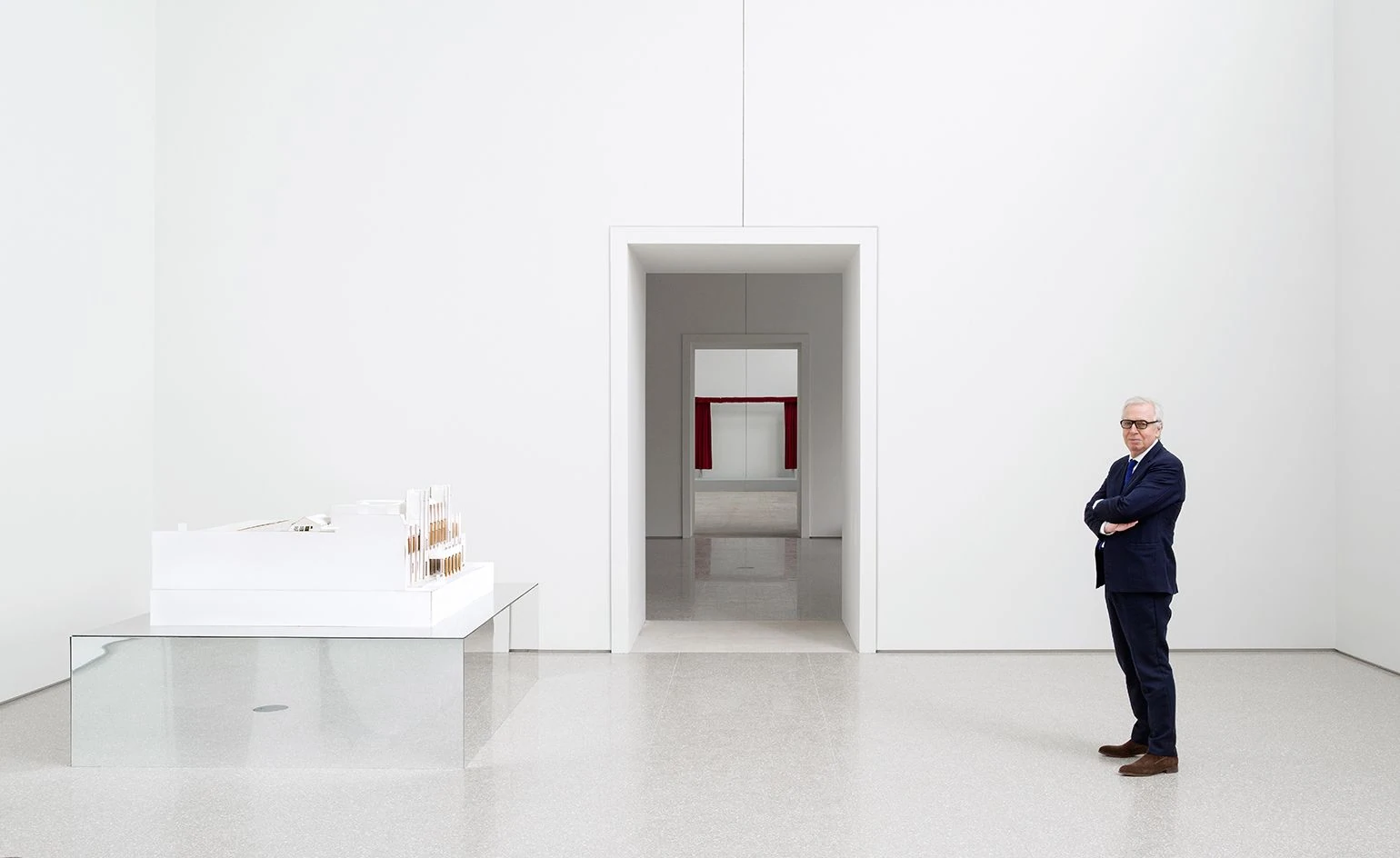
David Chipperfield’s buildings are often distinguished less by spectacle than by their attention to what is already there: a city’s history, the character of a site and the practical life of a building. That approach runs from the River and Rowing Museum in Henley-on-Thames to the reconstruction of Berlin’s Neues Museum. It has also carried his practice from its London beginnings to projects across the world, and brought him some of architecture’s highest honours, including the Pritzker Architecture Prize in 2023.
Training in London, work abroad
Born in London on 18 December 1953, Chipperfield graduated from Kingston School of Art in 1976. He received his diploma in architecture from the Architectural Association in London the following year. Before setting up on his own, he worked in the offices of Douglas Stephen, Norman Foster and Richard Rogers. In 1985 he founded David Chipperfield Architects, which later developed into an international practice with offices in London, Berlin, Milan, Shanghai and Santiago de Compostela.
Some of his first commissions came through retail interiors. He designed shops in London, Paris, Tokyo and New York, including an Issey Miyake shop in Sloane Street. Work in Japan led to further commissions there, and the practice opened a Tokyo office in 1989. His first commission for a complete building was a London house for the fashion photographer Nick Knight, in 1990. These early projects established a working life that would cross borders, while the questions of context and local character remained central to his stated approach.
One of his first major British commissions was the River and Rowing Museum in Henley-on-Thames, completed in 1997. Its design draws on the forms of traditional boat sheds and Oxfordshire barns. The building is raised on concrete pillars to reduce the risk of flooding, while untreated oak cladding connects it to the surrounding rural architecture. It is a useful early example of Chipperfield responding to a particular place rather than applying a single look everywhere.
Restoring the Neues Museum
In 1997, Chipperfield and architect Julian Harrap won the competition to reconstruct and restore Berlin’s Neues Museum, badly damaged during the Second World War. The work was not a matter of making the museum appear untouched. The architects restored surviving spaces and added new ones, using materials such as reinforced concrete and recycled brick. Traces of wartime damage remained visible. The intention, as Chipperfield put it, was for the new work to reflect what had been lost without imitating it.
The project brought history and contemporary design into direct contact. It also demanded attention to construction as well as concept: Chipperfield later stressed the importance of the building’s quality of execution. The museum received the European Union Prize for Contemporary Architecture in 2011. In 2018, the practice completed the adjoining James Simon Gallery, conceived as a visitor gateway to Berlin’s Museum Island and a connection between its institutions. The gallery opened to the public in 2019.
Berlin became one of several places where the practice worked with the relationship between existing architecture and new public buildings. In 2002, it began the Museum of Modern Literature in Marbach, Germany, completed in 2006. Set beside older museum and archive buildings, it provides reading rooms and views across the surrounding countryside; it won the RIBA Stirling Prize in 2007. Chipperfield’s work also includes the Neues Museum’s restoration and the James Simon Gallery, distinct commissions that together show his long engagement with Berlin’s historic centre.
Public buildings in Britain and abroad
In 2011, two significant British galleries designed by Chipperfield opened: Turner Contemporary in Margate and The Hepworth Wakefield. Turner Contemporary occupies a coastal site associated with J. M. W. Turner, who stayed nearby. Its six interconnected glass galleries are raised on pylons in response to the risk of flooding, and the glazing and shading address the exposed seaside setting.
The Hepworth Wakefield, devoted to the work of sculptor Barbara Hepworth, is formed from ten trapezoidal blocks. Natural light enters the upper galleries through large roof windows, while the building’s pigmented concrete façade was made on site. Both projects gave major cultural institutions a visible presence beyond London, in towns whose identities and settings informed their designs.
The practice’s public projects have also taken it well beyond Britain. Its work includes the extension to the Saint Louis Art Museum in the United States, which sits alongside the original building by Beaux-Arts architect Cass Gilbert, and Museo Jumex in Mexico City, designed largely around exhibition space within tight site constraints. In Sudan, the Museum of Naga was designed to protect the remains of ancient temples and a well at a World Heritage Site. These different commissions demonstrate the geographical reach of Chipperfield’s practice without requiring that they be treated as examples of one uniform architectural style.
Architecture, teaching and recognition
Chipperfield has argued against limiting architectural thinking to a particular style or material, saying that an architect must respond to the circumstances of each project. He has also stressed the responsibility to understand a city’s history and culture. That outlook helps explain the range of work associated with his name, from new galleries and libraries to the careful reconstruction of a damaged museum. His career is not defined by one formula, but by a recurring concern with how new work belongs in its setting.
Alongside practice, he has taught architecture in Europe and the United States. He was Professor of Architecture at the State Academy of Fine Arts Stuttgart from 1995 to 2001, held the Mies van der Rohe Chair in Barcelona and the Norman R. Foster Professorship of Architectural Design at Yale, and has been a visiting professor at the University of the Arts London. In 2012, he became the first British architect to curate the Venice Biennale of Architecture. Its theme, Common Ground, foregrounded the collaborative and interconnected nature of architectural practice.
His distinctions include the Royal Institute of British Architects’ Stirling Prize, awarded for the Museum of Modern Literature; the Royal Gold Medal in 2011; and the Praemium Imperiale for architecture in 2013. He was appointed a Commander of the Order of the British Empire in 2004 and knighted in 2010 for services to architecture in the UK and Germany. In 2021, he was appointed a Member of the Order of the Companions of Honour. The Pritzker Architecture Prize followed in 2023. His practice’s projects have received more than 100 architecture and design awards.
Why Sir David Chipperfield deserves a place in British Legacy
Chipperfield’s place in British architectural history rests on a body of work that makes a case for careful, site-conscious design. The River and Rowing Museum connects its form and materials to the landscape around Henley, while Turner Contemporary and The Hepworth Wakefield brought major gallery buildings to Margate and Wakefield. These projects show how architecture can serve public and cultural purposes in specific places, rather than treating each commission as an opportunity for an unrelated landmark.
The Neues Museum offers another measure of his contribution: a major restoration that acknowledged the building’s damage instead of concealing it. The project’s approach—retaining traces of history while making space for contemporary use—has become one of the clearest examples of his work. His international practice, teaching and curatorship of the Venice Biennale extend that influence beyond individual buildings. His British connection is not simply a matter of birthplace or honours: it is evident in the practice founded in London, the significant buildings completed in Britain, and his continuing contribution to architectural education and debate. Together, these achievements make his career a substantial part of Britain’s modern architectural story.
Sources
David Chipperfield — Wikipedia revision 1376296912 · David Chipperfield — Wikipedia
Adapted in part from David Chipperfield by Wikipedia contributors, under CC BY-SA 4.0. Text has been edited and combined with the existing article; this adapted text is shared under the same licence. Contributor history.