Sir Mark Elder’s career has moved between the opera house and the concert hall, from conducting Verdi at Covent Garden to leading the Hallé Orchestra through more than two decades as its music director. His work has spanned British institutions and orchestras abroad, but the Hallé years gave his career a defining Manchester chapter: he took charge when the orchestra’s continuing existence was in doubt and helped restore it to high musical standards.
Early training and the opera house
Born in Hexham, Northumberland, on 2 June 1947, Elder was the son of a dentist. He played the bassoon at primary school, at Bryanston School in Dorset and in the National Youth Orchestra, where he was also a keyboard player. At Corpus Christi College, Cambridge, he studied music as a choral scholar. His early development as a conductor included work with Sir Edward Downes, who became his mentor, and experience conducting opera in Australia, including at the Sydney Opera House.
Elder made his Royal Opera House, Covent Garden, debut in 1976 with Verdi’s Rigoletto. He returned to the same opera 50 years later, having conducted regularly at the house in the intervening years. His repertoire there ranged widely: alongside Verdi operas such as Simon Boccanegra, Nabucco and Attila, he conducted works including Arabella, Lohengrin, Elektra, Fidelio and Wozzeck.
From 1979 to 1993, Elder was music director of English National Opera. There he worked as part of the “Power House” team with general director Peter Jonas and artistic director David Pountney. His other early appointments included principal guest conductor of the BBC Symphony Orchestra from 1982 to 1985, the London Mozart Players from 1980 to 1983 and the City of Birmingham Symphony Orchestra from 1992 to 1995. In the United States, he was music director of the Rochester Philharmonic Orchestra from 1989 to 1994.
More than two decades with the Hallé
Elder was appointed music director of the Hallé in 1999 and gave his first concert in the role in October 2000. The distinction matters: the appointment began before his public debut with the orchestra. At the time, the Hallé had faced doubts about its continuing existence. Elder is credited with restoring it to high musical standards, and his tenure became the longest-running association of his career with a single orchestra.
He proposed changes to the concert experience as well as leading performances. Among his ideas was the abandonment of traditional evening dress for concerts. His long tenure was extended several times: in 2009 the orchestra announced an extension to 2015, and in 2013 it announced a further extension through at least 2020. In February 2023, Elder said he intended to step down at the end of the 2023–24 season. He concluded his tenure then and became the Hallé’s conductor emeritus.
The original account presents Elder’s programming as ranging from established works to contemporary compositions and lesser-known pieces. His career record also shows the breadth of his repertoire in opera, from the familiar Verdi titles of his early work to a wide range of later works. The available record does not detail particular Hallé outreach or education programmes, so the orchestra’s community work should not be attributed to Elder without further evidence.
Other posts, performances and recordings
The Hallé was not Elder’s only continuing musical commitment. He became a principal artist of the Orchestra of the Age of Enlightenment in December 2011 and was artistic director of Opera Rara from 2011 to 2019. He has been president of the London Philharmonic Choir since 2014 and holds the Royal Academy of Music’s Barbirolli Chair of Conducting. The Bergen Philharmonic Orchestra appointed him principal guest conductor from August 2022, initially for three years. In 2025, the Orquestra de la Comunitat Valenciana announced his appointment as its music director, effective from 1 September that year, for an initial two-year term.
Elder has also conducted the BBC’s Last Night of the Proms on several occasions. He first did so in 1987. He was scheduled to conduct in 1990, but was replaced after comments in an interview about potentially changing the programme if Britain had engaged in the first Gulf War. At the 2006 Last Night, he used the traditional closing speech to criticise restrictions on carrying musical instruments on aircraft after the 2006 transatlantic aircraft plot. He also argued for more opportunities for children to sing at school.
His work has reached listeners beyond the concert hall through recordings for Hyperion, NMC, Chandos, Opera Rara and Glyndebourne, as well as the Hallé’s own label. He has written about music for The Guardian and other newspapers. Elder has described his conducting as physical, contrasting himself with the famously composed Sir Adrian Boult; the recollection he gave of meeting Boult backstage after the 1978 Proms was that Boult had noticed he was “one of the sweaty ones”.
Honours and recognition
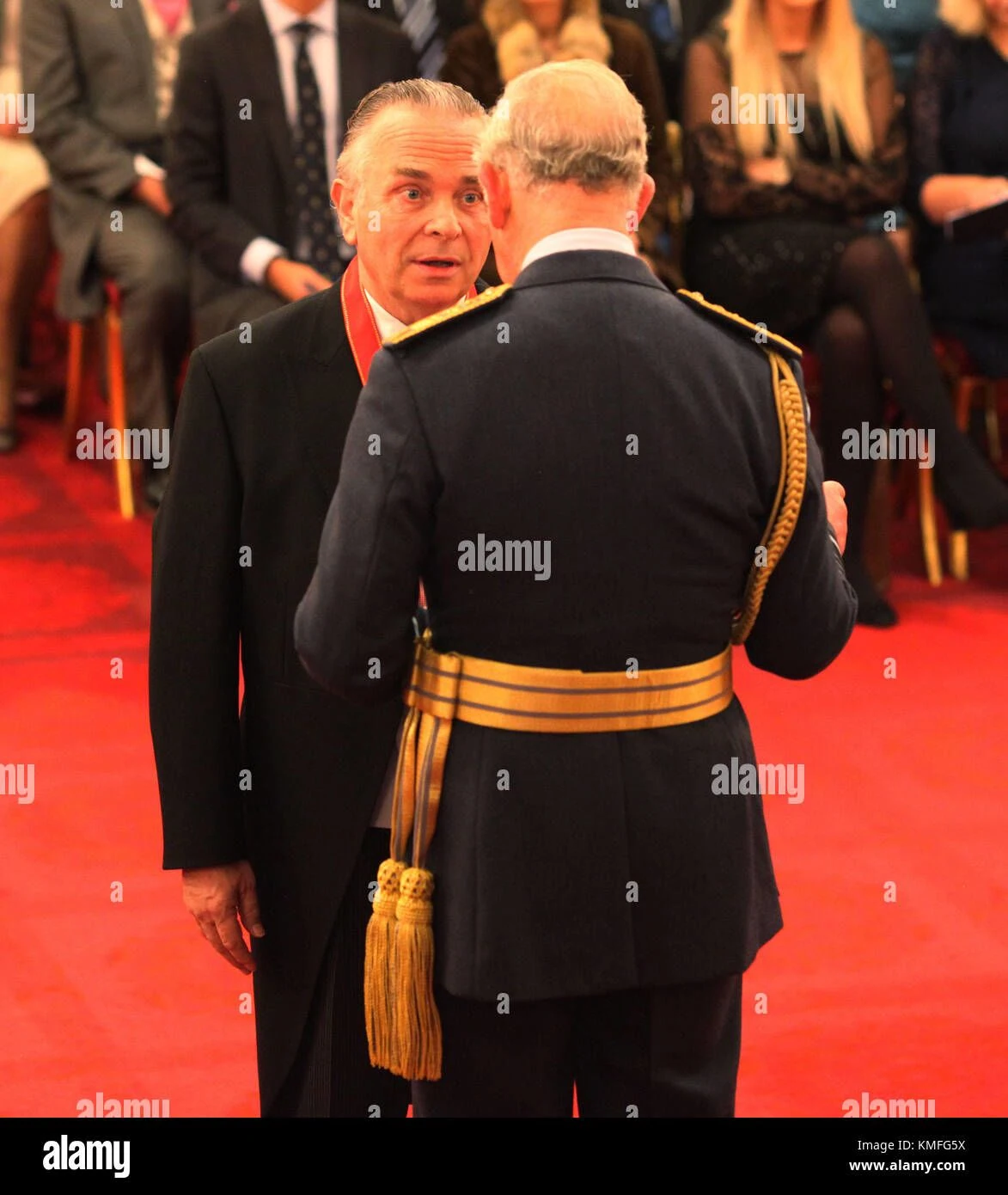
Elder was appointed a Commander of the Order of the British Empire in the 1989 Queen’s Birthday Honours. In 1991, he won an Olivier Award for his work at English National Opera, and in 2006 he received the Royal Philharmonic Society’s conductor prize. He was knighted in the Queen’s Birthday Honours in June 2008 for services to music. In 2017, he was appointed a Member of the Order of the Companions of Honour, also for services to music.
His recognition has included advocacy for access to classical music. In 2007, he was one of eight British orchestra conductors who endorsed the ten-year outreach manifesto “Building on Excellence: Orchestras for the 21st Century”. Among its proposals was free entry to a classical concert for every British schoolchild. In 2016, Elder was made a Companion of the Royal Northern College of Music in Manchester.
Why Sir Mark Elder deserves a place in British Legacy
Elder’s place in British musical life rests on sustained work across the institutions that train, perform and present classical music. At English National Opera, he served as music director for 14 years, working with Peter Jonas and David Pountney during the period described as the “Power House” team. At Covent Garden, his conducting career began with Rigoletto in 1976 and continued across a notably broad operatic repertoire. These achievements connect his name not only with individual performances but with long-term musical leadership.
The Hallé provides the clearest example of that leadership’s lasting local significance. Appointed in 1999, Elder stayed through the 2023–24 season, a period in which the orchestra moved from doubts about its continued existence to a restored position of high musical standards. His proposals included changing the conventions of concert dress, while his endorsement of a national outreach manifesto supported the principle that schoolchildren should have free access to a classical concert. That combination of institutional commitment, artistic range and attention to who can take part gives his career particular relevance to British Legacy. His honours—from the CBE and knighthood to the Order of the Companions of Honour—recognise services to music; the body of work behind them shows what that service involved.
Sources
Mark Elder (revision 1379468239)
Adapted in part from Mark Elder by Wikipedia contributors, under CC BY-SA 4.0. Text has been edited and combined with the existing article; this adapted text is shared under the same licence. Contributor history.