Sir Mo Farah’s defining races often came down to a final lap. Over 5,000 and 10,000 metres, he could stay with the leaders and then use a sharp finish to turn a close contest into a victory. The approach brought him four Olympic gold medals and six World Championship titles, while his rise through British athletics made him one of the country’s most successful distance runners.
A childhood Farah later set straight
Farah was born Hussein Abdi Kahin on 23 March 1983 in Gabiley, in what was then the Somali Democratic Republic. His early life was not the story once told publicly. In 2022, he revealed that, aged nine, he had been brought to the United Kingdom from Djibouti by a woman he did not know, given the name Mohamed Farah and made to work as a domestic servant. He had been separated from his mother and was prevented from attending school for his first years in Britain. He later adopted the name he had been made to use.
At about 11 or 12, Farah began attending Feltham Community College in west London. His physical education teacher, Alan Watkinson, recognised his running ability. Farah had arrived at school with little English, and his ambition at the time was to become a footballer or a car mechanic. Watkinson helped him pursue athletics and later assisted with his application for British citizenship. Athletics philanthropist Eddie Kulukundis paid the legal fees for his naturalisation, which was completed in 2000.
Farah joined Hounslow Athletics Club and competed in the London Youth Games. He won the first of five English schools cross-country titles in 1997. In 2001, the year he began training at St Mary’s University in Twickenham, he won the 5,000 metres at the European Athletics Junior Championships. These early successes established the foundations for a career that would develop over many seasons, rather than in one sudden breakthrough.
From European titles to the world stage
Farah’s progress through the 2000s included setbacks as well as medals. He finished sixth in the 5,000 metres at the 2007 World Championships and did not reach the final at the 2008 Beijing Olympics. He also won European cross-country titles and set British records, steadily moving from promising national runner to an athlete capable of challenging the world’s best.
The decisive step came in 2010 at the European Championships in Barcelona. Farah won both the 5,000 and 10,000 metres, becoming the first British athlete to take European gold in the 10,000 metres. The following year he won the 5,000 metres at the World Championships in Daegu and took silver in the 10,000 metres. His record-breaking times over both distances demonstrated that he could compete at the highest level; his championship victories showed how well he could judge a race.
In 2012, Farah won the 5,000 metres at the European Championships in Helsinki before returning to London for the Olympic Games. He took gold in the 10,000 metres and then the 5,000 metres, becoming Britain’s first Olympic champion in the longer event. The double made him a leading figure of the home Games, but it was also a measure of his competitive range: the 10,000 metres required sustained control, while the shorter race demanded a different kind of patience and speed.
Farah repeated the Olympic double at Rio de Janeiro in 2016. He became the second athlete, after Finland’s Lasse Virén, to win both Olympic distance titles at successive Games. In Rio’s 10,000 metres, Farah fell after being clipped but recovered to win. His second gold came in the 5,000 metres. The four victories in London and Rio form an exceptional record in British athletics.
World titles, records and the move to the roads
Farah’s global success extended beyond the Olympics. He won the 5,000 metres at the 2011 World Championships, then took both distance titles in 2013 and 2015. At the 2017 championships in London, he won the 10,000 metres and finished second in the 5,000. His six World Championship golds, alongside four Olympic titles, made him the most successful male track distance runner in global championship history, according to the supplied account.
His event range was unusual. Farah raced from 1,500 metres to the marathon and set a European 1,500-metre record of 3:28.81 in 2013. In 2020, he set the world record for the one-hour run, covering 21,330 metres in Brussels. His racing often depended on a fast closing lap, but that finish rested on his ability to remain in contention through the preceding distance.
After the 2017 World Championships, Farah shifted his main focus from track racing to the marathon and road events. He came third in the London Marathon in 2018, setting a British record, then won the Chicago Marathon in a European-record time of 2:05:11. He also won the Great North Run six times in succession, from 2014 to 2019. He retired after racing the Great North Run in September 2023.
Honours and public work
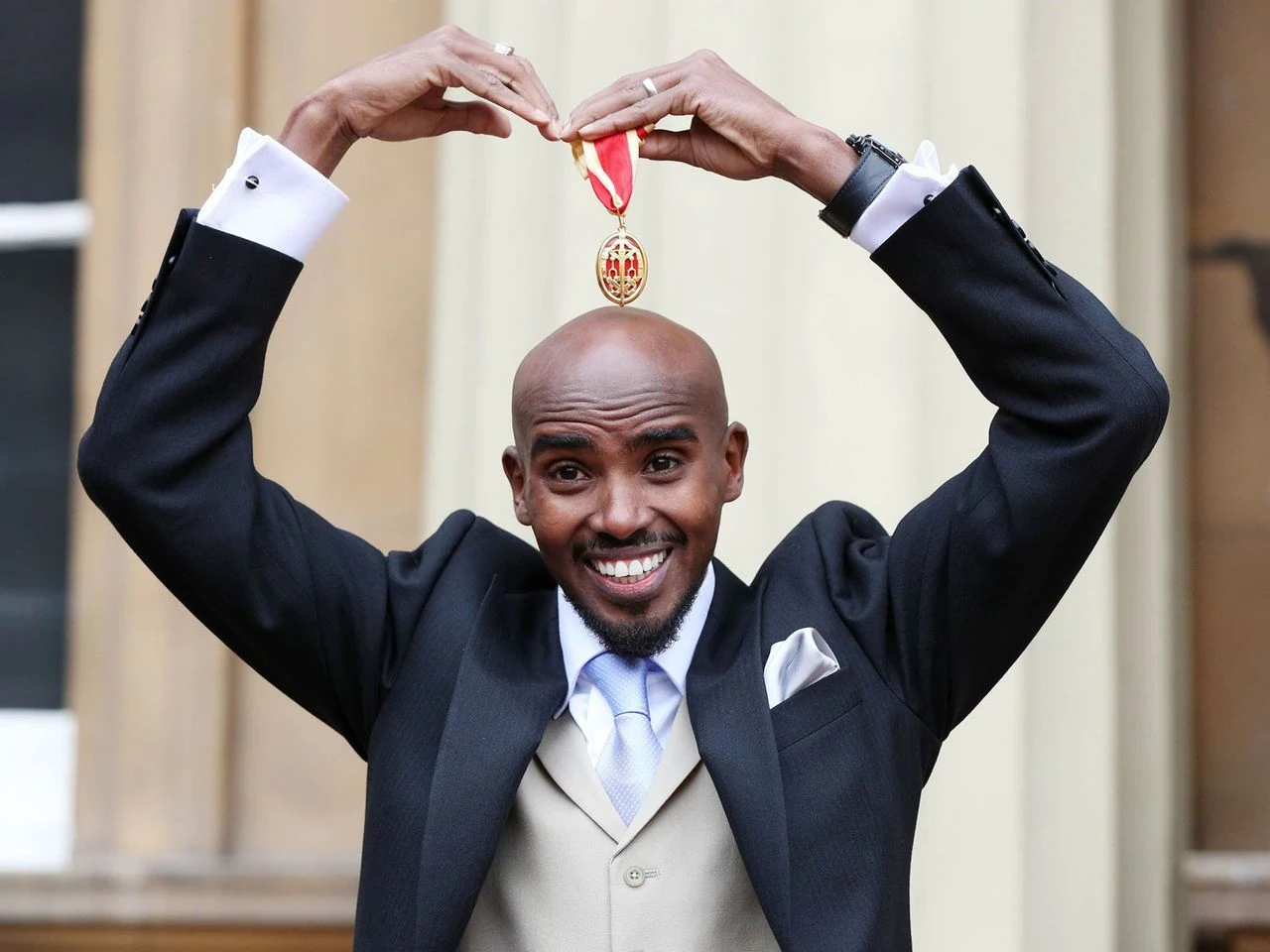
Farah was appointed Commander of the Order of the British Empire in 2013 for services to athletics and knighted in the 2017 New Year Honours. He won BBC Sports Personality of the Year in 2017. Those honours followed years of achievements for Great Britain at major championships, including the Olympic double at London 2012 and the world titles won on home ground in 2017.
His public life has also included charitable work. After a visit to Somalia in 2011, he launched the Mo Farah Foundation. In 2012, he won £250,000 for the foundation on the television programme The Cube. He has also taken part in public campaigning on issues including remittances and hunger. These activities sit alongside, rather than explain away, the sporting record: they show how Farah used his profile beyond the track.
In 2022, the BBC documentary The Real Mo Farah followed his investigation of his childhood and reunion with his Somali family. His disclosure changed the public understanding of his arrival in Britain. It also made clear why the simplified account of a young refugee moving to London at eight should not stand in place of the history he later described.
Why Sir Mo Farah deserves a place in British Legacy
Farah deserves a place in British Legacy for a sporting record whose scale can be stated plainly: four Olympic golds, six World Championship titles and victories across the 5,000 and 10,000 metres at two successive Olympic Games. He was not simply a medal winner in one event or at one home Games. His repeated success across championship cycles, in different countries and against different fields, made him the most successful British track athlete in Olympic history, according to the supplied account. His European 1,500-metre record and world one-hour record also show the range behind the championship reputation.
His British story is inseparable from the institutions and people who helped him develop: a west London school, teacher Alan Watkinson, Hounslow athletics and training at St Mary’s in Twickenham. He competed internationally for Great Britain and received the country’s highest honours for services to athletics. His later account of being trafficked as a child also corrected a public narrative that had obscured what happened to him. Remembering Farah therefore means recognising both the achievement and the person whose history he chose to tell. His career brought exceptional performances to British sport; his candour added an important, specific account of migration, exploitation and belonging to the legacy attached to those performances.
Sources
Mo Farah (revision 1376830983)
Adapted in part from Mo Farah by Wikipedia contributors, under CC BY-SA 4.0. Text has been edited and combined with the existing article; this adapted text is shared under the same licence. Contributor history.