Ridley Scott’s films make worlds feel built, inhabited and charged with possibility. From the industrial streets and rain-darkened skyline of Blade Runner to the ancient arena of Gladiator, his work has made visual design central to storytelling. The English director’s route to international cinema began in art school, television and British advertising; his later career has joined large-scale filmmaking with an enduring connection to the UK film industry.
From South Shields to the Royal College of Art
Scott was born in South Shields, County Durham, on 30 November 1937. His father, Francis Percy Scott, served as a senior officer in the Royal Engineers and was often away during Ridley’s childhood. The family moved between parts of England, Wales and Germany before settling on Teesside after the war. Scott later recalled his mother, Elizabeth, as a strong influence. The landscapes of his youth also stayed with him: the industrial surroundings of West Hartlepool, where he studied, informed the visual imagination he would bring to his films.
After attending Grangefield Grammar School in Stockton-on-Tees, he studied art at West Hartlepool College of Art and earned a diploma in design. He then went to the Royal College of Art in London, where he contributed to the student magazine ARK and helped establish the college’s film department. His final project was Boy and Bicycle, a black-and-white short featuring his younger brother Tony and their father. Scott made it in West Hartlepool and Seaton Carew in 1960 or 1961. Drawing and design remained practical tools in his filmmaking: he later described the habits of art school—paper, pens and drawing—as part of how he worked out visual ideas.
Television, advertising and a first feature
After graduating in 1963, Scott joined the BBC as a trainee set designer. He worked on programmes including Z-Cars and Out of the Unknown, and began directing television episodes in 1965. This early work placed him in a range of production roles before he moved towards commercials and feature films.
In 1968, Scott and his younger brother Tony founded Ridley Scott Associates (RSA), a film and commercial production company. Scott directed advertisements through the 1970s, including the 1973 Hovis commercial “The Bike Ride”. Filmed on Gold Hill in Shaftesbury, Dorset, it paired a nostalgic image of a boy pushing a bicycle with a brass arrangement of the slow movement from Dvořák’s “New World” Symphony. A 2006 poll voted it the UK’s favourite commercial. Scott also directed Chanel advertisements, treating them as carefully designed short films rather than straightforward product demonstrations.
The move into cinema began with The Duellists (1977), a feature set during the Napoleonic Wars and based on a story by Joseph Conrad. It won an award for best debut film at Cannes, though its international commercial impact was limited. Scott’s next film, Alien (1979), brought wider recognition. Made at Shepperton Studios in England, it joined science fiction and horror in a tense, enclosed setting. Scott’s decision to make Ellen Ripley, played by Sigourney Weaver, the central survivor helped create one of the film’s defining characters.
Building cinematic worlds
Blade Runner (1982), adapted from Philip K. Dick’s Do Androids Dream of Electric Sheep?, first disappointed at the box office. Its vision of a future Los Angeles—dense with rain, shadow and industrial detail—later became a major reference point for science-fiction cinema. The film’s questions about identity and what it means to be human have endured alongside its visual influence. Scott subsequently supervised Blade Runner: The Final Cut, released in 2007.
Scott’s career did not follow a single genre. He directed the fantasy film Legend (1985), the crime drama Black Rain (1989) and, in 1991, Thelma & Louise. The road film, starring Geena Davis and Susan Sarandon, brought Scott his first Academy Award nomination for best director. Its importance in his career sits alongside his work in science fiction: it showed his ability to shape a character-led story as well as a meticulously designed world.
In 1995, Ridley and Tony Scott formed Scott Free Productions in Los Angeles. Scott’s feature films from White Squall (1996) onwards were produced under its banner. The brothers also bought a controlling interest in Shepperton Studios in 1995; the studio later became part of the Pinewood Studios Group. These ventures connected Scott’s international career with British production facilities and a longer-standing place for filmmaking in the UK.
Gladiator (2000) brought together large-scale spectacle and a story centred on an individual’s loss and revenge. It won five Academy Awards, including best picture and best actor for Russell Crowe; Scott was nominated for best director. British visual-effects company The Mill worked on its computer-generated imagery. Scott followed it with films including Black Hawk Down (2001), which earned him another directing nomination, and Kingdom of Heaven (2005). Unhappy with the theatrical release of the latter, he supervised a longer director’s cut, an example of his continuing attention to how a film is assembled and presented.
Production, television and later films
Scott’s work as a producer extended beyond his own features. Through Scott Free, he and Tony were involved in television projects including The Good Wife. Ridley Scott also executive-produced documentaries made from footage submitted by the public: Life in a Day, assembled from material recorded around the world on 24 July 2010, and Britain in a Day, built from footage shot by the British public on 12 November 2011. These projects used his production experience to shape many individual contributions into a single screen work.
He returned to science fiction with Prometheus (2012), followed by Alien: Covenant (2017). His other films of the period included The Martian (2015), which combined a survival story with scientific problem-solving, and All the Money in the World (2017). For the latter, Scott replaced Kevin Spacey with Christopher Plummer and reshot the relevant scenes before the film’s scheduled release. In 2021 he directed both The Last Duel and House of Gucci; his later feature films included Napoleon (2023) and Gladiator II (2024).
His work has also continued on television. He was an executive producer of the BBC–HBO film The Gathering Storm (2002), and of series including The Terror (2018). In 2020, Raised by Wolves marked his return to television directing after a long interval. Across film and television, Scott has moved between directing and producing, using production companies to develop work on more than one scale.
Honours and a British film career
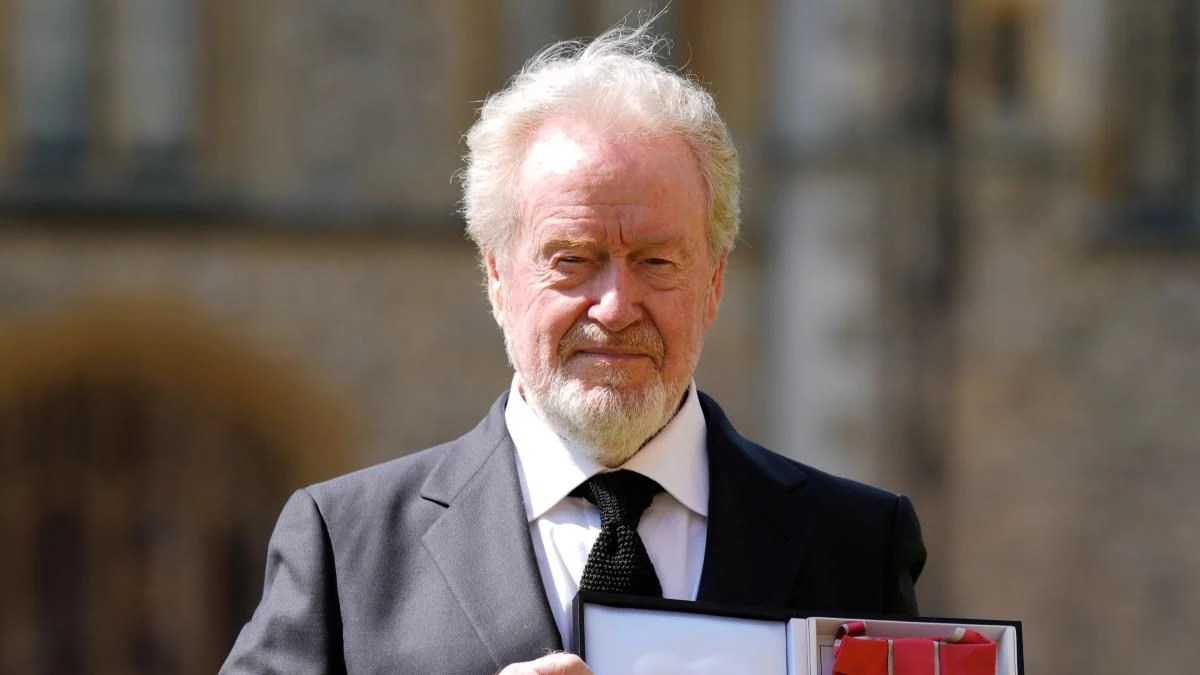
Scott was knighted in the 2003 New Year Honours for services to the British film industry. In 1995, he and Tony received a BAFTA for Outstanding British Contribution to Cinema. Scott received the BAFTA Fellowship for lifetime achievement in 2018. In 2024 he was appointed a Knight Grand Cross of the Order of the British Empire for services to the UK film industry. His other honours include a star on the Hollywood Walk of Fame and an honorary doctorate from the Royal College of Art, awarded in 2015.
The awards recognise a career whose influence is not confined to one national cinema. Scott’s films have been made and watched internationally, while his formative education, early television career, work with British studios and recognition for services to the UK film industry give that international achievement a clear British context. His visual approach—particularly his detailed environments and use of light—has become a defining feature of his work, from the industrial textures of Blade Runner to the monumental settings of Gladiator.
Why Sir Ridley Scott deserves a place in British Legacy
Scott’s place in British Legacy rests on more than his international success. He trained in Britain, developed his craft in British television and became a major director through a path that ran from art-school filmmaking into the country’s advertising industry. RSA’s Hovis commercial became a widely remembered piece of British television advertising, while Alien was filmed at Shepperton Studios. His career also demonstrates how British creative work can travel: a director shaped by British design education and production experience went on to make films that reached audiences across the world.
His contribution has also involved the means of making films, not only the finished images. Scott and his brother Tony established production companies, invested in Shepperton Studios and worked across feature films, television and documentary. Those activities helped connect creative ambition with the people and places required to realise it. His recognition with the BAFTA award for Outstanding British Contribution to Cinema, the BAFTA Fellowship and honours for services to the British and UK film industries reflects that wider contribution. Scott’s work gives British Legacy a specific story of artistic training, practical production and international reach—and of a visual filmmaker whose imagined worlds have become part of modern cinema.
Sources
Ridley Scott — Wikipedia revision 1378714215 · Ridley Scott — Wikipedia
Adapted in part from Ridley Scott by Wikipedia contributors, under CC BY-SA 4.0. Text has been edited and combined with the existing article; this adapted text is shared under the same licence. Contributor history.