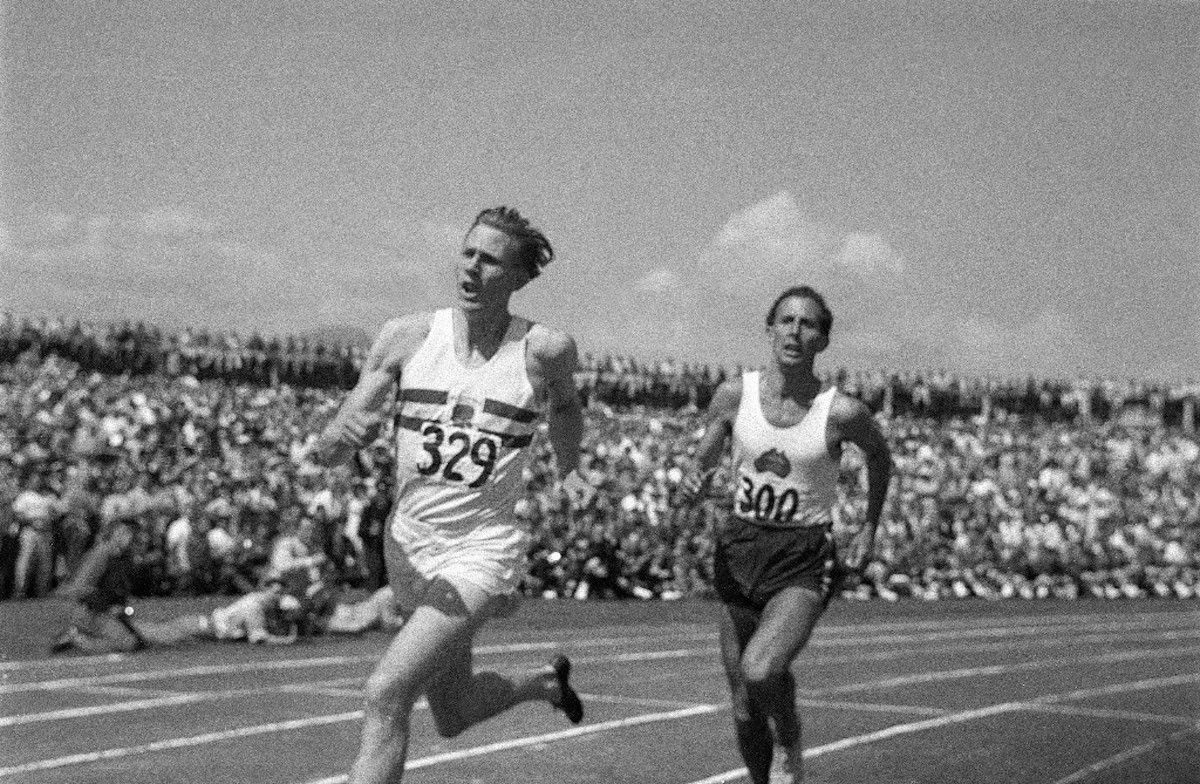
On 6 May 1954, Roger Bannister ran a mile in 3 minutes 59.4 seconds at Oxford’s Iffley Road track. Aged 25 and still a medical student, he became the first person to break the four-minute barrier. The run brought him lasting recognition, but athletics was only one part of his life: he went on to become a neurologist and was also associated with support for cancer research and multiple sclerosis charities.
The four-minute mile
Bannister’s run was a landmark in middle-distance athletics. The time—3:59.4—made concrete what had been regarded as a formidable physical and psychological barrier. Its achievement rested on a single performance, but the barrier it crossed gave the result a significance beyond the track. Bannister became known for showing that a mile could be run in less than four minutes.
The setting was Oxford’s Iffley Road track, and the date was 6 May 1954. Those details anchor the achievement in a specific place and moment in British sporting history. Bannister was not yet 26 and was studying medicine when he ran the record-breaking mile. His story therefore began, in public view, at the meeting point of athletic ambition and a medical education.
From athletics to neurology
Bannister’s later career took him into medicine. He became a neurologist, a profession concerned with the brain and nervous system. The shift from celebrated athlete to doctor is a notable part of his biography, though the available account offers no detail about particular clinical work or scholarly contributions. It is enough to say that his life after the famous run was not confined to sport.
He was also described as a supporter of cancer research and multiple sclerosis charities. The account does not identify organisations or particular campaigns, so the scale and practical effects of that support cannot be specified. His medical profession and reported charitable interests nevertheless place medicine alongside athletics in the outline of his public life.
Why Sir Roger Bannister deserves a place in British Legacy
Bannister’s place in British Legacy begins with an achievement that can be stated precisely: at Oxford’s Iffley Road track on 6 May 1954, he ran a mile in 3:59.4. Breaking the four-minute barrier made his performance a defining moment in athletics and gave it a lasting place in Britain’s sporting story. The significance lies not in vague claims about national character, but in the measurable result and the barrier it crossed.
His life also extended beyond that record. Bannister became a neurologist and was reported to support cancer research and multiple sclerosis charities. The available details do not establish particular outcomes, and his charitable contribution should not be overstated. Even so, the combination of a landmark sporting achievement, a medical career and reported support for causes connected with illness gives his biography breadth. Remembering Bannister means recognising both the run that made him famous and the professional and charitable dimensions that followed.