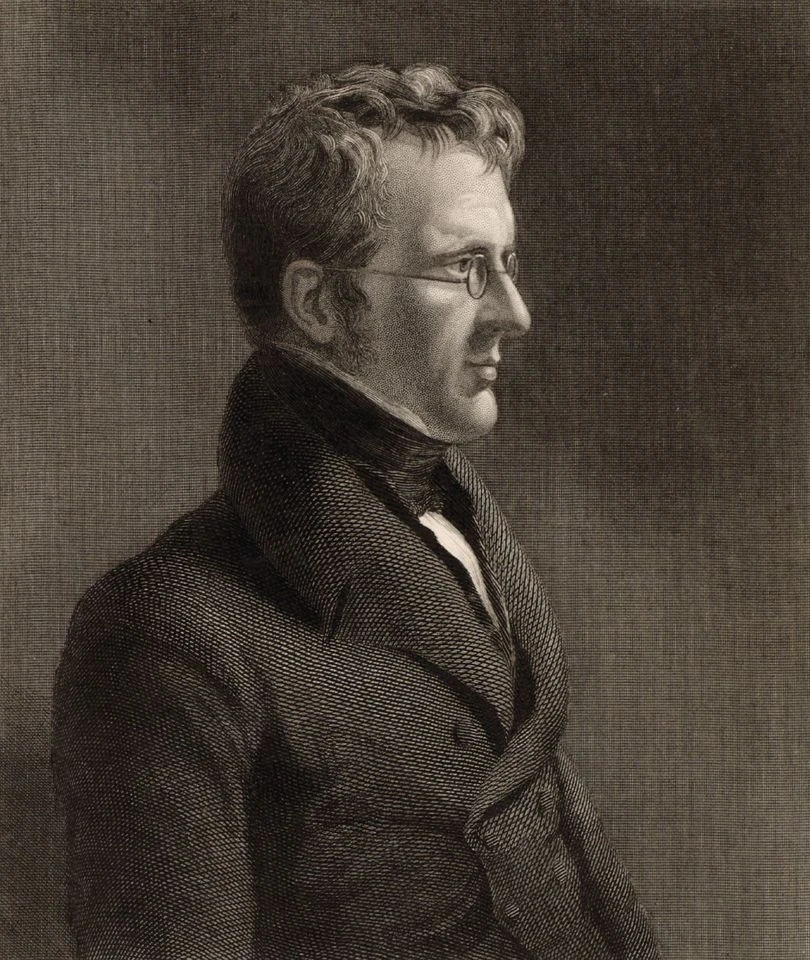
Thomas Fowell Buxton’s public work ranged from the prison cells of Newgate to the campaign against slavery in the British Empire. An MP for Weymouth, brewer and social reformer, he argued for changes to prison conditions and criminal law, took a leading role in the parliamentary abolition movement, and became the first chairman of the Society for the Prevention of Cruelty to Animals. His record combines parliamentary campaigning with practical support for reformers beyond the House of Commons.
Essex beginnings and a life in public affairs
Buxton was born at Castle Hedingham, Essex, on 1 April 1786. His father died when he was young, and his mother, Anna Hanbury, was a Quaker. Buxton completed his education at Trinity College Dublin, graduating in 1807. Through his mother, he became close to the Gurney family, including Joseph John Gurney and Elizabeth Fry, the prison reformer. He married their sister Hannah in May 1807.
In 1808, family connections helped Buxton obtain work at Truman, Hanbury & Company’s brewery in Brick Lane, London. He became a partner in 1811; the business was renamed Truman, Hanbury, Buxton & Co, and he later became its sole owner. His commercial career provided one part of his life, but he also became involved in social reform through the Quaker connections around the Gurney family. Although he belonged to the Church of England, he attended Quaker meetings with them.
Buxton supported efforts to raise money for London weavers affected by poverty under the factory system. He also backed Elizabeth Fry’s prison reform work financially and joined her Association for the Improvement of the Female Prisoners in Newgate. In 1818, he was elected MP for Weymouth and Melcombe Regis, a constituency he represented until 1837. In Parliament, he addressed prison conditions and criminal law as well as slavery.
Prisons, punishment and animal welfare
Buxton’s interest in prison reform was not confined to support for Fry. In 1818, he published An Enquiry, Whether Crime and Misery are produced or prevented by our present system of Prison Discipline, setting out his concern with the effects of existing prison arrangements. As an MP, he worked for changes to prison conditions and criminal law, opposed capital punishment, and sought to restrict the number of crimes for which it could be imposed. He did not achieve its abolition; the account of his parliamentary work records that the number of capital crimes eventually fell from more than 200 to eight.
His reforming activity also extended to animal welfare. On 16 June 1824, a meeting at Old Slaughter’s Coffee House in London established the Society for the Prevention of Cruelty to Animals. Buxton was one of its 22 founding members and served as chairman for 1824. The organisation became the RSPCA after Queen Victoria gave it royal assent in 1840. The role places Buxton’s work within a wider pattern of involvement in campaigns concerning the treatment of vulnerable people and animals.
From the Commons to the abolition campaign
The slave trade had been abolished in 1807, but slavery itself continued. Buxton joined the campaign to end it and, in 1823, helped found the British and Foreign Anti-Slavery Society, later known as the Anti-Slavery Society. That May, he introduced a resolution in the Commons describing slavery as “repugnant to the principles of the British constitution and of the Christian religion” and calling for its gradual abolition throughout the British colonies. He also pressed the government to send instructions to the colonies aimed at improving the treatment of enslaved people.
After William Wilberforce retired in 1825, Buxton became the leading parliamentary figure in the abolition campaign. The movement’s work involved more than speeches in the Commons: a petition he presented bore 187,000 signatures. Priscilla Buxton, his daughter, had helped organise it in 1833; she and Amelia Opie were its first two signatories. Buxton’s contribution was therefore part of a wider campaign in which organised petitioning and parliamentary pressure reinforced one another.
The Slavery Abolition Act was passed in 1833. It abolished slavery across most of the British Empire, but its provisions did not extend to India and Ceylon. Buxton’s campaign did not end with the Act. In 1836, working with Sir Stephen Lushington, he helped transfer funds from the Lady Mico Charity to establish educational institutions in the West Indies for children of formerly enslaved people. Mico University College in Kingston, Jamaica, is a remnant of that initiative.
African plans and their limits
In 1839, Buxton urged the British government to make treaties with African leaders to abolish the slave trade. The government backed an expedition to the Niger in 1841, organised by missionary groups and involving more than 150 people. Buxton himself was not part of it. The expedition reached the Niger Delta and began negotiations, but fever caused heavy losses: more than a quarter of the party died rapidly, and the mission was cut short that year.
The failed expedition forms an important limit to the story of reform. Buxton’s proposals were intended to connect opposition to the slave trade with trade in other goods and the spread of Christianity. David Livingstone was strongly influenced by those arguments and later became a missionary in Africa who opposed the slave trade. Buxton was created a baronet on 30 July 1840. His health declined, and he died at Northrepps Hall near Cromer, Norfolk, on 19 February 1845, aged 58. He was buried at Overstrand.
Memorials and a continuing record
Buxton’s memory has been marked in several places and forms. A monument stands in Westminster Abbey. The Buxton Memorial Fountain, commissioned by his son Charles to commemorate emancipation, was designed by Samuel Sanders Teulon. It was first installed in Parliament Square, removed during the Second World War, and placed in Victoria Tower Gardens in 1957. In Weymouth, where Buxton served as MP for 19 years, Buxton Road runs past his former home at Belfield House, and a permanent memorial was unveiled on Bincleaves Green in 2017.
His commemoration also reflects the breadth of his public associations. Plaques honour him at Norwich Cathedral and Norwich Friends Meeting House, and a bust is displayed at St George’s Cathedral in Freetown, Sierra Leone. Between 2002 and 2017, his likeness appeared on the English five-pound note as part of a group around Elizabeth Fry. These memorials accompany the record of a reformer whose work involved parliamentary argument, campaigning organisations, charitable support and attempts to influence government policy.
Why Sir Thomas Fowell Buxton deserves a place in British Legacy
Buxton’s place in British Legacy rests on specific work across several reform campaigns. As an MP, he helped make abolition a sustained parliamentary cause after the end of the slave trade had left slavery itself untouched. He helped establish the British and Foreign Anti-Slavery Society, introduced a Commons resolution calling for gradual abolition, and presented a petition bearing 187,000 signatures. The Slavery Abolition Act of 1833 did not end slavery everywhere in the empire—India and Ceylon were exceptions—but it marked a major legislative outcome of the campaign. Buxton also supported the later use of charitable funds to establish West Indian educational institutions for children of formerly enslaved people.
His British significance is not limited to abolition. He supported Elizabeth Fry’s prison reform work, examined prison discipline in print, argued for changes to criminal law and sought to restrict capital offences. He also served as the first chairman of the society that became the RSPCA. These activities show how reform could draw together parliamentary action, voluntary organisations and practical assistance. The varied memorials to Buxton, from Westminster Abbey and London’s Buxton Memorial Fountain to Weymouth and Norwich, record that reach. His legacy is best understood not as a single heroic achievement, but as sustained participation in campaigns that challenged slavery and pressed institutions to change how they treated people and animals.
Sources
Fowell Buxton — revision 1360071514
Adapted in part from Fowell Buxton by Wikipedia contributors, under CC BY-SA 4.0. Text has been edited and combined with the existing article; this adapted text is shared under the same licence. Contributor history.